
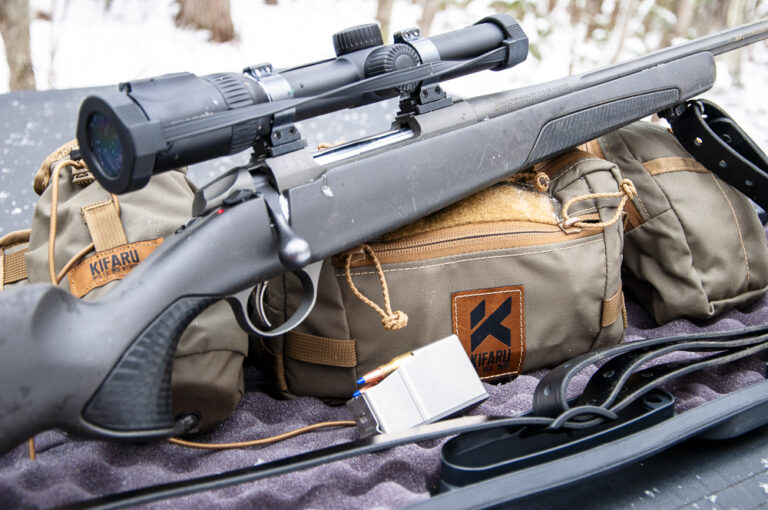
The Kifaru Rogan pack system is yet another essential organizational piece from our top backpack maker.
Back in my early 20s, when the fog of youth rendered every far-fetched idea plausible and possibly even worth pursuing, I hatched a plan for a DIY backcountry mule deer rifle hunt in Wyoming. Before long, the Bighorn Mountains, just west of Sheridan, loomed large over the truck’s hood as we careened westward. The miles clicked away on I-90 through blinding wind-driven snow, which swirled and obscured the 18-wheel tractor-trailer of death barreling past right next to us in the fast lane.
That hunt would prove to be much tougher than we thought it would be.
Much tougher.
And even though the Bighorns left tags unfilled and provided only lessons in humility, I returned with a new respect for the pack system and the company that made it all possible.
That company is Kifaru.
Before the misadventure, I’d interviewed Kifaru’s founder, Patrick Smith, about all things backpacking and backcountry hunting. I came away with a newfound appreciation for the seriousness of such a crazy undertaking as backcountry hunting. Smith, a dyed-in-the-wool elk hunter who insisted on carrying the elk back out on his back, had developed Kifaru backpacks into true hunting-specific systems. They were made in the USA. And they were built to last. Even the military wanted them, with Kifaru supplying tactical pack systems to overseas operations.

Fast forward to today, and while Smith says he’s still designing packs for the concern in semi-retirement, Kifaru is now under the new management of Aron Snyder, and he and his staff are some of the most hardcore backcountry elk and mule deer hunters you’ll ever meet. They do scary things. Things I wouldn’t dare.
Kifaru now resides in Riverton, Wyoming.
On a recent Montana hunt, I needed packs for my wife, Michelle, and me, and quickly visited Kifaru. For myself, I chose the 44 Mag pack; Michelle got the 22 Mag pack. Those packs hauled a mulie buck back out of the badlands, and effortlessly bore weights in excess of 100 pounds, allowing us to get everything—all the meat, the cape, and the antlers—out in one trip. The reason I went straight to Kifaru is simple: I don’t like mass-produced junk. We bought those packs with our own money because I know they will last a lifetime.
Expanded Line
Best known for its rugged, handmade backpack and shelter systems for hunters, Kifaru now also makes more niche gear for archery, fly fishing, and small-plot deer and turkey hunters.
While I never became much of a backcountry hunter, I still appreciate deer hunting in my home state of Wisconsin, and that’s where the Kifaru Rogan enters the story.
While preparing for a handgun hunt during our state’s nine-day gun deer season, I quickly realized that, since I’d have my Glock 40 10mm in a chest rig, I’d need a system other than a bino harness/backpack to tote things like field-dressing kits and water. A small lumbar pack would be ideal, but I’ve been less than impressed by most commercial models, which use flimsy, single nylon straps to support the packs. Those nylon straps are hell to pay if you load the pack with any weight.
I immediately turned to Kifaru.
One of the things that I learned from talking to Patrick Smith all those years ago was that the pack’s belt had to function first and foremost as a load-bearing system—and it’ll make or break the human bearing the load. It’s the difference between a ruined trip cut short by pain, or one that continues and possibly leads to a filled tag. Smith would spend weeks in the backcountry living out of his packs (which he’d stuff with over 100 pounds of gear and supplies), and the belt he built was sturdy enough to keep all of the pack’s weight on your hip platform, not on your shoulders. That was the only way to overcome the human biped’s physiological limits—the weight must be on the hip platform. Kifaru packs use belts that set the industry standard for hauling out heavy elk parts. That says just about all you need to know about it.
So, when I learned that Kifaru was now making a lumbar pack called the Rogan, which pairs with its massively sturdy Battle Belt, I knew it would be solid. And it was.
The Battle Belt is a massive 5-inch-tall weight-suspension system with two rows and four columns of Molle webbing for total customization. It includes a plastic insert for rigidity, using the same principle as the popular Wilderness belts and other gun belts, which are standard for concealed carry. You could probably suspend a dump truck from the thing, which is really what sets Kifaru stuff apart. It makes heavy loads feel like they’re not even there.
According to Kifaru, “A removable plastic stiffener creates structure around your hips that will keep the weight of the rig from torquing away from your body and keeps the load stable.”
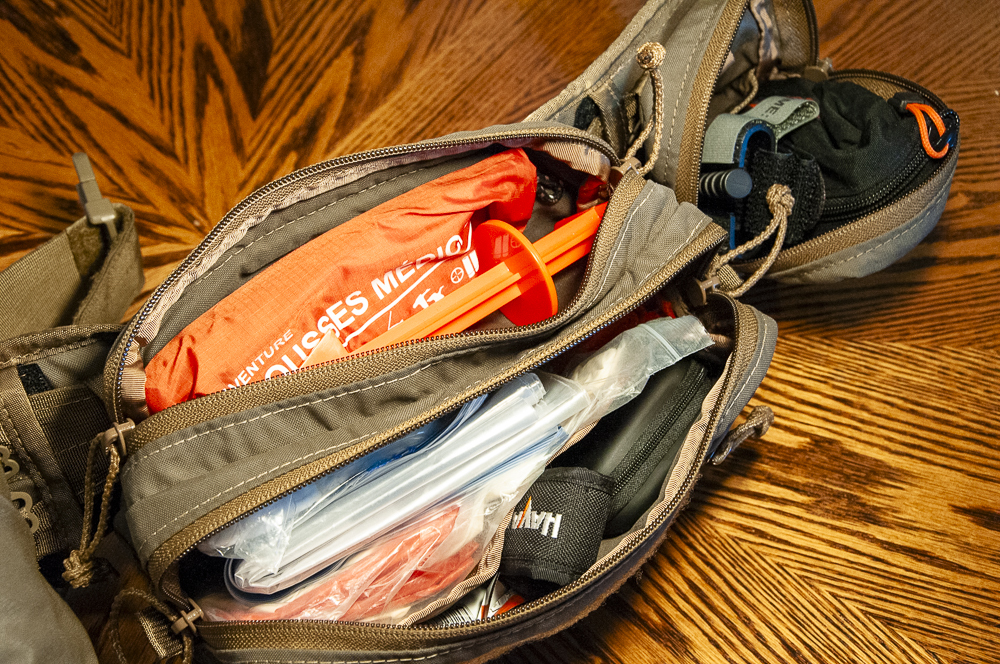
Affixed to the Battle Belt is the Rogan lumbar pack, which has two main compartments and several smaller gear-organization pockets. I was able to fit my field-dressing kit, an Adventure Medical Kits first-aid kit, a Suunto compass, extra gloves, Safariland earplugs and case, a Havalon replaceable-blade razor knife, a deer-dragging harness, a fire-starting kit, Clif bars, and toilet paper. There is also a third, smaller compartment on the front with a key lanyard, the perfect spot to tuck your wallet and affix your truck keys so they don’t get lost.
Attached via mil-spec webbing on the right side is a Mini Belt Pouch that holds my quick-access essentials—a Cat-5 Tourniquet and a Streamlight headlamp. On the opposite side (left hip) is a large water bottle pouch that fits the Nalgene bottle perfectly.
Of course, that Molle webbing throughout means the Kifaru Rogan Run-N-Gun Belt is completely modular: Need more space? Swap one of the many accessory pouches or packs from the Kifaru ecosystem.
One final note about the Rogan’s construction. Between the 500D Cordura, YKK zippers, and Duraflex buckles, Kifaru leaves nothing to chance. These packs aren’t cheap. But they are lifetime accessories, and Kifaru’s staff and the guides and outfitters who depend on them need serious gear and cannot afford to take chances in the backcountry. The Rogan Run-N-Gun Belt benefits from that same military-grade ruggedness. That’s no BS. When you leave the trailhead and head into the wilderness, something as simple as a broken zipper can cause essential survival or emergency communications gear to fall out, leaving you in a serious pickle. The numerous tragic cases of missing hunters are a testament to that fact.
In the Field
After arriving up north for my hunt, the first thing I noticed about the Kifaru Rogan was how easy it was to snap on and off, and how sturdy it was. The wide, insert-reinforced Battle Belt locks around you, and the load does not shift. It doesn’t flop like cheap so-called fanny packs. Since I would be walking several miles tracking bucks in the snow, the outfit needed to be rock-solid.
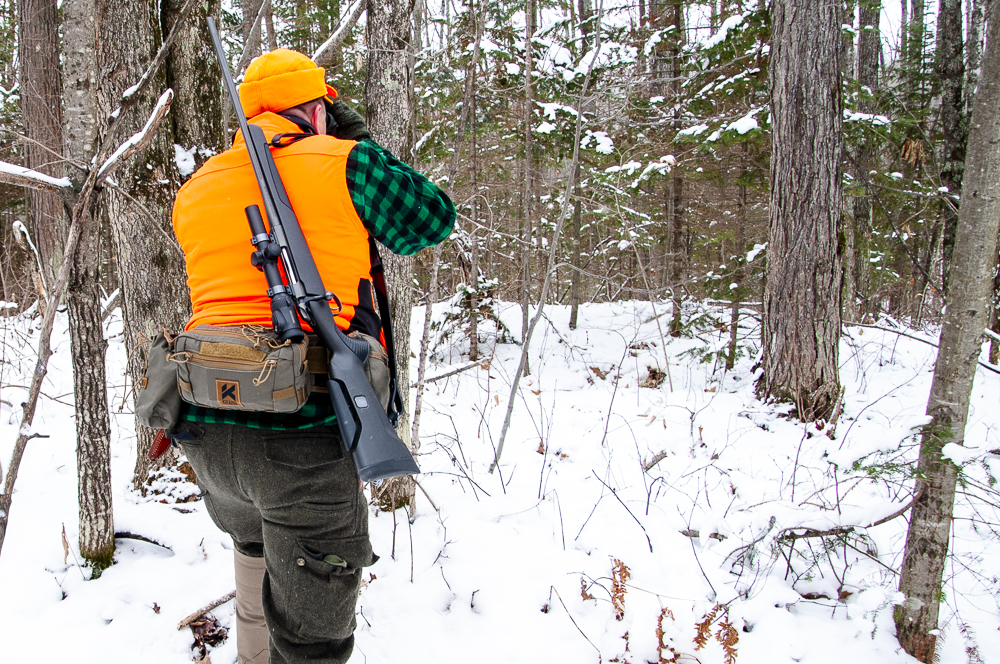
Another thing I noticed on that deer hunt was that the Rogan was silent. The packs and pouches attached to the Battle Belt don’t shift around—and the 500D Cordura material has sufficient stiffness to stay put when you move. When you’re trying to get within shot distance of a bedded buck, you can’t afford the swish-swish-swish sound of cheap nylon flopping around and rubbing on itself. For that reason, I think Kifaru packs in general, and especially the Rogan, are ideal for big woods buck tracking.
The only complaint I had about the Rogan was the elastic cordage that tightens the mouth of the water bottle pouch, which formed a loop and kept snagging on brush during the still hunt. However, while moseying through a cedar swamp, a limb snagged the loop, pulling it free, leaving two tag ends. After that, it was no longer an issue. I left it like that, and all is right with the world.
Conclusion
Some pieces of gear enhance the quality of your hunts, and the Rogan Run-N-Gun Belt is a prime example. The older I’ve gotten, the more I’ve come to value organization. I’m more focused on the mission running smoothly than punching a tag. The experience matters. Of course, I could lie and claim that I no longer get excited jumping a big buck, but let’s face it, we all turn into emotional basketcases when we spot antlers. And I hope I always do. The critical thing is to be organized, prepared, and ultimately safe out there. For that, the Kifaru Rogan gets the nod.
Kifaru Rogan Run-N-Gun Belt Specs
Small (32″-42″) / Large (38″-52″)
500D Cordura
4-way stretch Tweave in high-stress areas for flexibility and resilience
YKK zippers for long-term reliability and smooth operation
Duraflex buckles for a secure fit
Mil-spec webbing used throughout for structural reinforcement
Water bottle pocket for easy access to hydration
Mini Belt Pouch for quick-access essentials
Lightweight, low-profile fit for unrestricted movement
Made in the USA
Website: Kifaru.net
Kifaru’s Duffel Bags Take Organization Up a Notch
There’s nothing worse than trying to find stuff and dragging arms full of hunting gear to the truck in the bleary-eyed, early morning mad dash to your hunting spot. But now, thanks to Kifaru’s rugged, well-thought-out duffel system, what used to take me several exhausting trips from the house to the truck requires just one.
And the probability of dropping something essential between here and there (only to discover it missing sometime later in the day, when it’s critically needed) has gone from probable to impossible.
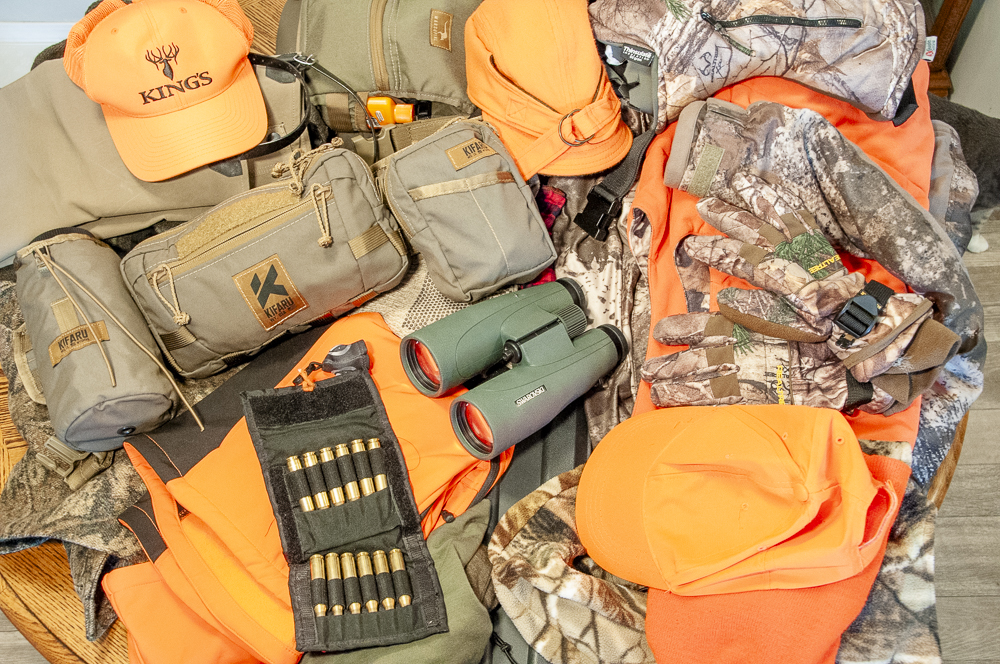

Kifaru makes duffel bags in three sizes—the Rampart (2,000 cu-in), the Kenosha (2,850 cu-in), and the gigantic Rondy (7,850 cu-in). I used two Kenosha duffels to organize all my hunting gear, reducing what would have been four or five cumbersome trips from the house to the truck down to just one. It eliminated the risk of forgetting gear or dropping stuff. And it keeps your truck organized.
The Kifaru Kenosha is a duffel built as only Kifaru could: It’s made of the same quality materials and components as its weight-bearing and mountaineer-grade packs, but its real story is the thoughtful design. Like all Kifaru stuff, a scary amount of brain energy was expended in redesigning the duffel for the needs of hunters. For example, rather than a single zipper down the middle, the Kenosha uses a smart full-panel U-shaped zipper that opens wide, making it easy to fit more stuff in there and keep it tidy. The interior of that panel has three mini-zipper compartments to stow small accessories, and there are two retention straps on the bottom to secure everything inside—just like high-end luggage. The bottom is reinforced and has a thick foam pad.

Next Step: Get your FREE Printable Target Pack
Enhance your shooting precision with our 62 MOA Targets, perfect for rifles and handguns. Crafted in collaboration with Storm Tactical for accuracy and versatility.
Subscribe to the Gun Digest email newsletter and get your downloadable target pack sent straight to your inbox. Stay updated with the latest firearms info in the industry.


Where did you get the cartridge wallet in the pic ?
Price?