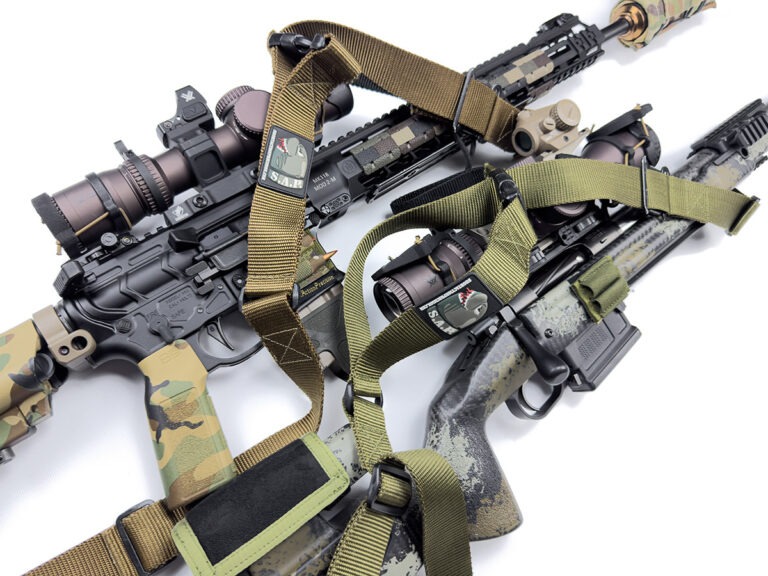
The steadier your rifle, the tighter your groups. Good shooting support gear will help with that.
Shooting support gear is an interesting topic. As of right now, there are more companies producing more shooting accessories than ever before, and a good number of them are unfortunately poorly made … or just downright snake oil. Not every sling is equal, not every tripod is equal, and there are certainly a lot of bipods out there.
So, let’s look at where the need for support gear started and see where it takes us.
An (Abridged) History of Sights and Slings
If we go all the way back in history, to when firearms were first adopted, you will see that they were typically large and required a lot of material support to get them into position to use. As guns were miniaturized, attempts began to emerge that made them lighter, more portable and more ergonomic. It could be argued that the quintessential shape of the modern rifle emerged as early as 1700, but it could also be argued that it wasn’t until at least the 1850s that we saw what could be truly considered early modern rifles.
But, the most important part of the story of stability is the precision in which we can aim.
Marksmanship on our side of the Atlantic has always had a history of being much more individual, whereas European armies during these formative years were much more concerned with fighting gentlemanly warfare. The vast majority of European shoulder arms lacked proper sights, entirely preferring instead massed volley fire.
Though it is true that many soldiers and hunters used crossed sticks or even primitive monopods, none of these things offered much utility until rifled barrels and adjustable sights extended effective distances. Smoothbore flintlocks were versatile weapons that could load and handle fast but were not generally very accurate at longer distances requiring steady support.
The barrel length of these arms at the time had more to do with the infantry idea of bayonets than accuracy or projectile velocity. American flintlock rifles at the time were pinnacle weapons and ushered in the truth that aimed fire was the future.
American sighting quality continued to advance into the Industrial Revolution, with Westward expansion seeing great strides in what rifles could do at long range. This is an interesting point because, over time, it became evident that the European armies entering the 20th century had a conspicuous lack of individually adjustable sights on their rifles, as opposed to what has existed and continues to exist on individual American weapons.
The advanced rear sights of the era, from Vernier to the M1903, showcased the emphasis placed on an individual’s ability to minutely adjust their sights for precision, where the average European soldier could perhaps only crudely adjust elevation off a zero established by an armorer.
Individual marksmanship became a high priority for American forces. This is when we first saw widespread use of accessory support attached to the rifle entering the mainstream: the sling. The American use of slings as crucial to stability went beyond the common sandbags and rolled blankets or backpacks used for centuries as improvised support. It was indeed revolutionary to make what amounts to a carry strap into an adjustable field support that could dramatically improve hit likelihood.
This dynamic changed a great deal of things, although slowly at first, but it could be said that the sling as a stabilization mechanism was the first of our modern stability advances.
Slings, Then and Now
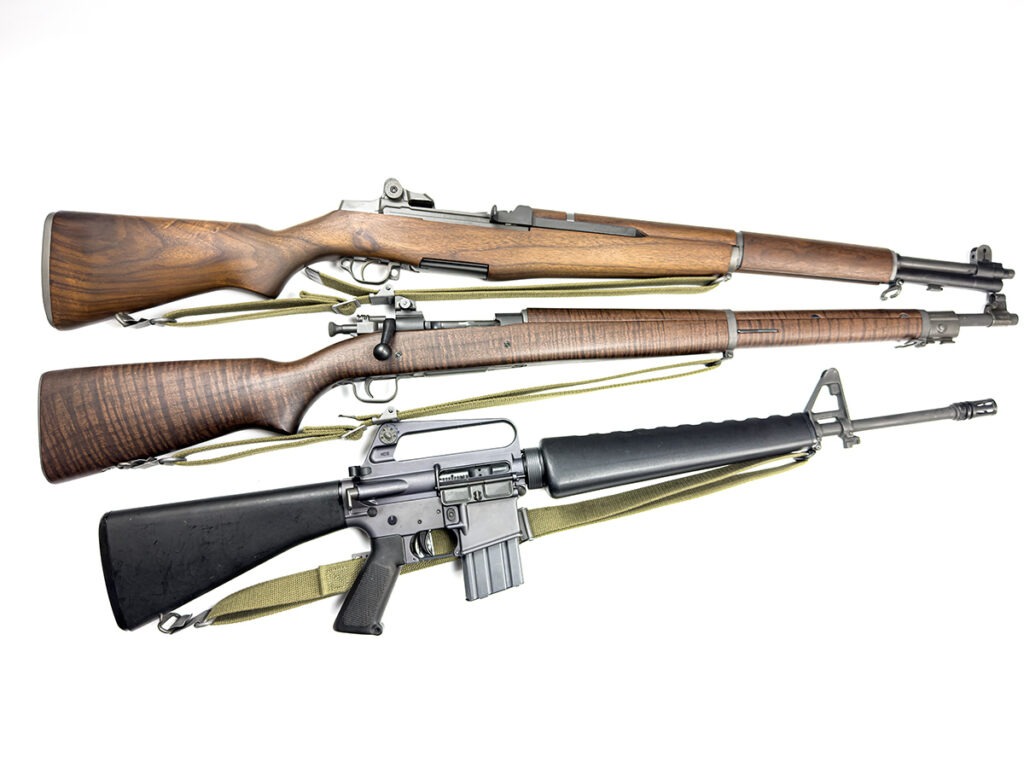
It’s common in our shooting culture to use slings as support items—although not every sling out there is cut out for the task. There are still a great number of simple, two-point slings that are used as carrying straps, and it should be noted that not all stock designs and even rifle designs benefit from the tension of a sling being used as a support.
On most of our modern guns, especially those of military pedigree, we find that they do pretty well snuggled up, even as just a “hasty sling” style. For much of American history, two very common sling styles have dominated the conversation and the competition line. They are still around today, and I personally use both of them for national match competition.
First and older of the two is the classic 1907 sling. This is the iconic “hook“ sling that is one of the most functional sling designs ever created. The sling consists of two pieces, and I will be heavily debated if I call one the front loop or the back loop. We can simply refer to one as the long loop and the other the short loop.
Everybody has a different way of attaching this sling; there is no real correct way, except for getting the results you want. The 1907 sling uses a two-prong hook to engage equidistant holes in the straps to provide what amounts to a consistent set of adjustments. Many of these slings have numbers along the holes, very similar to what you would find on your Picatinny rails for mounting optics or accessories. They give you a consistent and repeatable location depending on your shooting position.
There are plenty of great manufacturers of this style of sling, among them are excellent, heavy competition leather versions like the ones featured in this article by J. Berlin. And an all-weather version, and again a modern classic, is made by Turner Saddlery. Other versions of this sling are available through companies like Brownells, as well as replica military companies. It should be noted that not all of these leather slings are created the same. It’s advisable to get versions that are made of stronger leather with high-quality rivets for a real competition use.
Another one of the best types of slings out there, for adjustability and competition use, is the World War II era US G.I. cotton web sling. I use these slings on a great number of my military competition rifles. They are lightweight and, while not as permanent in terms of adjustment, are very easily adapted to a cuff style on the upper arm quickly. These things can be made very tight, almost to tourniquet level, and offer a great deal of rigidity for accurate shooting. They are also quite fast to use as a hasty sling and detached from the rifle very easily. They are fairly common to find at surplus stores, gun shows and online. The versions that you see in this article are around $25 on Amazon. I have been competing with these for years, and they have held up extremely well for the price.
Now, making a jump to the far more modern, we have slings here from Short Action Precision. This company has been making slings for years. These slings are very popular and common in the PRS sports, although they have a great deal of utility for general field use and hunting. They are not, however, legal for all shooting sports, as some types of shooting explicitly exclude slings with an integrated cuff.
This type of sling is fast to use and fast to get out of. It has a wide range of adjustability and comes in a number of colors. It can be easily adapted to use modern QD swivels and can be used as a cinch for barricades, against trees and a number of other field expedient uses. I’ve even used one as a makeshift sling for a tripod in the past. While there are certainly other slings available on the market, out of all of those that I have tried over the years, the SAP slings are one of the few that actually increases stability while in use.
Bipods, the Tried and True
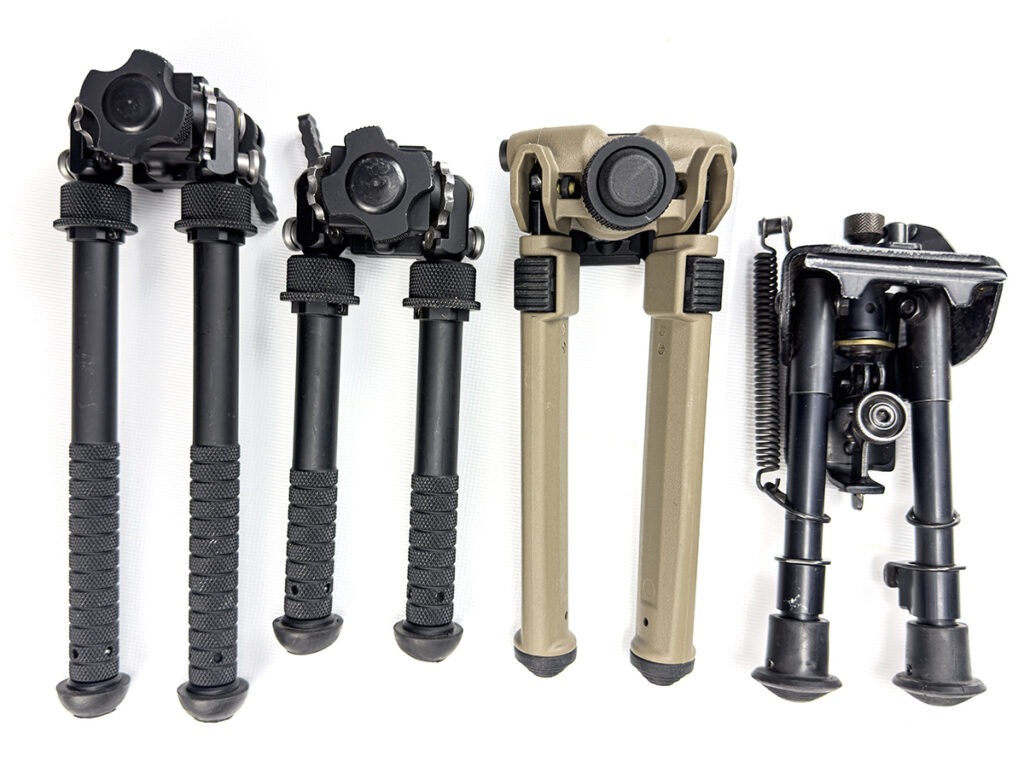
Bipods have been heavily in use on standard small arms since the Cold War era. Up until then, it was vastly more common to find them on machine guns and heavier weapons, but in the modern era they have become distinctly more popular across the board. The recent past has seen bipods moved from barrel-mounted fixtures to stock-mounted fixtures, and in our current era, they typically mount to the variety of rails that we have. As we have come to understand that putting adverse pressure on a barrel certainly affects accuracy, it’s rare to see any small arms outside of historical replicas that have them barrel-mounted.
Just like everything in our modern era, modularity is the name of the game. Classic bipods, such as the Harris, typically mount to the sling studs on common rifle stocks. Harris models are still very common (and so are their cheap knockoffs) and have never lost reliability over the years. I would argue that they are still some of the best bipods available and still some of the fastest and easiest to use. You really can’t go wrong with one of them, and they are available in quite a few different lengths for whatever use you may have.
However, just like anything, a size penalty comes into play, and I’ve never really been a fan of them in extended length because they aren’t quite as stable or offer as much adjustability as tripods, which we will be covering in a moment. In my opinion, the BRM swivel model is the best of the bunch.
Other excellent modern bipods that I’d highly recommend are from Magpul and Atlas. These are on opposite ends of the price scale, but both offer benefits to shooters with ARCA or Picatinny rails on their stocks or handguards. Magpul offers a variety of mounting interfaces, but my favorite is adjustable to fit both rail sizes instantly. A knob on the side controls how wide the jaws open to grab your chosen interface. Magpul bipods are rugged, but like the Atlas, have a bit more adjustability than is often necessary in the field; in particular, they can be shifted out of line with the centerline of the rifle and can get “floppy” if not tightened up when moving.
The Atlas bipods are some of the best in the industry for modularity and durability, but they are categorically heavier and a bit harder to use in some ways. Set up for a QD lever, they are very fast and easy to get on and off the rifle but are also the slowest to deploy as compared to Harris or Magpul bipods. I use them in the field, but they usually end up hanging out in my backpack unless I know I’m going to be setting up on a ridgeline overlooking a game trail.
Tripod Considerations
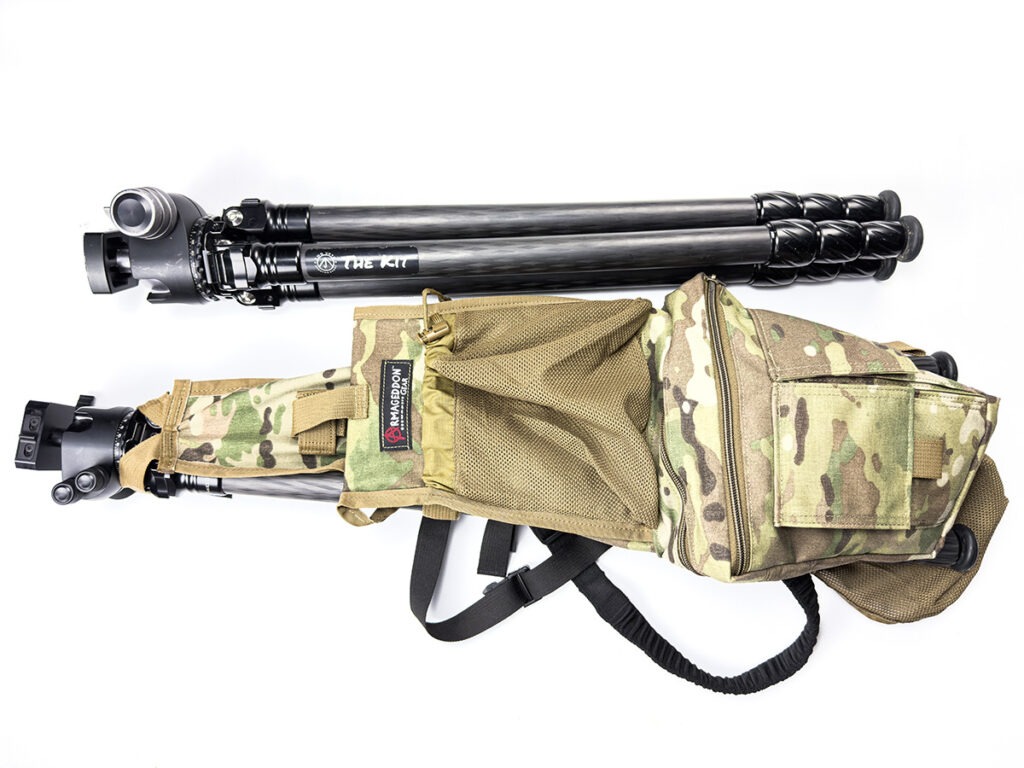
Tripods are one of the most popular field accessories to emerge in the shooting public’s consciousness over the past few years. Actual field shooting rarely takes place at ground level, making bipods somewhat less effective than you may imagine. Even ankle-height grass can pose difficulties using bipods.
For hunting and field work, most people aren’t doing that prone. Sitting is about as low as I normally go, but even then, I’m only sitting on the ground maybe half the time. I’m usually trying to sit on a milk crate or my backpack unless I’m forced to be in a blind. Point being, a tripod is just flat out the best thing for field shooting as you can adapt it to your terrain and maintain high stability.
There are a range of tripods to consider, and some are of dubious quality. You can get away with the cheap, clamp-style versions that are commonly found at sports stores or online, but if you want the absolute best you’re gonna have to drop some change. Weight is a major consideration, as is transport size. I find that there isn’t much sacrifice going with a smaller tripod, especially if you’re not taking a ton of shots from standing, which is only something I do if I absolutely must.
When it comes to tripods, the lighter and more compact you go the more expensive you get, but the better they are, as weight on a tripod only comes into play when carrying it, not really shooting with it as it should be fully stable on three legs. Some guys do add some extra weight here and there for standing, but I don’t like carrying that into the field.
The only brand of tripods I use—and have for years—is Two Vets. That isn’t to say you won’t have good luck with other brands, but as far as my own experience, Two Vets tripods have been the ones that have held up for me for dozens of hunts and pack-ins, and have been dropped, exposed to freezing rain and snow and never failed to work. I have used their older “The Kit” model for years, and the new Voyager more recently, which I find to be even better in form, function and weight. The weight factor for tripods is big for me, and it fits nicely in an Eberlestock backpack without any fuss.
Tripods are quite adaptable to not just rifle use, they can be used for spotting scopes, and I have even adapted an astral telescope to use the interface because it’s more solid than the cheapo photography tripods in common use. More than ever now tripods are being treated as little bases for both shooting and even as makeshift shelters. Yes, you read that right. Certain models can be fitted tent material, and even Two Vets makes what they call the Tripod Teepee, literally a compact tent that can be used with a tripod to make an experiment blind or emergency shelter.
Tripods are also being used as field hubs to carry gear, notes and as a “desk” of sorts. Armageddon Gear’s Tripod Caddy is an excellent example of this concept. Not only can you carry a variety of gear, including magazines and ammunition, but it also allows you to relax a bit and get your gear off your neck and shoulders. It works as a convenient location to place binoculars, thermal monoculars, rangefinders, your phone and more. Using accessories like this allows the field hunter to remain mobile and, in the event you need to quickly detach your rifle to stalk, you can leave your gear in a safe location
Arca Interfaces and Accessories
The ARCA interface is something that is becoming more common on rifle stocks and forends as the days pass. While it is another article to explain how and why this interface has become popular, it’s pretty much the go-to solution for anybody looking to get the most out of their tripods and other accessories that do best on a smooth, uninterrupted surface.
The beauty of the ARCA is how versatile it is and how it benefits pretty much every modern rifle it can be integrated into. I find that it’s the best interface for a tripod, as opposed to the old-style clamp. It offers quick detachment and consistent tension. Black Slate Industries, a company that I have come to enjoy, offers a solution to the most annoying problem associated with the ARCA rail: the annoying hard edges.
The best positioning for an ARCA interface is near the magazine well. This is also where most people carry the rifle in the hand while moving. The squared-off surface is not very comfortable, and on competition rifles it can be downright painful. Black Slate makes excellent ARCA rail covers, and they are surprisingly one of the only ones available in the industry. What this tells me is that people using ARCA rails on their rifles aren’t spending much time with them in the field; the range is one thing, but carrying these guns is another thing. They are comfortable and offer just the right amount of texture.
Bags and More
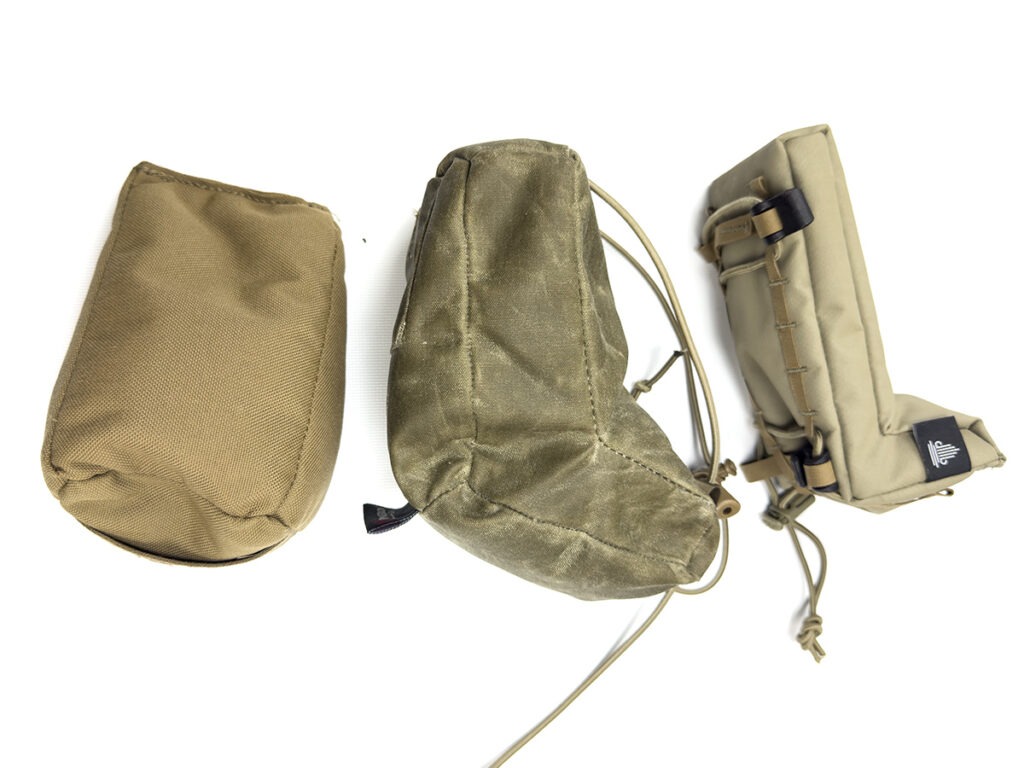
Gun-mounted shooting bags are becoming increasingly popular as well for added stability. Some of these are able to mount to ARCA rails, but since the vast majority of existing guns don’t use ARCA (yet), other solutions needed to be implemented. My favorites are again from Armageddon Gear, which makes a huge variety of bags, but I wanted to spotlight another company that has a truly awesome product: Stoic Solutions. They make a little, L-shaped bag that lashes on with elastic cable directly to a rail of a riflestock.
What I really like about their barricade bag is that it lets you get the gun wedged in where it wants to be, not awkwardly resting on the front of the stock. I used this bag for my entire last hunting season and found that it was really nice shooting out of blinds. Not only that, but it also does extremely well as a substitute for a tripod when in dense wood; it makes snuggling up to tree limbs very stable and removes the bounce upon firing.
Is every rifle benefited by a mounted bag? Probably not; there are reasons to not use one, but since it is so light, the Stoic Solutions product here easily stores in a pocket when not in use. I find it really nice on rimfire rifles when squirrel hunting.
Closing Thoughts
Despite how many products are currently available for us today, we are still somewhat in an unregulated era of these products; there are a lot of de facto standards, not true standardization. As you might notice, I have slings designed over a century ago adorning modern match rifles featuring the most modern ARCA rails. A lot of this will come down to user preference and intended use, and each offers its own benefit.
Editor’s Note: This article originally appeared in the June 2026 issue of Gun Digest the Magazine.
More Shooting Support Gear
- Best Shooting Support: If You Can Get Steadier, Get Steadier
- Top Rifle Slings That Carry Their Weight
- The Best Shooting Bags
- Stabilize Yourself: Best Rifle Bipods
Next Step: Get your FREE Printable Target Pack
Enhance your shooting precision with our 62 MOA Targets, perfect for rifles and handguns. Crafted in collaboration with Storm Tactical for accuracy and versatility.
Subscribe to the Gun Digest email newsletter and get your downloadable target pack sent straight to your inbox. Stay updated with the latest firearms info in the industry.