COOPER CITY, Fla. — Three men posing as FBI agents took off when the owner of a Cooper City home they were trying to rob shot at them, the Broward Sheriff’s Office said.
Threemen wearing baseball hats and T-shirts with the letters FBI on the back pulled a sport utility vehicle into the driveway of the home shortly after 4 a.m. Monday, Miami TV station WPLG reported.
Two of the men got out of the SUV, while the third acted as alookout, police said. Read more
CHARLOTTE — Police say a man shot a would-be robber Thursday night at an east Charlotte ATM.
According to police, the man wasattempting to use a Cash Points ATM on Eastway Drive at North Tryon Street around 11 p.m. A suspect seemingly saw that as an opportunity and tried to rob the victim at gunpoint.
TULSA, OK — Tulsa Police say one of two men shot during a violent home invasion early Thursday morning has died. They identified him as 18-year-old Darreon Carter.
Carter was shot in the head and leg. The secondsuspect, 23-year-old Daniel Holman, remains in critical condition in a Tulsa hospital. He was shot in the head and stomach.
The men were shot by the resident in the apartment in what police say was a case of self-defense. Read more
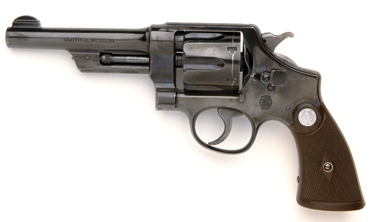
Smith & Wesson introduced their first large frame (referred to as the N-frame), swing-out cylinder, DA revolver, the .44 Hand Ejector – also known as the ‘Triple Lock” or “New Century” – in 1907 to compete with Colt’s New Service revolver.
Up until this time all of S&W’s large-caliber revolvers had been of the hinged-frame, top-break variety, and, while popular, they were never viewed as quite rugged enough or chambered for powerful enough cartridges to be a real threat to Colt’s predominance in the American military and civilian markets. S&W brought out their first swing-out cylinder revolver, the .32 Hand Ejector, in 1896 followed by the 38-caliber Military & Police revolver in 1899.
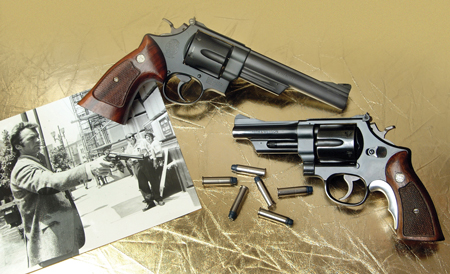
The .38-44 Heavy Duty was designed for serious police work and fired a special heavy-duty .38 Special loads that came close to equaling the .357 Magnum. PHOTOS BY JAMES WALTERS AND BUTCH SIMPSON
The .44 Hand Ejector used the same basic mechanism as these smaller caliber revolvers. The cylinder was locked by a rod that passed through the ejector system and latched into a recess on the face of the breech while a second lock was provided by a spring loaded stud in a lug underneath the barrel that snapped into the forward end of the ejector rod.
But S&W felt that a stronger system would be required with the powerful cartridges they intended to use, so additional locking was provided by a bolt housed in the ejector rod shroud that locked into a mortise on the cylinder yoke. The .44 Hand Ejector could be ordered with 4-, 5-, 6- or 6.5-inch barrels, with wooden or hard rubber grips and a choice of blue or nickel finish.
S&W also introduced a new cartridge that was to become as famous, if not more so, than the revolver itself: the .44 S&W Special. This was based upon their popular .44 Russian but used a case 0.2 inch (5mm) longer and loaded a 246-gr. lead bullet moving at 755 fps. In addition to becoming popular for law enforcement and self defense, it quickly earned a reputation for accuracy and preempted the .44 Russian as the dominant target shooting cartridge of the day.
While .44 Special guns accountedfor the majority of sales, the Triple Lock revolver was alsooffered chambered for the .44-40,.45 Colt and, for the British market,.450 Boxer and .455 Webley.When World War I broke out in1914, the British government placedlarge orders with S&W for revolvers.In addition to producing purpose-built .455 revolvers, many 44-caliber gunswere retrofi tted with .455 cylinders andbarrels to supply the anxious British.
But in the brutal conditions of trenchwarfare it became obvious that the Triple Lock was far too fi nely made arevolver: the third lock and the ejector rod shroud often became clogged withmud or debris, preventing the cylinderfrom closing.
S&W rectified these problems by thesimple expedient of removing the offending parts. The modified revolver, dubbed the .455 Hand Ejector, Second Model or.455 Hand Ejector, Mark II, went into production in 1915. All British issue MarkIIs had 6.5-inch barrels and boasted a commercial-grade blued finish. The big Smith proved popular and by 1918 more than 68,000 had been supplied to Britishand Canadian forces.
As it became obvious that the United States would soon be entering the conflict on the Allied side, the U.S. Army began casting about for additional weapons and while they were committed to the 1911 Colt pistol, it soon became obvious that not enough could be produced to meet demand. In 1916, the Army approached S&W about a “substitute standard” handgun and were offered the Hand Ejector, Second Model.
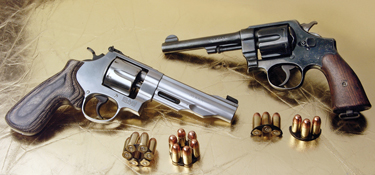
S&W pioneered the “half-moon” clip with their famed .45 caliber M1917 revolver (right). The new Performance Center M625 revolver continues this tradition with “full-moon” clip loading. PHOTOS BY JAMES WALTERS AND BUTCH SIMPSON
But while the Army was not adverse to using revolvers they insisted upon one precondition: any substitute standard handgun MUST use the issue .45 ACP cartridge!
This presented a problem as the rimless ACP cartridge would not function with the standard revolver ejector system. Working in conjunction with Springfield Armory, S&W’s engineers developed what has become known as the “half moon clip,” a semicircular piece of flat stamped steel with cutouts into which three rimless .45ACP cartridges could be snapped.
This allowed the rimless cases to be ejected by the extractor bearing on the clip and had the secondary advantage of allowing very fast reloading. The only modifications required to the design were a shorter cylinder to provide clearance for the half moonclips and wider cylinder stop stud to keep the cylinder in place when swung open. When the U.S. declared war on April 2, 1917, S&W began production and delivered the first Smith & Wesson Revolver, Caliber .45, Model 1917 on September 6, 1917.
While the Army’s original intention was to issue these revolvers to rear echelon and support troops, shortly after the first M1917s reached France, they began appearing in the trenches. It proved to be a rugged, powerful fighting handgun capable of standing up to the vile conditions of trench warfare with aplomb and were soon much in demand by American doughboys.
By the time contracts were canceled in 1918, S&W had delivered 163,476 Model 1917 revolvers to the U.S. Army.
Gun Digest is the source for firearms news, pricing and guns for sale. Readers benefit from in-depth editorial expert advice, show reviews and practical how-to instructions. With your Subscription, you’ll also learn about threats to your Second Amendment rights. Click here to begin your subscription to Gun Digest.
Inside this Issue:
– C.O. Arms 1911 Reviewed – Carrying the J-Frame Revolvers – A Classic Carbine – A Concealed .38 Saves Lives – Trends of Values: Rifles, Shotguns and Handguns – Classified Listings Guns for Sale – Industry News – Much, much more!
Not a subscriber? Make sure you don’t miss another issue! Subscribe now
In July, participants in a community clean-up effort also exercised their Second Amendment rights.
As the Los Angeles Times reported, “More than a dozen people packing pistols on their hips strolled down the Hermosa Beach strand…picking up garbage and distributing fliers about the rights of gun owners. The event was part of a burgeoning and controversial ‘open carry’ movement nationwide promoting the right to carry guns in public.”
Open carry is legal in California, as long as the firearms are unloaded, though open carriers may legally have ammunition with them, too.
“Members of South Bay Open Carry, which organized the beach cleanup, said they hope such events will dispel misgivings about gun owners and make carrying a handgun in public more acceptable,” the Times noted. “Organizers said they turned the event into a cleanup to demonstrate that they are contributing to the community.”
“Just because somebody is carrying a gun doesn’t mean that they’re a criminal,” said Scott Brownlie, a 25-year-old firefighter. “If a lot of people were allowed to carry more … there would be a lot less crime.”
Gun controllers have claimed that open carry makes the public feel threatened. Yet, as this California event, “Most people walked by the group without a second glance. A police spokesman said the department received no complaints about the event.”
Police Superintendent Jody Weis said that those who want guns must be fingerprinted, submit to a background check, pay a $100 application fee and then $15 for each gun they register. Police also said they are initially giving themselves 120 days to process applications.
The new law, which officials say is the strictest of its kind in the nation, was pushed by Mayor Richard Daley and passed by the City Council July 2, just a few days after the Supreme Court ruled on that Americans have a right to possess handguns for protection.
Perhaps not surprisingly given how quickly city officials moved, Weis acknowledged that the department did not yet have all the information residents will need to obtain what is called a Chicago Firearms Permit. Read more
We’re told Reid has been good on guns (NRA Executive Vice President Wayne LaPierre described him as "a true champion of the Second Amendment") and apologists for supporting him will tell you he has kept many bills from coming to the floor — if he is out as majority leader, we might get committed anti-gunners Dick Durbin or Chuck Schumer in his place.
NRA has an incumbent-friendly policy that dictates our support for pro-gun incumbents seeking reelection.
Reid has had some good pro-gun votes, which some may dismiss as reflecting political pragmatism as opposed to core principles, especially considering the attitudes of his Nevada constituents. But Erickson also presents a list of anti-gun votes the senator has cast, and these must also be factored into the mix. Read more
Prosecutors Wednesday dropped their case against a Colorado Springs liquor store owner who was arrested in 2010 on suspicion of shooting a shoplifter he allegedly chased into the parking lot.
Chang Ho Yi, 58, faced a potential charge of attempted first-degree murder, though prosecutors never officially charged him with a crime.
Bryson Dewberry, then 22, was wounded in the jaw, and a second person hit in the leg, when Yi fired once into a car after the Oct. 25 theft at Austin Bluffs Plaza Liquor, Colorado Springs police said at the time.
The thief jumped into the car after stealing a bottle of Grey Goose vodka, and the driver was pulling away, police said in an arrest warrant.
In a brief court appearance before 4th Judicial District Judge Ronald Crowder, prosecutor Dan Zook said the District Attorney’s Office would defer to a grand jury, which declined to return an indictment. Read more
CLEARLAKE, Calif. – A Clearlake man who drove his pickup into the home of a former employer and allegedly threatened to kill the man was shot and mortally wounded early Sunday.
The Clearlake Police Department said 51-year-old Kevin Quinn of Clearlake died shortly after he was shot multiple times by 67-year-old James Mitchell.
“They’ve had previous issues,” Clearlake Police Sgt. Tim Hobbs told Lake County News on Sunday afternoon.
Hobbs said that Quinn had worked for Mitchell a few years ago, noting, “They weren’t on good terms then.”
Hobbs’ report on the incident explained that at 2 a.m. Sunday Mitchell was asleep in his residence in the 14200 block of Olympic Drive when Quinn allegedly drove a 1994 Chevrolet Silverado pickup into the front of Mitchell’s home.
Hobbs said Mitchell armed himself with a handgun and went to the area of his residence where he heard the crash. When Mitchell went into the room he reportedly was confronted by Quinn, who had gotten out of the pickup.
Quinn allegedly advanced toward Mitchell in a threatening manner while making threats to kill him, Hobbs said.
Mitchell attempted to flee his own residence, and as he was trying to get out of the house Quinn caught up to him, Hobbs said.
Mitchell fired his handgun at Quinn and struck him multiple times before going outside of the residence to notify police, according to Hobbs’ report. Read more
Predators look for helpless targets. Have there been any mass shootings at churches? How come you never hear about mass shootings at gun shows. The recent passage of a new law in Louisiana makes it legal to carry your sidearm in church. Check out this link: https://www.digitaljournal.com/article/294375
Whooo RAYY for that! You SHOULD have a sidearm in church. You SHOULD be able to stop evil people anywhere they perpetrate evil. And if some nut job decides to shoot up a church, he should fear that rounds will be coming back at him. End of story. If you disagree with me you are just plain wrong. We need to fight back.
Around the Ocala area, “Throughout the past two years, Davis has scoured hunting stores and pawn and gun stores for ammunition,” the Ocala Star-Banner reported.
“Those that could keep it in stock were asking premium prices and usually getting them.
“Since I was a young man, I never remembered having difficulty finding ammunition,” Davis noted. “It’s never been like this.”
While many reason for the shortage are cited, including two wars and fears over the bad economy, “there’s the obvious, quantifiable reason: After the 2008 election, a lot more guns were sold. And those guns require ammo, especially since the new owners started enjoying the sport of target shooting.”
“We had people who never owned a handgun in their lives come into … the store and buy,” said Sandy Brygider, owner of Ocala Armory on U.S. 27. “And the big demand for guns was from Obama getting elected. Obama sold more guns than Clinton, which I never thought would be possible.”
Jackson County District Attorney Gerald R. Fox said in a statement he will no longer prosecute Wisconsin’s prohibitions on carrying concealed weapons, transporting uncased or loaded guns in vehicles, carrying guns in public buildings and taverns and carrying switchblades and butterfly knives.
He said the Supreme Court’s ruling renders those statutes unconstitutional.
“These so-called ‘public safety’ laws only put decent law-abiding citizens at a dangerous disadvantage when it comes to their personal safety, and I for one am glad that this decades-long era of defective thinking on gun issues is over,” Fox wrote in the statement, released this week.
He ended the statement with “Let Freedom Ring.” Read more
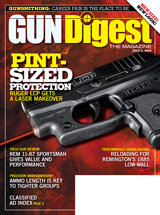
Gun Digest is the source for firearms news, pricing and guns for sale. Readers benefit from in-depth editorial expert advice, show reviews and practical how-to instructions. With your Subscription, you’ll also learn about threats to your Second Amendment rights. Click here to begin your subscription to Gun Digest.
Inside this Issue:
– The Ruger LCP – Gun Review: Model 11-87 – Precision Reloading: Cartridge Length – Handloading for the Low Wall – Gunsmithing as a Career
Not a subscriber? Make sure you don’t miss another issue! Subscribe now
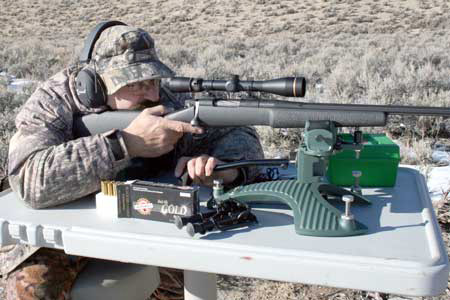
I shot the Tactical Hunter off of a good rest and portable bench. McMillan gives bench-rest accuracy in a hunting rifle that is easy to carry.
Dave Morelli puts the McMillan Tactical Hunter through the paces at the range. Will this out-of-the-box hunting rifle live up to its accuracy promise?
I always wondered why our tactical guns had to be so precise and shoot one-half-minute groups but it was acceptable for the hunting rifle to shoot one or even one-and-a-half minute groups. I realize that the target area is bigger, but I always thought if a one-minute gun was good enough, then a half-minute gun should be better.
Many manufacturers like Remington and Savage are producing off-the-rack varminters or police rifles with tighter tolerances than the general population of rifles and some guarantee one-half-minute groups. Other choices would include having a gun custom made or having a gunsmith re-barrel and chamber one of your rifles adding components that are known to improve accuracy. Now McMillan offers another choice: a hunting rifle made with one of their custom actions and built with the same care and precision as their high-quality tactical rifles.
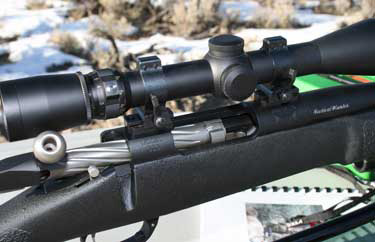
McMillan’s Tactical Hunter is a lightweight hunting rifle with all the performance of a custom gun. It comes in all the traditional hunting calibers. My test rifle was already equipped with a Leupold scope from the McMillan shop. The rifle they sent was a .308 Winchester caliber and the first ammo I shot through it was the 168-grain variety from Black Hills. The 168-grain bullet is probably the best all-around weight to shoot out of this caliber. I did switch to 175s in my F-Class gun because it holds super sonic speed at 1000 yards more consistently, but that is another story.
The G-30 action has great lines and is well machined. The bolt slides effortlessly but has a comfortable fit. McMillan holds non-critical tolerances at .005 inch and critical tolerances to ½ thousand.
The ultra light graphite technology that goes into the McMillian stock gives the hunter a rifle that he can carry all day and not sacrifice strength. The un-scoped rifle weighs in at 7 pounds. It has a one-inch Pachmayr decelerator pad and the barrel is full floated off of a glass pillar bedded action. The barrel has a generous float with plenty of space to keep debris from jamming in between the barrel and stock.
The barrel is a lightweight, hunting contour; however it is made from match-grade stainless steel, fluted with a target crown. The barrel and action are covered in a matte black finish that appear to be tougher than a bag of nails. The 22-inch barrel comes with a 1-in-12 twist, which is a little slower than most .308s where a 1-in-10 is most common.
The action is McMillan custom (G30) and is well built with good lock up and a properly fit bolt. One of the important features of an action is how it is tuned and fitted to the barrel. This action is blueprinted perfectly perpendicular to the axis and the barrel is threaded and hand fitted for a perfect fit, providing bench-rest accuracy in a rifle that can be carried all day.
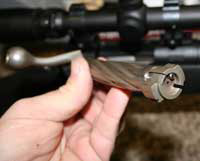
The action is machined out of premium grade 17-4 stainless steel. It is one of the toughest stainless materials and the machining in non-critical parts is .005-inch tolerance. Critical parts are machined to .0005 inch. That’s a half a thousandth! The fluted bolt aids in reliability helping to sweep mud and debris away for smooth action and is pleasing to the eye. The bolt is fitted with a Remington-style plunger ejector and a robust Sako-type claw extractor that has been redesigned by McMillan. It is on the front of the bolt and threw brass clean away with mild working of the bolt.
The raceways are cut and finished with tight tolerances and are polished with no tool marks. The bolt is also designed for easy no-tool takedown. I really like this feature. Most bolt problems I get in my shop are critters that haven’t been cleaned because sportsmen don’t have the tools or knowledge to disassemble the bolt. I disassemble my bolts about once a year these days but I would recommend more often for a professional marksman. The bolt handle is easily manipulated, and I thought it would lend to a quick follow-up shot if needed.
McMillan redesigned the Sako type extractor, which is a robust choice for a tactical or hunting rifle. Although Remington extractors rarely fail, the Sako type is a stronger design. They used the Remington style plunger ejector, which is also battle proven.
The action is designed to accept Remington-style triggers. This is great as there are a lot of aftermarket triggers produced for the Remington action. The trigger on the Tactical Hunter was phenomenal. There is nothing like a properly tuned trigger to aid the shooter into placing an accurate shot. There was no creep, a tiny bit of take up and two pounds later it is gone. The trigger is so clean and crisp I was surprised to find it measured out two pounds. I would have thought it was lighter.
The Leupold scope was a 3-9×40 with quick-detach rings and bases. The scope was easy to install and the Leupold quick mounts are rigid and repeatable. The scope can be removed and replaced without losing zero. The only thing I checked before heading in the field was to bore sight it to see if it would get me on paper. I thought it was close enough so off we went.
Using a 1000-yard target center for the first group my bore sight was off about 10 inches left and a couple low. I like using the big target so I can always have a hit on paper for quick corrections and no shots off target to calculate correction. The group was about a minute, and after correction I had it just off center a little. This was good enough for the test. The second group was slightly less than a minute.
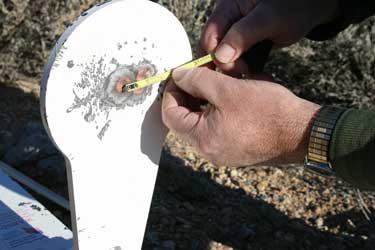
The rifle held more than acceptable groups and shooting at the popper produced this group at 200 yards.
For a light rifle I didn’t notice the recoil was any greater than one of my heavier guns. The Pachmayr recoil pad really made up the difference. The rifle was pleasant to shoot and carry. I packed it back and forth to the target without a strap. You could definitely carry this rifle all day.
After shooting several groups and gong targets, it seemed like the groups were getting tighter. My partner shot about a ¾-inch group. I have never used Black Hills Ammo before but it proved to be some accurate stuff.
I used one of my .308 ballistics charts to calculate elevation for longer shots and came in pretty close, hitting the 5-inch popper out to 300 yards. The only other factory stuff I had around was Federal 168-grain hunting loads, which gave the same sized groups. I believe a little loading savvy would tighten them up a bit more. I did manage to group around an inch on the popper at 200 yards.
The 10-inch gong was hit over and over with ease out to 400 yards. Under a minute is plenty of accuracy for a tactical rifle and now is the standard for a hunting rifle. Normally I shoot heavy-barreled guns, I might not have let the barrel cool enough for this rifle as it had a thinner hunting type barrel. Usually in a hunting scenario the first shot is the most important with the possibility of a follow up shot.
Barrel heat is not as much of a concern. Usually the temperature when hunting is much cooler, also. I have heard some hunters go through a box of shells while in the woods. I would think that after about the fifth shot the barrel was warming up enough to throw most of the following shots off quite a bit. I think they call this phenomenon canyon busting.
I give the McMillan Tactical Hunter an A, as it gives the hunter the confidence of a custom rifle with the weight of a hunting rifle. Now the custom hunting rifle can come to you right out of the box.
This article appeared in the May 10, 2010 issue of Gun Digest the Magazine.
The hearings on Elena Kagan — President Obama’s radical pick to join the U.S. Supreme Court — began yesterday.
This is a VERY IMPORTANT battle that gun owners must fight, as evidenced by the slim victory in the McDonald v. Chicago case that was handed down by the high Court yesterday.
Kagan doesn’t have a record of judicial opinions, but her views on the Second Amendment are no mystery:
* Kagan drafted a directive in favor of a semi-automatic import ban while serving in the Clinton administration;
* As a law clerk, she advised against allowing the Supreme Court to hear arguments in Sandidge v. United States that the D.C. gun ban was unconstitutional;
* Kagan was also part of the Clinton team that pushed the firearms industry to include gun locks with all gun purchases and was in the Clinton administration when the president pushed legislation that would close down gun shows; and
* Just today, Kagan gave a hint to her true colors. When asked a simple question by Senator Grassley of Iowa — does the Second Amendment codify a pre-existing right from God or is it a right created by the Constitution? — Kagan looked like a deer caught in the headlights. After an awkward pause, she said: "I’ve never considered that question."
Yikes… the Supreme Court is no place for on-the-job training! Read more
Looking to go armed, but are stuck in the weeds as to what to arm yourself with? Here are 20 of the best concealed carry gun options that will keep you on the defensive.