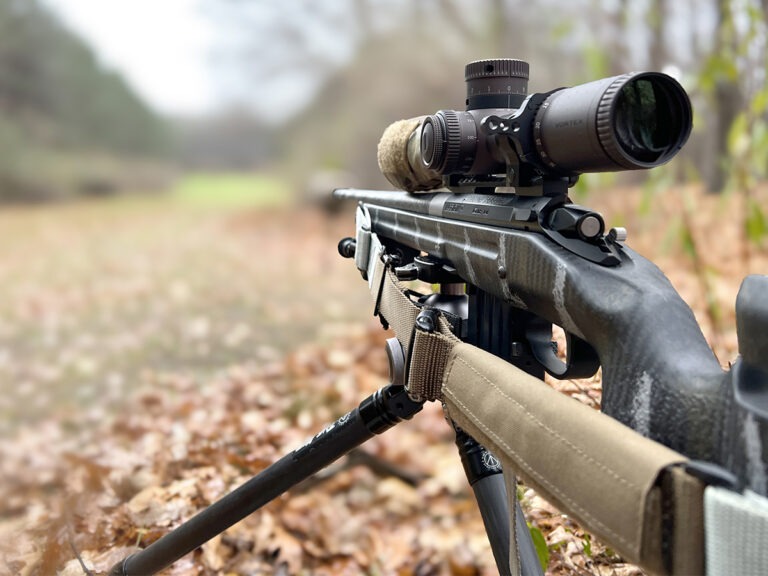
We take a closer look at Vortex Optics’ high-end Razor HD Gen III riflescope line.
I’ve had a ton of time in the field and range with a slew of world-class optics from a host of great companies. What follows here is a compilation of what I believe are some of the best optics not just from Vortex, but also in the broader field of optics. While nearly everyone has a certain loyalty to a given brand, perhaps handed down from generation to generation (Dad had a Ford or Ram, you know the gist), I have the benefit of being able to test in unbiased ways long term and come to conclusions over dozens of products and test environments.
Every scope featured in this article has been used for hunting, competition, been carried for miles, dropped at least once and moved from gun to gun, so this will be an honest assessment of the lineup.
A Solid Pedigree
Vortex is a company that listens to shooters, and as a result, many of the features on these scopes are extremely modern, which may seem like a dumb thing to say until you realize that there has been a great deal of stagnation across the board in optics. Perhaps you get a new reticle, maybe a bit of a turret upgrade here and there. The response time in engineering has always been like watching grass grow.
Back when I was first getting into long-range shooting, it was big news that there were scopes coming out with reticles that matched the turret adjustments. Yeah, you read that right.
Newcomers to shooting never had to deal with mil scopes with MOA clicks. Hell, not even all of them were true MOA, just ¼ inch at 100 yards. The monkey math it took to get off the ground was frustrating.
Shooters today are living in a world with temp-stable powders, extremely accurate (and inexpensive) rifles off the shelf, ultra-consistent bullets and brass, and optics so good that I could seldom imagine them decades ago.
Back when the struggle was real, the best rifles and optics weren’t up to what we have today. The amount of voodoo it took to get a rifle truly shooting was staggering, and as a culture, most of that has disappeared. People don’t really bed their stocks, true their actions or send out rifles for the magic of re-barreling. Nowadays, you can build a rifle capable of one-hole accuracy in your garage with pre-fit barrels and pretty much any chassis you want.
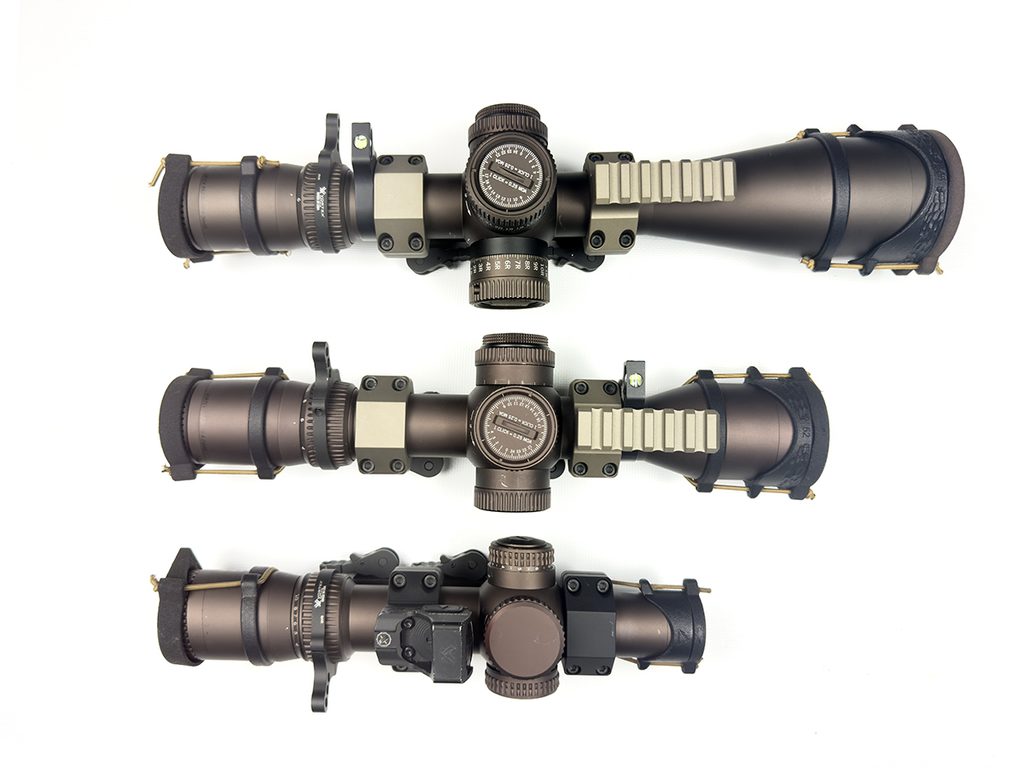
The optics situation likewise is very different than it used to be. In the old days, you dared not take your scope off your rifle. Even at that, you had to be super protective of your zero because it could be a challenge to get everything the way you wanted. You still hear it all the time: “I set that scope 10 years ago, and it shoots and I’m not gonna touch it.” Well, you don’t have to worry about that these days. Optics are so damn good that you can take scopes from rifle to rifle in various calibers and just move your turrets to your known zero with that rifle.
Now, the magic isn’t anything other than great engineering and a healthy amount of listening to shooters—and each of these scopes here truly demonstrates the exact things I would want in optics if I were designing them based on my experience. I’ve broken scopes in both range testing and in the field, and ruggedness is something these optics have in spades. I will say that the individual scopes in the Razor HD line are heavier than most of their peers of the same general size range, but this is not something that I see as a negative in practice considering that I would absolutely take a few more ounces for the pound of doubts that pile up with less rugged options.
Razor HD Gen III 1-10x24mm FFP
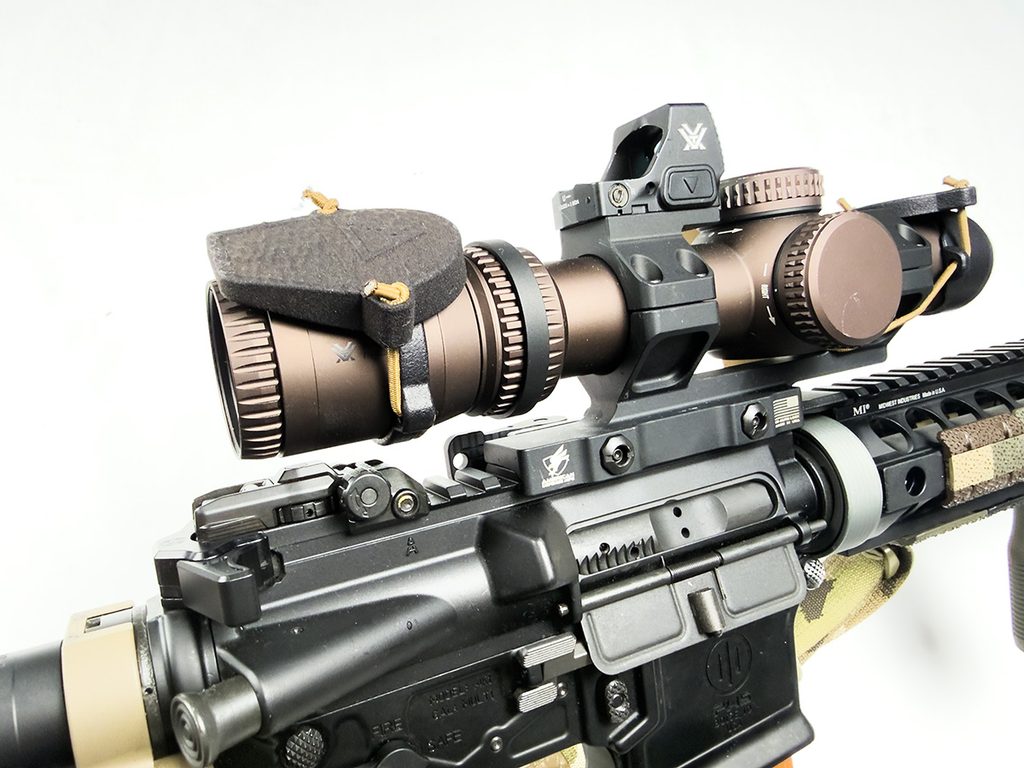
While it’s certainly not the “baby” of the family, this optic is physically the smallest yet manages to pack a ton of features in a limited amount of space. At just 10 inches in length, it falls into the category of LPVO scopes but boasts a very nice magnification range that places it in line with what used to be sniper rifle optics in the old days. It outclasses most other optics in its size category in terms of overall utility considering it can be easily used to shoot past 1,000 yards and also clear a shoot house with both eyes open. I find it’s one of my most heavily used scopes due to the fact it’s light enough for a 16-inch 5.56 carbine but also does great on larger-frame rifles and plays nice with clip-on thermals and night vision.
The scope has a very well designed physical layout that includes capped turrets, something that I really like to see on knock-around optics and scopes that spend a lot of time on slings, in the bottom of the canoe or kayak, or in and out of stands. Not to mention the abuse an optic can take when shooting in competition. I’ve slammed this scope on the ground by accident, smashed it into barricades, dropped the entire thing on concrete, dropped it out of a tower blind, had it on a .50 BMG for a demo day when a weaker scope broke, and many, many more uses that most people would never want their scope to go through. That being said, I never intentionally abused it, and I would say that during normal use I was very careful with it. I never doubted my zero and even after all that I have never had issues with repeatability.
The optical quality is stellar, but buyers should know this is still a narrow tube by comparison to the light-collecting abilities of its bigger brothers, and I generally keep it on a lower power in the dark woods I sometimes hunt in. This is a super high-end, do-all scope for virtually any use you could have, the only thing I would change in general is the very center of the reticle. Because it does serve almost as a red dot on 1X with illumination on, the center dot complex when precision shooting is a bit chunky and, in a hunting scenario, can obscure parts of the animal.
Now, this is a personal issue and preference note; this scope can do so much that it’s not noticeable 99 percent of the time. I usually have it with illumination on at about 5X in match shooting where I can use it with both eyes open. Shooting paper isn’t the same as shooting animals, and I do think that I’d love to see a version of this scope with a simple mil reticle that focuses the eye to center for a fine aiming point while maintaining mils for field holdovers.

Razor Hd Gen Iii 1-10x24mm Ffp Illuminated Rifle Scope – Razor Hd Gen Iii 1-10x24mm Ffp Ill. Ebr-9 Bdc Mrad Shdw W/Mt
Razor HD Gen III 4-24x44mm FFP
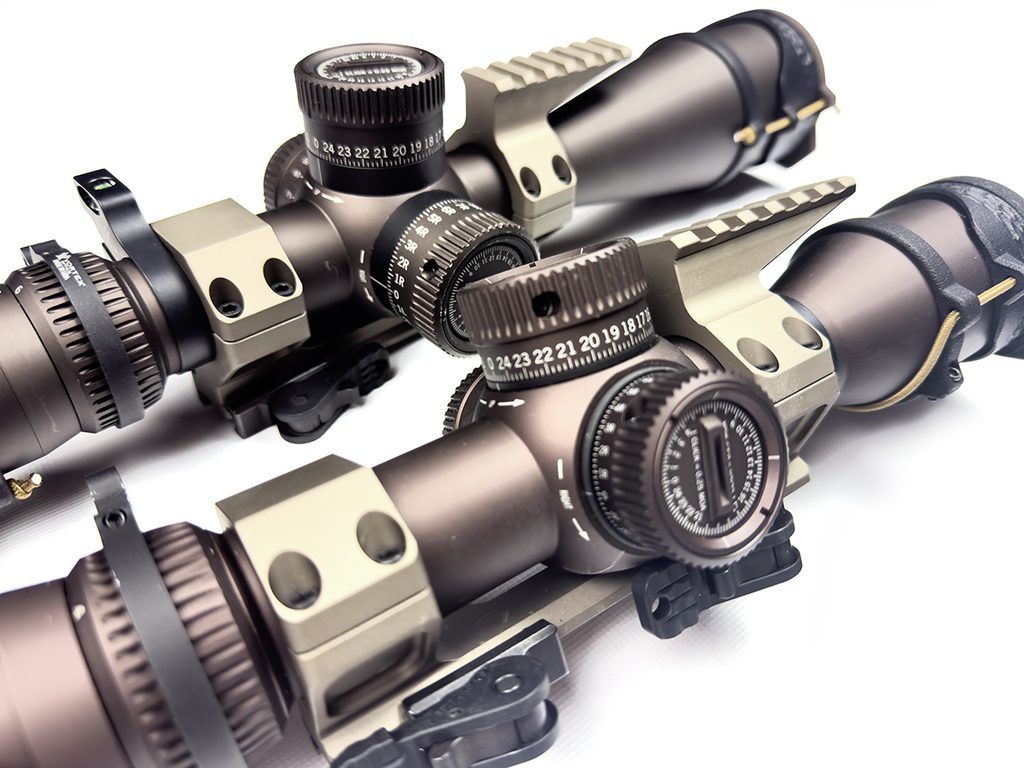
A recent addition to the Gen III family, the 4-24x44mm is arguably one of the most versatile scopes on the market today. It’s big enough to be used for serious long-range and target work, yet small and light enough to take to the field for extended periods of time. It blends the features of its bigger and smaller brethren in a great way that takes away the negatives associated with heavy target scopes or sparse-featured LPVOs.
The elevation turret is the same rough layout as the much larger 6-36X, but the scope sports a covered windage turret. In all my years in the field I have always wanted this feature on a scope of this size range and Vortex really delivered. So why does this little feature matter so much? Most of us that have a good deal of field and experience don’t like dialing in windage—we prefer to hold for it. The exposed elevation turret is always a bit of liability because it’s the most likely to be bumped or damaged in the field. I’ve had it many times with old scopes I have since retired where, after a day of carrying on the shoulder, the windage is suspiciously moved an undetermined amount. It makes you wonder if it’s just off by one mil or a whole rotation.
I’ve used this scope in the field since I first received it some time ago, and it has been an absolute pleasure, especially when paired with rifles in modern calibers like 6.5 Creedmoor or my new favorite, 6GT. The magnification range is extremely well thought out for using these more modern calibers. Bigger scopes I’ve used that end up at around 25X tend to be much more target-oriented, where this scope is still quite compact at just a foot long, making it suitable for carbines or SPR builds in addition for full-size bolt actions. I like this scope on suppressed, 18-inch bolt guns because it offers a world of performance in such a small, light package—you can go from ringing steel at 1,000 yards to hunting in the tight brush. I’ve put more than 5,000 rounds through rifles with this scope mounted, from .338 Lapua to .22 LR, and it tracks right back to each rifle and load after I move it. This is, dollar-to-specs, one of the best scopes on the market.

Vortex Optics Razor Hd Iii 4-24x44mm Ffp Iilluminted Scope Razor Hd Iii 4-
Razor HD 6-36x56mm FFP
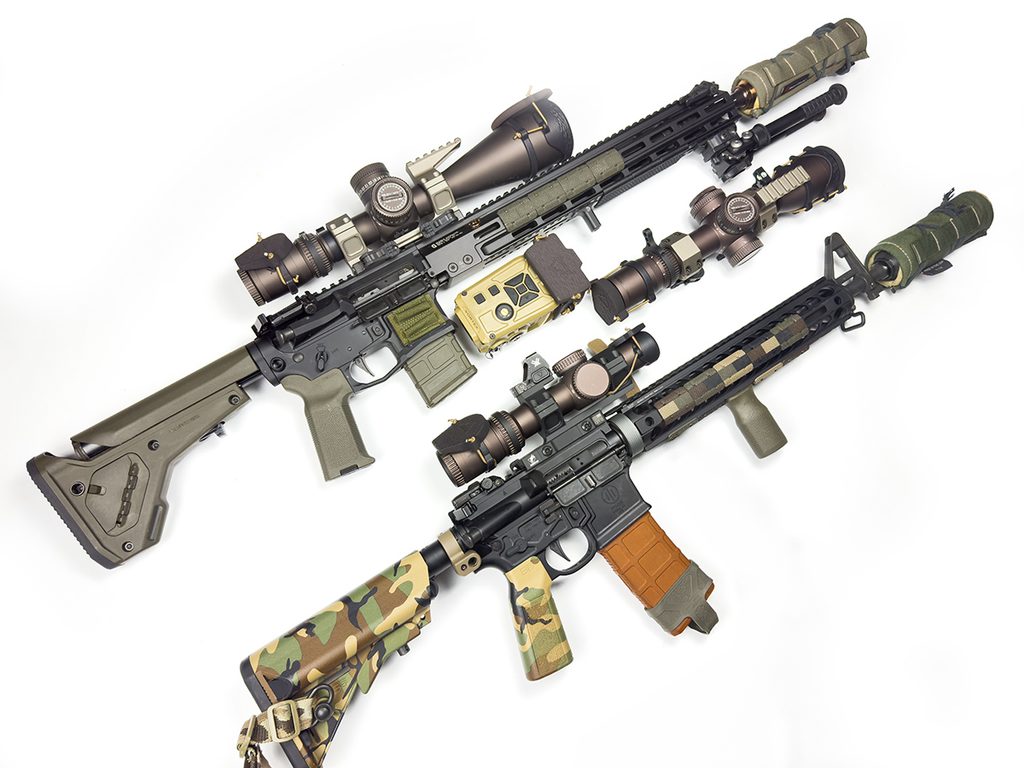
Ah, the big boy. This is the scope most people think about when in the Razor HD product line. Not only is it visually impressive, but it’s also one of the most rugged and repeatable scopes I have ever used. I have been shooting this model for years, and I’ve had it on dozens of rifles. This is the optic that I use for my article production when testing accuracy. No matter the caliber, no matter the distance: This is one scope that I trust to deliver the best results.
I have taken the scope hunting many times as well. It is, however, larger than I like for close-quarters, especially in wooded areas, the reticle does tend to disappear into the background when on lower power. At a higher magnification, it’s slightly difficult to use for the same reasons, the reticle becomes much more usable the higher you get, but you end up losing field of view. In open areas, this is not a problem.
On larger calibers at longer ranges, it’s absolutely fantastic. As an interesting note, I also believe it is one of the best optics for precision rimfire shooting at long distance. The MOA version that you see in this article is fantastic on a full-size rimfire for NRL shooting. I’ve shot .22 LR past 600 yards with this scope mounted, and it was a blast. Although, I admit it showed me just how poorly prepared I was compared to the true rimfire guys. The wind matters a lot in these circumstances, and let’s just say I wasn’t as good at reading it as the next guy.
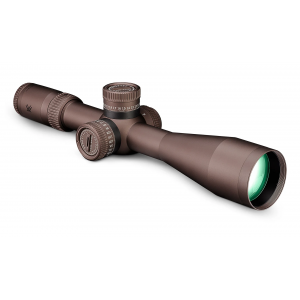
Vortex Optics Vortex Razor HD III 6-36x56mm FFP EBR-7D MRAD Reticle Rifles
Final Thoughts On Vortex Optics’ Razor Line
While this might end up seeming like a bit of a commercial for Vortex, that’s not really what I’m trying to accomplish here. There are a lot of great optics out there.
One of the benefits of writing for these pages is that I can be very honest in my results. In fact, I see it as a general betrayal if I was to tell you to go with something I didn’t personally use or believe in. For instance, I was privileged to be one of the first people in the country to have the extremely high-end and compact Vortex AMG 1-10, a truly incredible optic. However, while I am happy to put it in my article photography, I have not yet had field experience with that optic. I’m assuming it’s going to do just as good over the thousands and thousands of rounds that I plan on putting through it, but I can’t tell you how it’s going to stack up against any other scope until I put it through its paces.
The three scopes in this article have seen a combined total of perhaps 25,000 rounds. I’m not just talking .22 LR, either. These are some of the most rugged optics out there, and I can strongly recommend them while keeping my integrity. If I had to pick just one, it would be the 4-24X. I think it is the best of all worlds and is what I think the standard for a modern optic should be.
Gear Notes: Accessories To Know
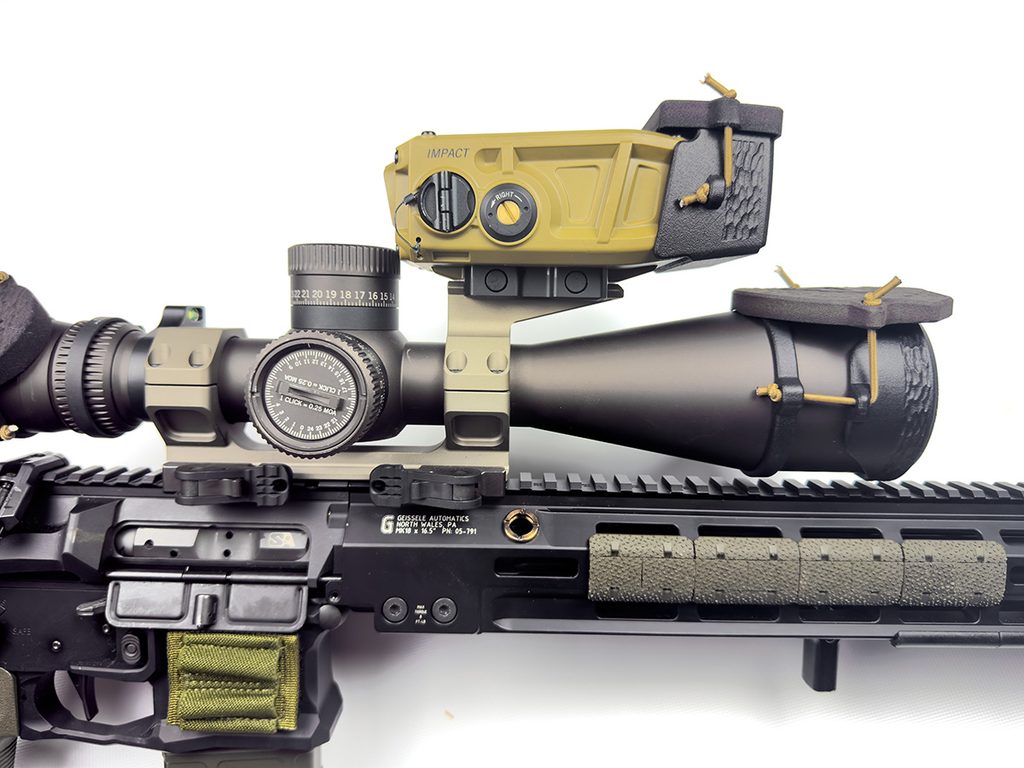
All the scopes in this article are decked out with what I had determined to be some of the best in accessories. One Hundred Concepts makes some incredible scope accessories. I use them on virtually all of my optics. These are unique, field repairable lens covers that integrate kill flash tech and totally silent operation, so there’s no “pop” when you open them. The covers are user configurable, and all they require is some sort of elastic to work. If you find yourself with a damaged cap, you can quickly and easily fix it yourself.
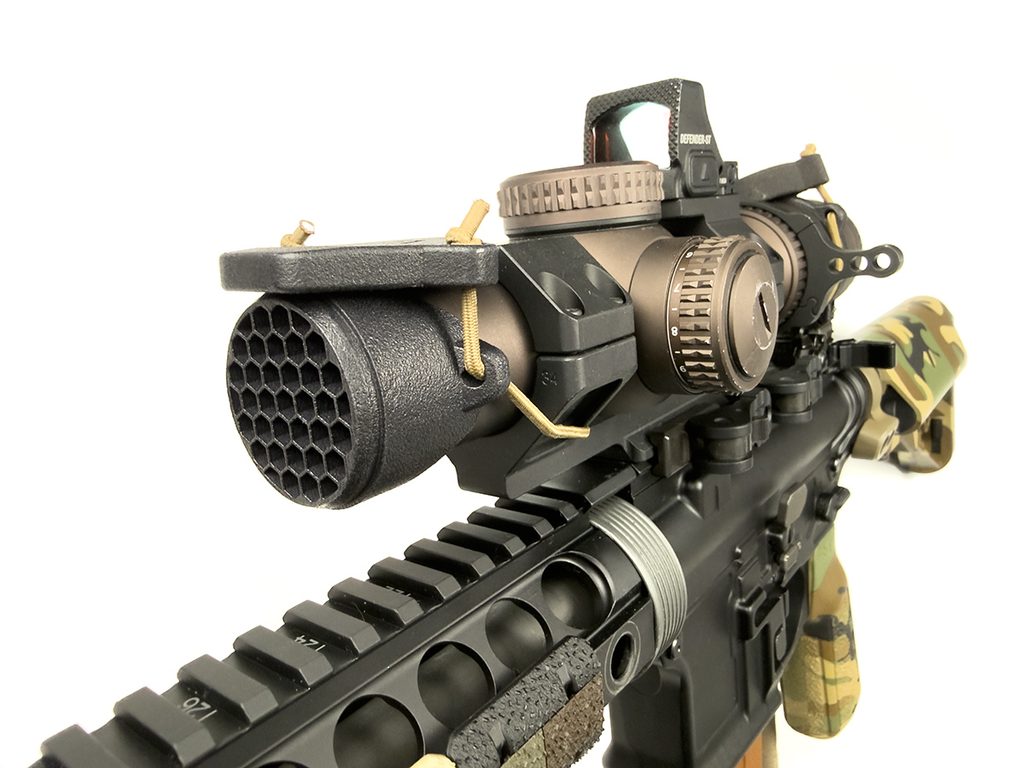
I also like the mounts from American Defense Manufacturing. ADM mounts are of extremely high-quality, and they are very reputable. I have these mounts installed because I tend to move my scopes from gun to gun, and the adjustments on the bases are very precise. Using these mounts, as well as a predetermined zero in my notes, I can move a scope from say a 5.56 NATO AR, over to a bolt-action 6.5 Creedmoor with a 20 MOA rail. All I have to do is set the locking levers on the mount to the appropriate tension for that individual rail, move the turrets to the known zero, and I am within a click or two 99 percent of the time. Getting a good zero isn’t magic thanks to how precise the scopes are.
Editor’s Note: This article originally appeared in the November 2026 issue of Gun Digest the Magazine.
More On Riflescopes
- Lightweight Riflescopes: Top Options & Their Future
- Scope Magnification: What’s The Right Amount?
- Understanding Rifle Zero And Scope Mounts
- How To Choose The Best Rimfire Riflescope
Next Step: Get your FREE Printable Target Pack
Enhance your shooting precision with our 62 MOA Targets, perfect for rifles and handguns. Crafted in collaboration with Storm Tactical for accuracy and versatility.
Subscribe to the Gun Digest email newsletter and get your downloadable target pack sent straight to your inbox. Stay updated with the latest firearms info in the industry.