
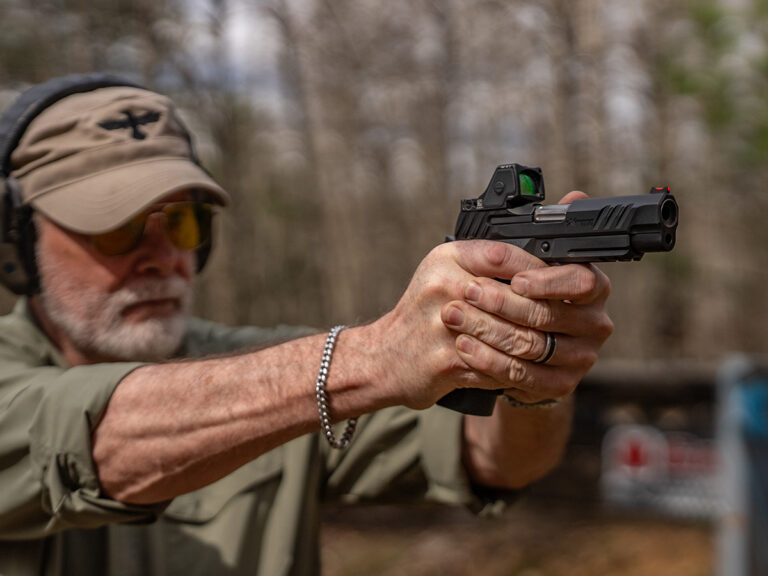
When it comes to carry guns, are red dots really that much better than iron sights? I hit the range to find out.
Just 13 years ago, when I authored the book, Handgun Training for Personal Protection, I included a chapter on red dot sights, where I wrote, “The future is coming. When it gets here, we will all shoot better and faster.” In some ways, reflex-style red dot sights have come a long way in the past 13 years, and today, many believe a self-defense handgun without one is unsuitable … or even antiquated. I’ve spent a good part of the past five years becoming proficient with reflex sight-equipped handguns, and I wanted to explore just how much more effective they might make a self-defense pistol.
There’s a lot to consider when comparing a red dot sight to fixed sights, such as the size they add to a pistol, as well as the red dot sight’s durability and electronic dependency. All those considerations are mute, however, if we cannot—like I predicted 13 years ago—shoot better and faster with them. Most everyone will tell you they feel like they shoot better with a red dot sight—I feel like I am more accurate with one—but are the advantages of a red dot sight a measurable fact for most shooters?
What I wanted to learn was pretty straightforward: Can a shooter shoot better and faster with a red dot sight?
A Fair Fight
To conduct a test like this, some parameters must be established to make it fair. First, all the shooting must be conducted with the same or identical handguns. Second, the shooters cannot be permitted to substantially familiarize themselves with the handgun or sight system before testing. And finally, the shooters should represent a varied skill set comprised of a shooter who predominately uses a red dot sight, a shooter who predominately uses fixed sights, and a shooter who uses both about an equal amount. Each shooter should conduct the same drills with each sight system without more than just a few familiarization shots.
The Pistol
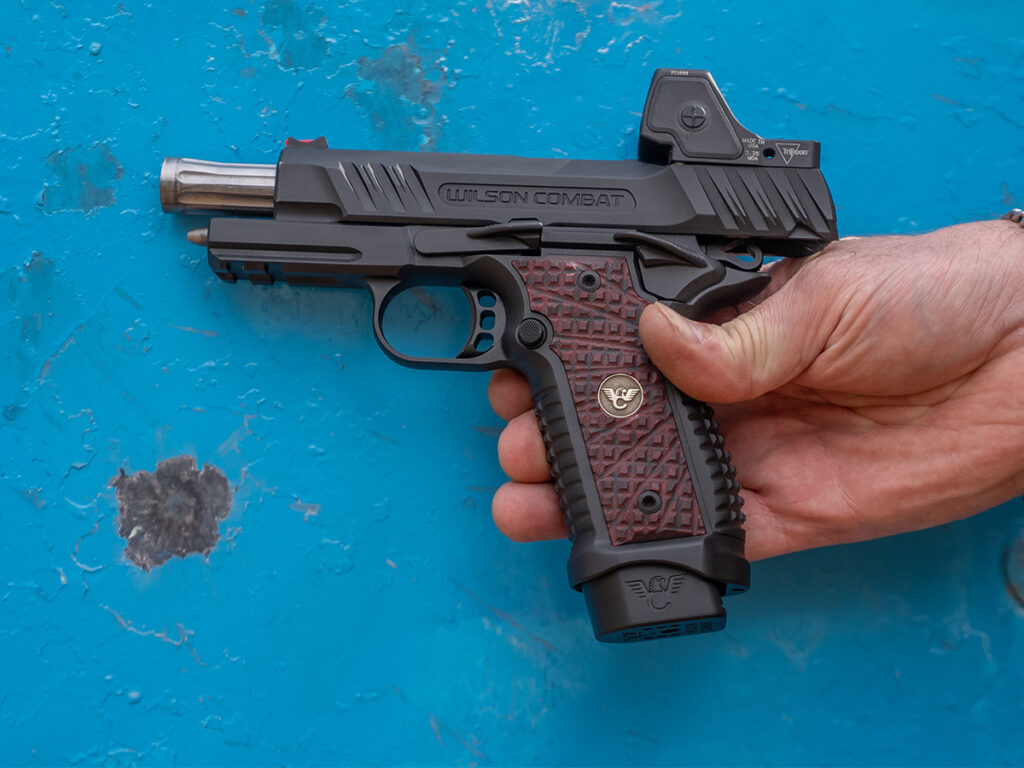
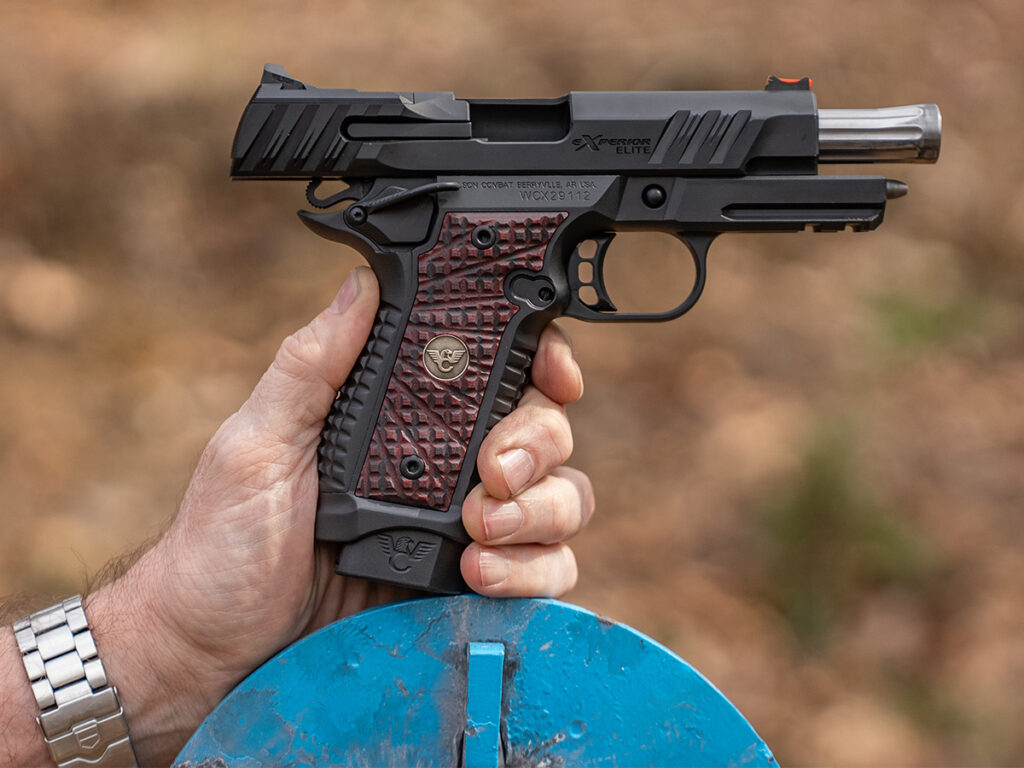
The handgun chosen for this test was actually somewhat responsible for the conduct of the experiment. Wilson Combat just introduced their eXperior Elite pistol, which is an optics-ready Commander-sized pistol. The optics plate on this pistol is fitted with a fixed rear sight, and when the plate is removed for red dot installation, there are no co-witnessing sights. This meant that a shooter could not cheat during the test because only one sight system would be available at any given time.
The Shooters
Three shooters were chosen based on their preferred or most practiced sight system, but also with the knowledge that they could perform—on demand—each drill to its par time standard, with no misses, using their preferred sights system.
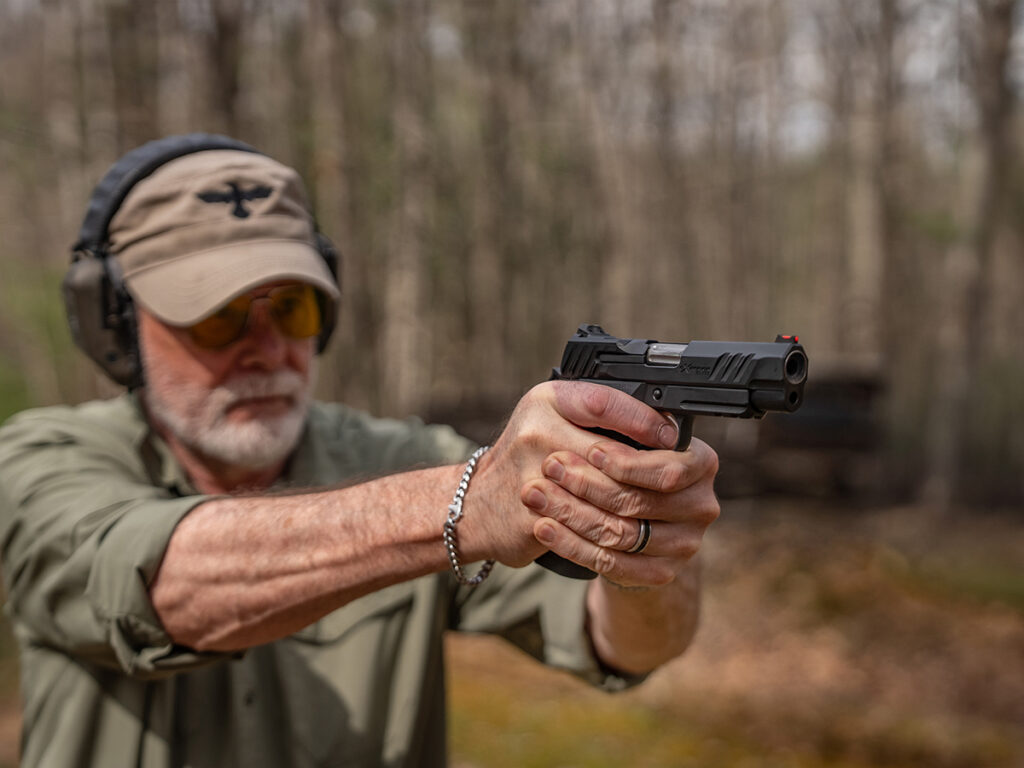
Shooter 1 spends about as much time shooting a red dot-sighted pistol as a fixed-sighted pistol. Shooter 2—a police officer—carries a pistol with a red dot sight as a duty gun. And Shooter 3 has limited experience with red dot-sighted pistols.
Irons Vs. Red Dots: The Test
Three drills were chosen. The first involved shooting three, five-shot groups—slow fire—from a sandbag rest at 10 yards using the red dot sight and the fixed sights.
The second was the Step Back Drill, which required drawing from the holster and engaging an 8-inch steel plate with two shots at 5, 10, 15, 20 and 25 yards, with each two-shot string timed separately. Par time for this drill is less than 20 seconds when the times for all five stages are added.
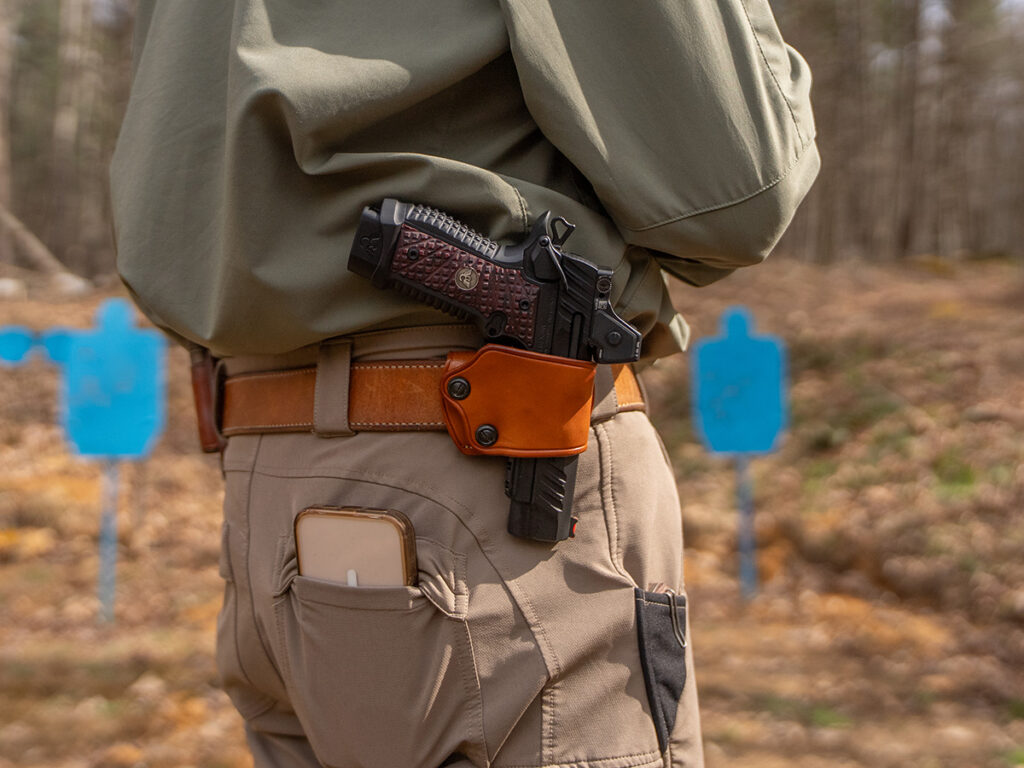
The final test was similar to half of the common El Prez Drill. The shooter started holstered and engaged three steel silhouette targets with two shots each from 15 yards. The guidance for each shooter on drills two and three was to shoot only as fast as you felt you could hit with every shot.
Test 1: Precision
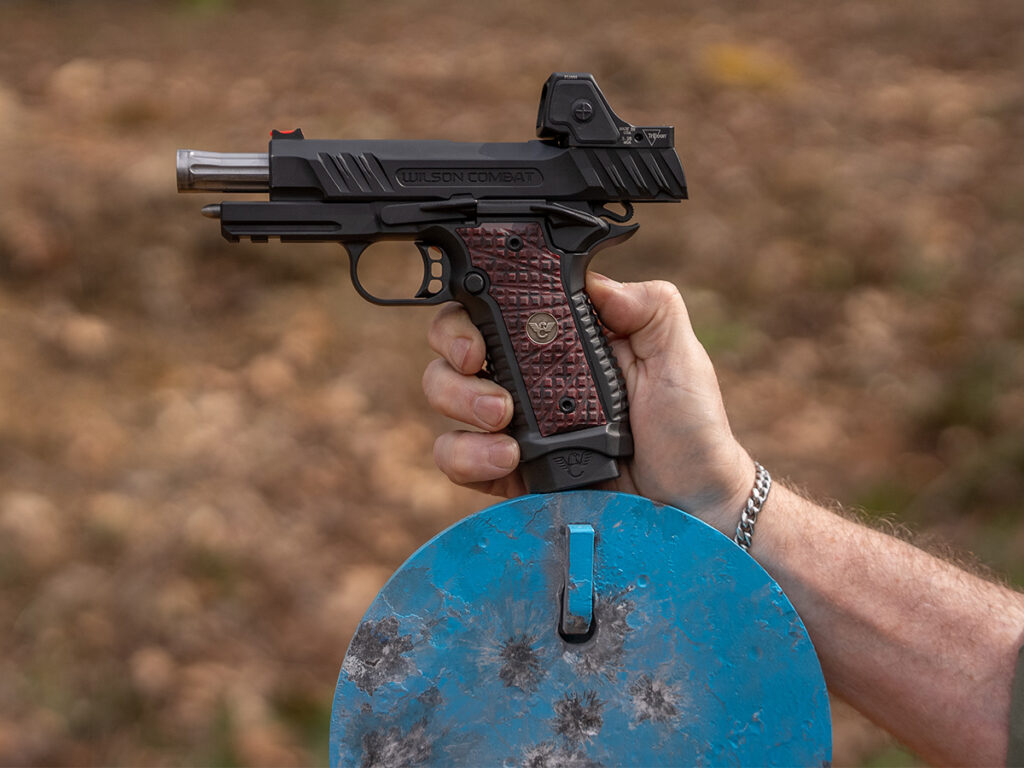
This test was designed to see which sights system could be used to deliver the most precision on target, and the results here were not surprising. Groups fired with the red dot sight were substantially smaller, on average by 39 percent. Additionally, Shooter 1 and Shooter 2 shot so similarly with both sights systems; Shooter 3 did not conduct this test. The performance gap here was substantially in favor of the red dot sight. However, it should be noted that the five-shot groups at 10 yards, still averaging less than an inch that were fired with fixed sights, demonstrate more than necessary precision for any self-defense handgun.
| Precision (10 Yards) | Fixed Sights | Red Dot Sight |
| Group 1 (Avg.) | 0.91 | 0.49 |
| Group 2 (Avg.) | 0.97 | 0.56 |
| Group 3 (Avg.) | 0.84 | 0.60 |
| Average: | 0.91 | 0.55 |
Test 2: Step Back Drill
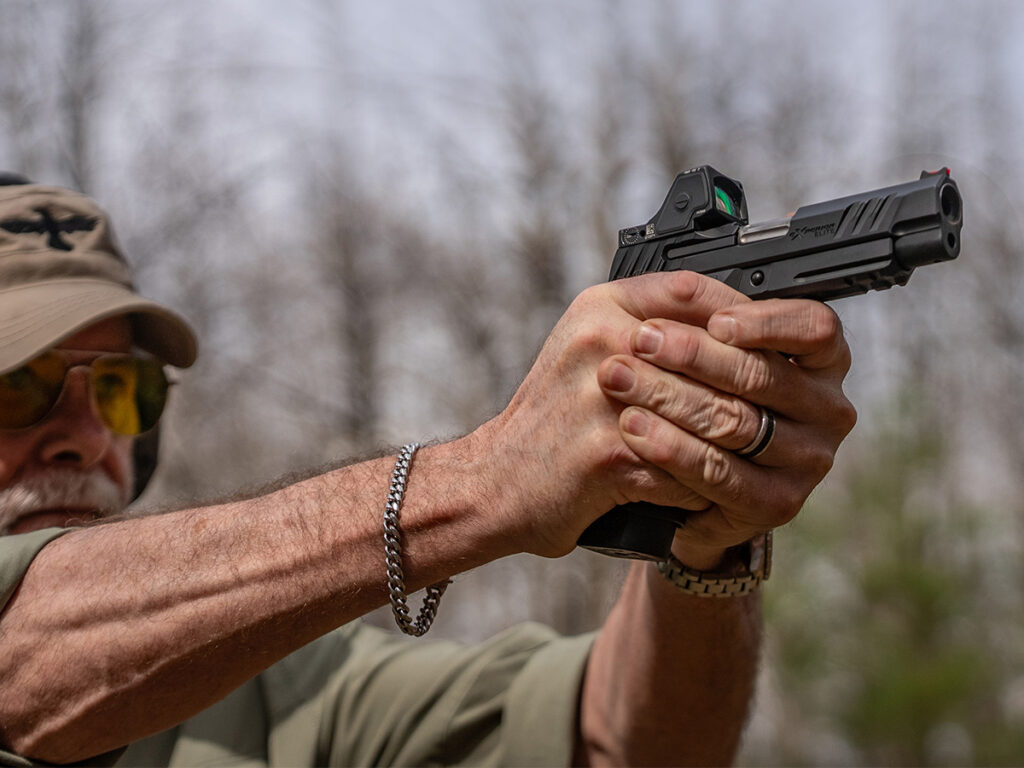
With this test, the waters began to cloud. All three shooters obtained hits with the fixed sights faster than with the red dot sight, on average by almost 14 percent. Surprisingly, at 20 yards, Shooter 2 and Shooter 3 were faster with the fixed sights. As expected, at 25 yards all three shooters were faster with the red dot sight by almost 20 percent. However, when the overall times to complete all five stages was compared, fixed sights proved to be about 2 percent faster. The average time for each drill with the red dot sight was 3.31 seconds, and the average time with the fixed sight was 3.25 seconds. The fixed sights were faster up close, and the red dot sight was faster at maximum distance, but when all five distances were considered, it was realistically a tie.
| Step Back Drill (5, 10, 15, 20, 25 Yards) | Fixed Sights | Red Dot Sight |
| 5 Yards | 1.75 | 2.01 |
| 10 Yards | 2.40 | 2.59 |
| 15 Yards | 3.02 | 3.85 |
| 20 Yards | 4.19 | 4.14 |
| 25 Yards | 4.91 | 3.98 |
| Average: | 3.25 | 3.31 |
| Total: | 16.26 | 16.56 |
Test 3: Multi-Target Drill
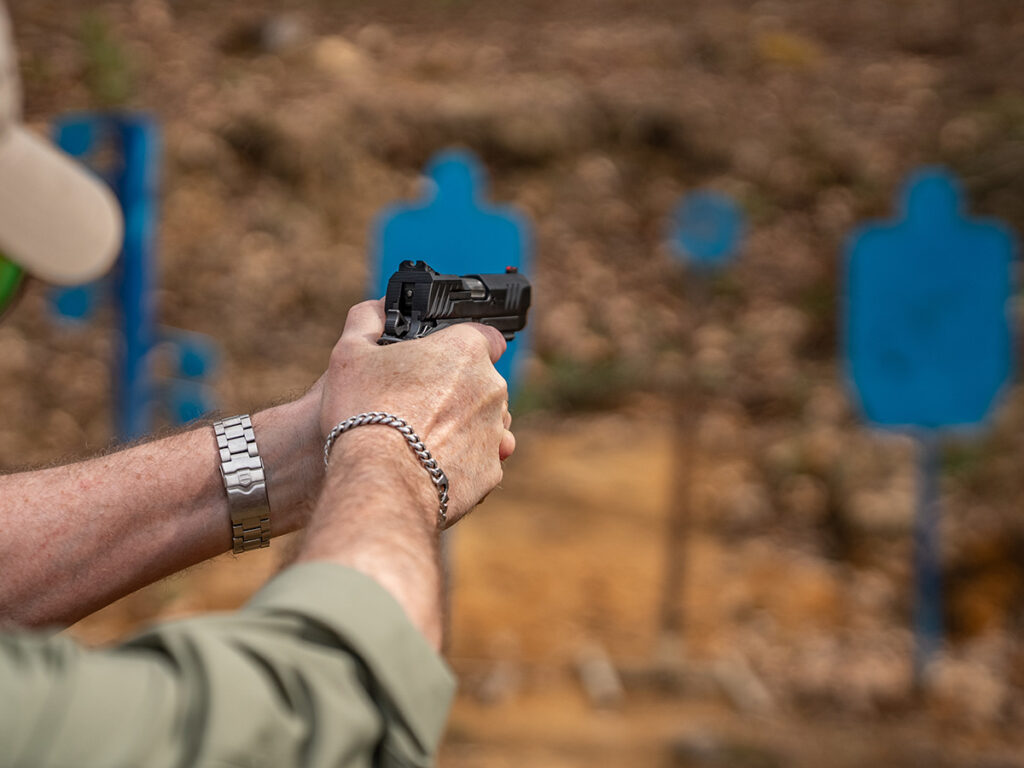
Where Test 2 required a measured balance of speed and accuracy, Test 3 was less demanding from an accuracy standpoint. Hitting a silhouette-sized target at 15 yards is not difficult. By the numbers, all three shooters shot faster with the fixed sights than they did with the red dot sight. The fixed sights won the drill by about 9/10ths of a second. Split times between shots on the same target were 4 percent faster with the fixed sights, and transition times between targets were 5 percent faster with the fixed sights. The fixed sights were even faster out of the holster for the first shot by—on average—a quarter second or 13 percent.
| Multi-Target Drill (15 Yards) | Fixed Sights | Red Dot Sight |
| 1st Shot | 1.85 | 2.14 |
| 2nd Shot | 2.18 | 2.61 |
| 3rd Shot | 2.84 | 3.34 |
| 4th Shot | 3.10 | 3.73 |
| 5th Shot | 3.64 | 4.47 |
| 6th Shot | 3.91 | 4.80 |
| Average Split Time: | 0.46 | 0.61 |
| Average Target Transition Time: | 0.60 | 0.74 |
| Average Total Time: | 3.91 | 4.80 |
Lessons Learned
What I can tell you, with some degree of confidence, is that you can make more accurate shots with a red dot sight than you can with a fixed sighted pistol at any distance. Also, if you’re capable of performing the drills in Test 2 and Test 3 to standard with any pistol, you can probably perform them the same, if not faster, with a pistol that has fixed sights. This, of course, goes against the common narrative that red dot sights are better for concealed carry. Fixed sights performed the same or better during these two tests and do not have the failure potential of red dot sights.
However, I think there are exceptions. If you’re an extremely high-level competitive shooter who only—or mostly—uses a red dot sight, and who conducts hours of frequent practice with a red dot-sighted pistol, I’m confident you can shoot a red dot-sighted pistol more accurately and faster, especially as distances increase. Also, anecdotally, I can tell you that new shooters respond to red dot sights better than fixed sights. I’ve proven this numerous times working with new shooters to include my two daughters. Learning how to manage a trigger press and keep three planes of focus in tune with fixed sights is difficult.
So, Do You Do the Dot?
I still believe, as I predicted in my book, that dot-sighted handguns are the future and will lead to better and faster shooting. However, based on this experiment, what I’ve witnessed with other shooters and what I’ve learned from other instructors, I don’t think the future is here just yet. Granted, this was a very limited test, and there are a lot of variables left to be examined, like the best dot size, color and brightness for speed, and the best window size and shape for target acquisition. Maybe more importantly, for the red dot sight to commonly outperform fixed sights at realistic self-defense distances, we might have to progress to a generation raised on dots and not fixed sights.
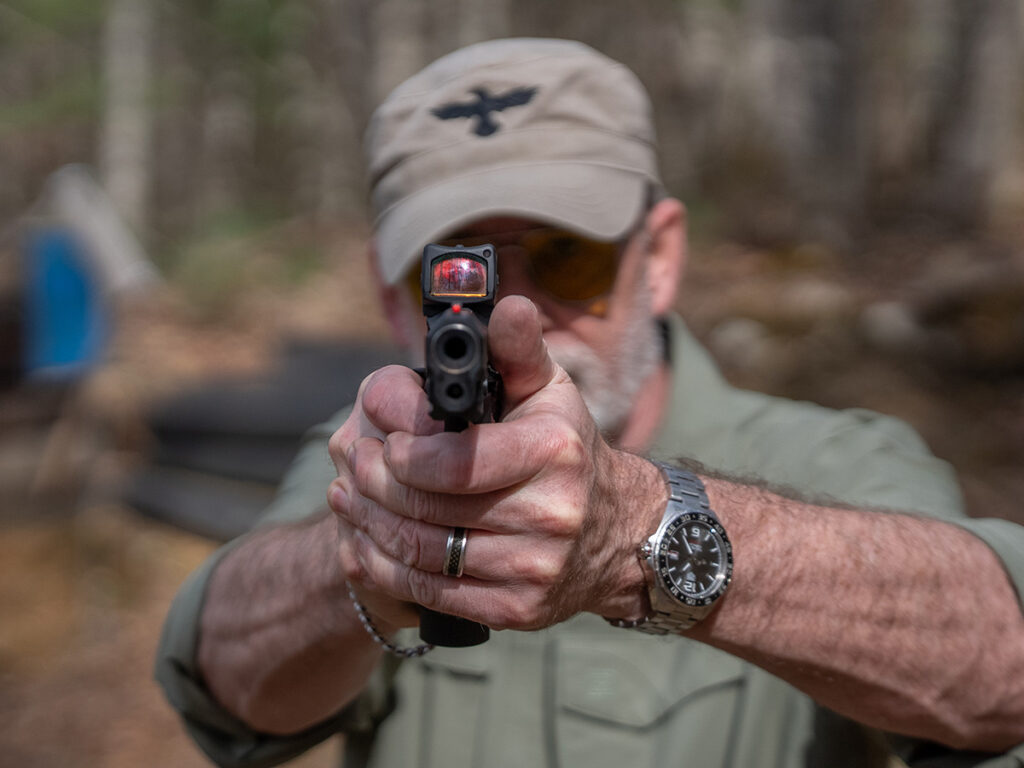
I shoot dot-sighted pistols about as much as I shoot fixed-sighted pistols. At realistic self-defense distances, and in practical scenarios, I shoot fixed sights better. But, if I had to make a precise shot at 25 yards and beyond, I’d damned sure want a red dot sight. The results of this test and the potential failure possibilities with a red dot sight further support my decision to not use them on carry guns.
However, I’m not trying to convince you to do the same.
What I hope this article does do is convince you to conduct your own testing. You might come to the same conclusion, realize you need more practice with a dot or fixed sights, or discover the red dot sight works better for you all the time.
Mostly, I hope you don’t just drink the Kool-Aid, because doing what all the cool kids are doing should not be the deciding factor in your weapon platform.
Gun Notes: Wilson Combat eXperior Elite
The eXperior Elite pistol from Wilson Combat is their newest and arguably best rendition of their X9 platform. It was the perfect pistol for this test; when a red dot sight is mounted, there is no provision—without aftermarket accessories—for co-witness fixed sights. This is because Wilson Combat uses the same slide cut and pin mounting system on the eXperior Elite that they developed for their Division 77 P1 pistol. This prevented the shooters from cheating either way.
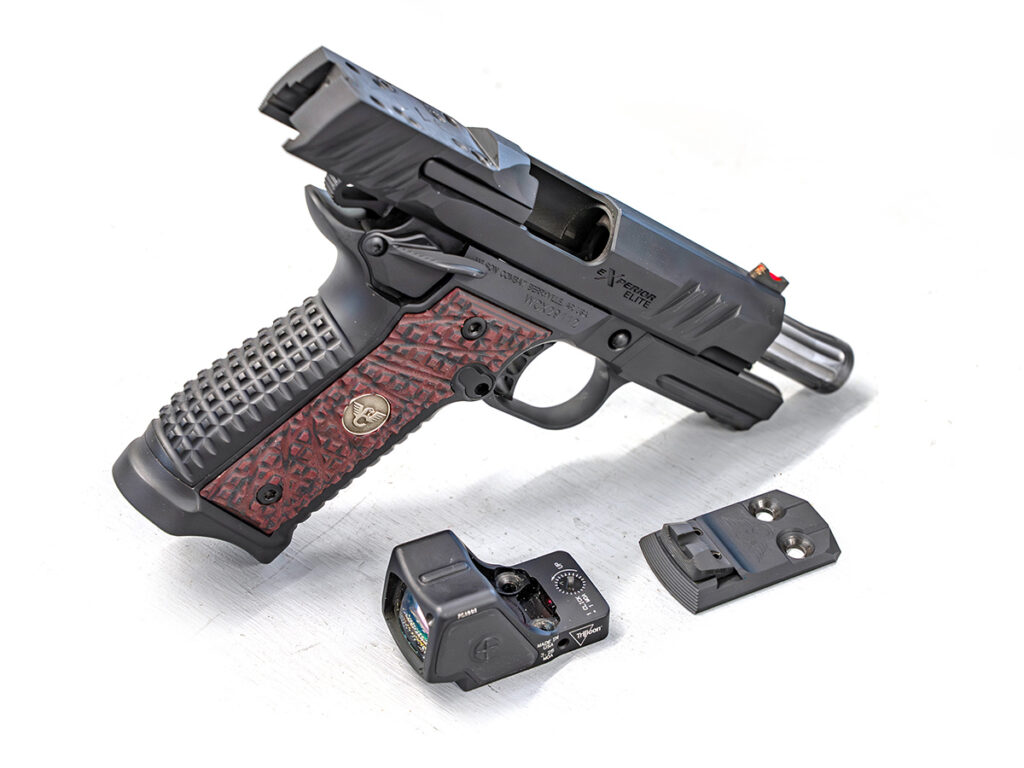
Additionally, being a brand-new pistol, none of the shooters had any prior experience with it. Also—though unrelated to the experiment—it’s worth noting the extreme level of precision this pistol delivered, which is undeniably a product of its new double locking lugs. And finally, there were no stoppages of any sort experienced by any shooter during this experiment. The eXperior Elite pistol is available now from Wilson Combat with a base price of $3,999.
Editor’s Note: This article originally appeared in the July 2026 issue of Gun Digest the Magazine.
More On Pistol Red Dots

Next Step: Get your FREE Printable Target Pack
Enhance your shooting precision with our 62 MOA Targets, perfect for rifles and handguns. Crafted in collaboration with Storm Tactical for accuracy and versatility.
Subscribe to the Gun Digest email newsletter and get your downloadable target pack sent straight to your inbox. Stay updated with the latest firearms info in the industry.



Great points made and based on possible failures with the red dot setups I decided to stick with straight stock/production right out of the box. I own a Glock 47 and it’s my first season of competitive shooting. I’ll let you know what intel I have after the season.
Try to clear a stovepipe stoppage with a red dot mounted. I’m referring specifically to the “sweeping” method of clearing. In a life and death fight, no stoppage should cause you to have to “seek cover” and clear your weapon. As for critical shots at distances of 25 yds/mtrs and beyond, I once shot a basketball sized group from 100 yds in the kneeling position with a Glock 22 using FMJ ammo. What’s my point? How critical is the shot? Maybe wait/maneuver for better position? Wait for someone with a long gun? Again, I’m only talking about real world encounters, not square range shooting. IMHO, both sights have their plusses and minuses. Just saying!
Despite the draw backs of a Red dot vs Open sights (e.g. battery life, damage probability etc.) I would choose the red dot always.
I have been in and also train our military teams and sport shootings teams with pistol, rifle and shotgun for urban and sport shooting. What stands out immediately in the sporting world was that the novice and good shooters with open sights immediately move to the top class when they start using optics. Even newcomers will constantly outperform very good shooters using optics and then they drop off when using open sights again.
Off course its horses for courses. At close distance about 5 to 7 meters sights are hardly used, while the shooter relies on training and basic shooting memory to shoot. I have seen a shooter during a World Championship Man vs Man win only to realise once he was finished he had never switch on the red dot for that event.
At medium and long distances and low light level there is nothing that beats a red dot. I have seen shooters that shoot during night exercises with flashing lights complete a course in half of the time of open sight users and with almost a 100% accuracy.
The new micro dots make Conceal Carry or Every Day Cary so much easier and user friendly and more and more users change to red dots.
If indeed most self defense shooting is done inside 7 yards, iron sights are just fine..but i do like red dots.
I disagree with your conclusion, that an RDS is better. Your own numbers show it isn’t on 2 of 3 tests.
Look, I don’t begrudge anyone for wanting something better or more advanced than the centuries-old fixed sight “system.” Competitive shooters rightfully should seek the most accurate sights they can work with that still meet the rules of their particular branch of shooting sports. But for those of us who aren’t competing, it’s very, very difficult to justify the cost of these things when demonstrably tiny increases in speed and accuracy are all we can expect. Your own tests show that. Thank you, by the way, for a pretty fair-run experiment, even if I disagree with your bottom-line conclusion.
I’ll have two shots on target before the sights reach eye level. Acquiring a dot is way too slow.
This article only applies for experienced shooters.
For the average person who owns a gun and seldom goes to the range … and will likely only need the gun in a life and death crisis:
Iron sights always work, their battery will never die on you. And the bad guy will seldom be more than a few feet away. Very few gun owners are going to be able to hit anything fifteen yards away in a crisis.
And I own a stainless Ruger security six four inch barrel 357 made maybe fourty years ago … A really sweet shooter … Lewis
Very relevant Richard, thank’s. Frankly on anything I depend for any life / death or get hurt or not scenario, I try to stay away from any technological “gimmick” that could fail for whatever reason. When everything go as should, technology could improve performance on certain aspects but in everyday life rarely everything go as should every time. I also acknowledge it is another matter for a professionnal “commando” whose members train every day and have a gunsmith or.other equipment within reach as soon as something doesn’t work properly.
I would really like to see standard deviations for the drills, along with the times shown in this article. I find the test results very interesting! I am a competitive shooter (USPSA/SCSA) for the past 27 years, and I shoot mostly with iron sights until cataracts caused issues. Post cataract surgery mostly iron sights again. When I decided to shoot Carry Optics, I used the same model of pistol with the same modifications used with my Production pistol, and added a red dot sight. I did not remove the iron sights, but that said, I made no effort to ensure co-witness iron sights. The minimal co-witness just happened is a byproduct of the dot installation. I have never lost the dot on a draw or transition. (Knock on wood. I know it will happen sometime.) I tried to learn the “why”. In all honesty, I have no concrete answer. I think part of the answer is my iron sight draw, with literally over 100k repetitions (and maybe a lot more), is so ingrained, the dot draw results in the dot being where it should be. I also think part of it is, while I am consciously looking for the dot and not the irons, my brain is looking for both and processing the information. I am not saying, “Get co-witness sights,” and I am not saying, “Don’t.” You have to find out what works best for you. I have so will not change. I can definitely say that dry fire practice, regardless of sight type, is a must.