
A closer look at what stress does to your mind and body during and after a lethal force incident.
Imagine you wake at 2 in the morning to the sound of breaking glass. Your heart races. In a split second your brain goes into overdrive: you worry about your family, defending your home, and the safety of the people you love. You jump out of bed, grab your weapon, and move through a house you know like the back of your hand. In the living room you see the silhouette of a figure who is too large to be one of your loved ones. You turn on your weapon light. A pistol is raised toward you and a shot rings out—it misses to the left. You raise your weapon, present, engage, fire three shots, and the intruder drops to the ground. You move forward cautiously, weapon trained on the body, check for a pulse, confirm they are dead, take a breath and then the adrenaline dump hits: Your hands start to shake. You call 911 and let the system do its work.
That entire scenario—the way your brain and body respond—is what we will explore. Today, we look at the science behind a home-defense encounter involving the use of deadly force. We will break down how your body and mind will react and the neuroscience of extreme stress responses. This information can help civilians and first responders prepare for and recover from these intense events.
Primal Neural Mechanisms: Fight, Flight or Freeze
A home-defense gunfight activates primal neural mechanisms in the human body. These mechanisms affect perception, decision-making, memory and behavior and are often beyond conscious control. Most people prepare for the physical aspects of home defense: training at the range, choosing an appropriate weapon and caliber for a home environment, and understanding layout and construction hazards. Today, we want to prepare for the neurological and psychological stress responses and understand what happens beyond our technical training.
The 2 a.m. breaking glass is the stimulus that engages the brain’s emergency operating system: the fight, flight, or freeze response. The amygdala—the brain’s fear and threat center—can be “hijacked.” When it takes over, the brain favors rapid threat detection and reflexive response over slow, rational processing. The amygdala drives reactionary decision-making and triggers chemical changes by activating the hypothalamic–pituitary–adrenal (HPA) axis. For simplification, think of the HPA axis like a thermostat: When it senses danger, the hypothalamus signals the adrenal glands to release adrenaline, which speeds up the body’s reactionary processes.
These neurochemical changes activate the sympathetic nervous system. Heart rate rises, pupils dilate, and blood vessels shift to push blood to core organs and muscles. This suite of neurological and biological events prepares your body for a fight.
Time Perception and Sensory Distortions
Startled awake, your fight-or-flight response begins and your brain changes how it processes sensory input. You move down the hall toward the threat, but it may feel like the longest walk of your life. Ambient sounds can seem muffled by rushing blood. Tunnel vision can narrow your visual field, and you may feel detached, as if you are watching yourself rather than acting.
During extreme stress, time perception and sensory distortions are common. A phenomenon called tachypsychia alters time perception—moments can feel stretched. Auditory exclusion (reduced ability to hear) and tunnel vision (loss of peripheral awareness) are neuroprotective physiological responses to threat. You may also experience depersonalization or dissociation because of the adrenaline surge. Understanding these neurophysiological changes can help you maintain composure and an effective protective posture. Mental rehearsal and stress-inoculation training are key to managing these responses.
Fine Versus Gross Motor Skills
As you approach the room, adrenaline courses through your body. Your heart pounds, your hands feel heavy or numb, and small fine-motor tasks become difficult. When you break the threshold and see a silhouette in the window light, you raise the weapon and aim.
Adrenaline impairs fine motor control (manipulating small objects or performing precise tasks) while gross motor skills (large, forceful movements) dominate. This has important training implications. Under stress people do not perform above their training level; they revert to the highest level at which they have been trained. Practice must include weapon manipulation under stress, target acquisition and a stress-fire routine. Shooting for sport and shooting to survive are different skills. Being accurate at the range does not guarantee competence under life-and-death stress. Design your training and home-defense plans with those differences in mind.
Threat Perception, Bias and Decision-Making Under Stress
You have a backlit silhouette in your sights. Your heart races, your hands tremble and thoughts—or the absence of them—move through your brain at lightning speed. You flip on the weapon light and see an unknown person holding a knife. You fire two rounds. The body hits the floor.
The prefrontal cortex is responsible for analytic thinking, impulse control and moral reasoning. Under extreme stress, the prefrontal cortex can be bypassed by faster, threat-driven circuits. Heuristics—mental shortcuts used for pattern recognition and rapid judgments—can be influenced by prior experience, training or trauma and may produce bias. Those rapid judgments can mean the difference between a life-saving action and a tragic mistake. Purposeful training that conditions decision-making under stress is essential to mitigate the risks of snap judgments.
The brain also uses rapid decision cycles such as the OODA loop—Observe, Orient, Decide, Act—to speed up responses. Conditioning, scenario-based planning, and realistic training are necessities for anyone who intends to use a firearm for personal defense.
Post-Incident Effects: Memory, Guilt and PTSD
After the event, your ears may ring and you may smell cordite. You turn on the lights, see the body, check for a pulse and confront a surge of emotion and physiological reaction.
In the aftermath of a shooting, the brain often shows acute stress responses. Memories may be fragmented, distorted or incomplete. Sometimes false or confabulated memories appear as protective mechanisms. This is one reason eyewitness testimony can be unreliable. Survivors may experience moral injury or survivor’s guilt after taking a life, even when the action was legally and ethically justified. Without appropriate therapeutic measures, acute stress reactions can evolve into post-traumatic stress disorder (PTSD).

Returning to baseline takes time. Neurotransmitters (serotonin, dopamine) and hormones (cortisol) must rebalance. Sleep and mood are affected. Memory consolidation and emotional regulation can be impaired. It is imperative to connect with appropriate professionals, allow yourself to rest and process the event, and engage in corrective therapies as needed. Training and mental rehearsal can prepare you to act, but post-incident care is just as important for long-term recovery.
Conclusion
A home-invasion gunfight is not only a physical event—it is a neurobiological upheaval. Preparation, training and mental rehearsals will make you and your family safer. Responsible firearms ownership includes legal knowledge and range practice, but it also requires cognitive and psychological preparation both before and after an incident. Develop a plan that includes pre-incident training and post-incident care for yourself and your family. This is not just a legal issue; it is a psychological and physiological one as well.
Editor’s Note: This article originally appeared in the April 2026 issue of Gun Digest the Magazine.
More On Home Defense
- Self-Defense: Understanding Castle Doctrine
- The Night’s Watch: Choosing The Best Shotgun For Home Defense
- Tips To Perfect Your Home Defense Strategy
- Comprehensive Home Defense: Firearms & Beyond

Next Step: Get your FREE Printable Target Pack
Enhance your shooting precision with our 62 MOA Targets, perfect for rifles and handguns. Crafted in collaboration with Storm Tactical for accuracy and versatility.
Subscribe to the Gun Digest email newsletter and get your downloadable target pack sent straight to your inbox. Stay updated with the latest firearms info in the industry.


Very instructive and exactly what it is. I don’t know if you’ve been through something like that yourself, but it definitely looks like it, or at least you had interactions with many who have been through that. The only thing I could add is repeating the best advice I ever heard : “try to stay away from the legal system”. It could mean many things and also different things to different persons and I won’t extend myself on what it means to me, but the bottom line : the aftermath could be even harder than what the self-defense scenario had already been. Depending where such a situation arises (country, state, ect), some legal systems will tear you to pieces, transform you into an agressor and the original agressor into a victim and the amount of money you will have to spend for a good lawyer and eveything that goes with that could cost you your home. It is a very serious matter, even if ethically and humanely you could be justified.
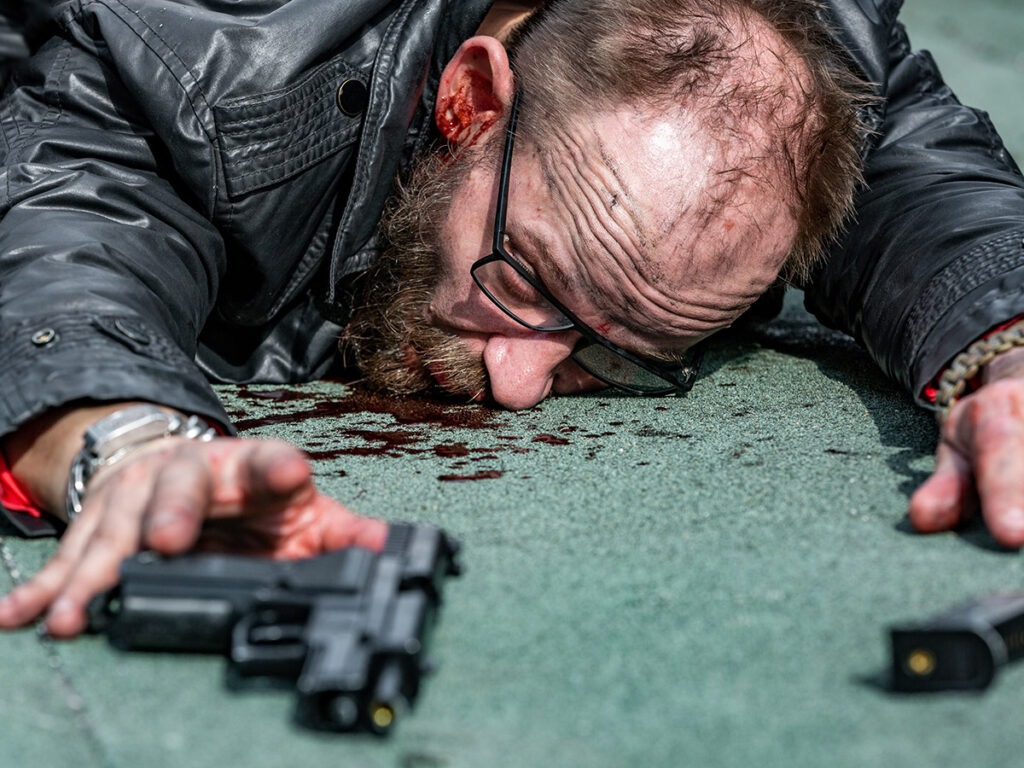
Thank you for this article. The graphic photos help illustrate the reality and severity of such an encounter. The worst case scenario is you dead on the floor of your own house in a pool of blood instead of the armed intruder.