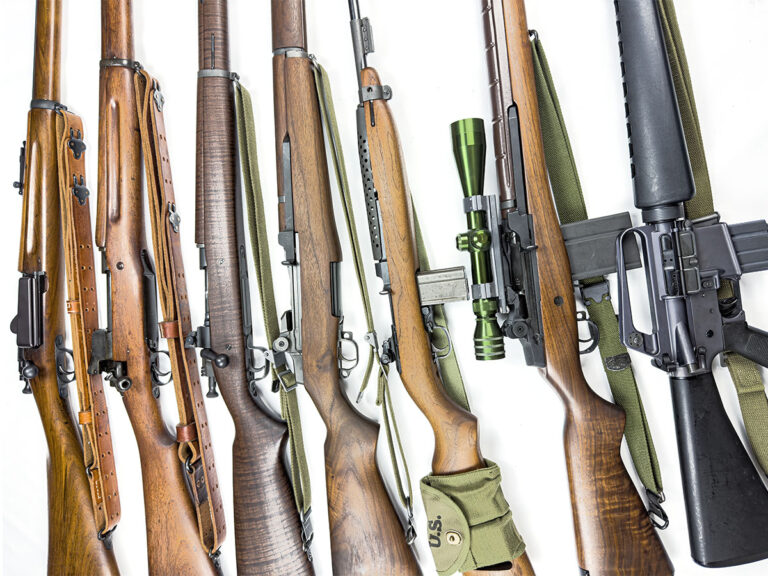
We take a look at some of the lesser-known service rifles that helped shape America’s first 250 years.
The history of our country is absolutely awash in firearms, to the point that it’s impossible to fit all of them into a single article. In lieu of a list that would make your eyes glaze over, I look at a selection of rifles that are significant to our country in terms of the small arms theory of the time and the cartridges that they fired in our mutual defense.
Again, while this list is not comprehensive, every one of the rifles in this article is currently supported by modern companies, whether it be complete rifles or parts to get yours up and running again (such as barrels and stocks). Keeping our history alive not only honors our country, but it can be pretty fun as well.
Spanish-American War
The Krag and .30-40 Cartridge
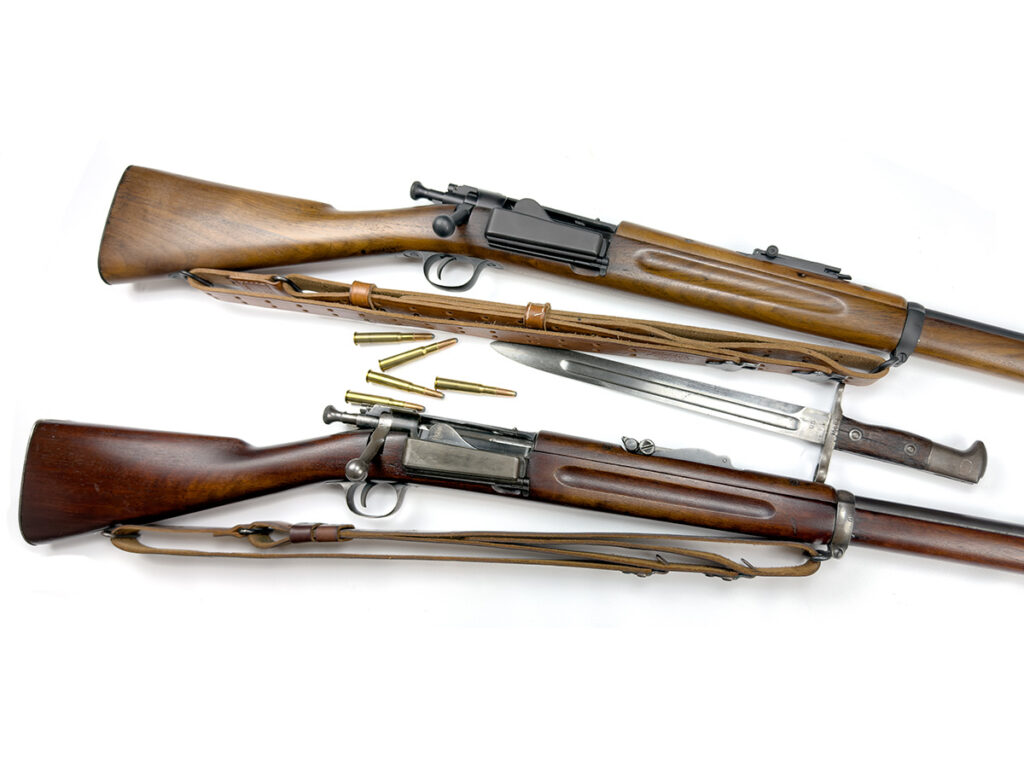
The Spanish-American War was one of those conflicts that exists in the American mind almost as modern mythology. Of course, there has been a lot of tall tales and obvious propaganda in every war, but the flavor of the Spanish-American War was a bit different on our palate. It has a central character of Theodore Roosevelt, one of the most famous Americans of all time. It has the cavalier, almost boyish aesthetic that has permeated most of the media surrounding it—and not just in our day. This war represented American adventurism, sacrifice not just in the name of duty, but through the need for a young nation to display its strength. It was a war that recruited Ivy League students and frontier cowboys alike, a real cross-section of American grit.
During this pivotal phase of American development, the standard service rifle was the Krag-Jorgensen chambered in the .30-40 cartridge. While there were a number of variants of this rifle, the most famous are the later variations, such as the 1898 featured here. The Krag represented an interesting, but somewhat obsolete, way of thinking … even when it was officially adopted.
Most of the world militaries at the time were using clip-loading designs, such as the Mauser and Mosin—firing fast, aerodynamic bullets at what is now considered normal velocities. The American government, however, has seemingly always had a problem being stuck in the past, and the Krag represented what would’ve been an excellent development in the decades prior to its adoption. The .30–40 cartridge fired an obsolete round-nose bullet at around 2,000 fps, and in addition it could only be loaded by single rounds through a side gate, not a stripper clip.
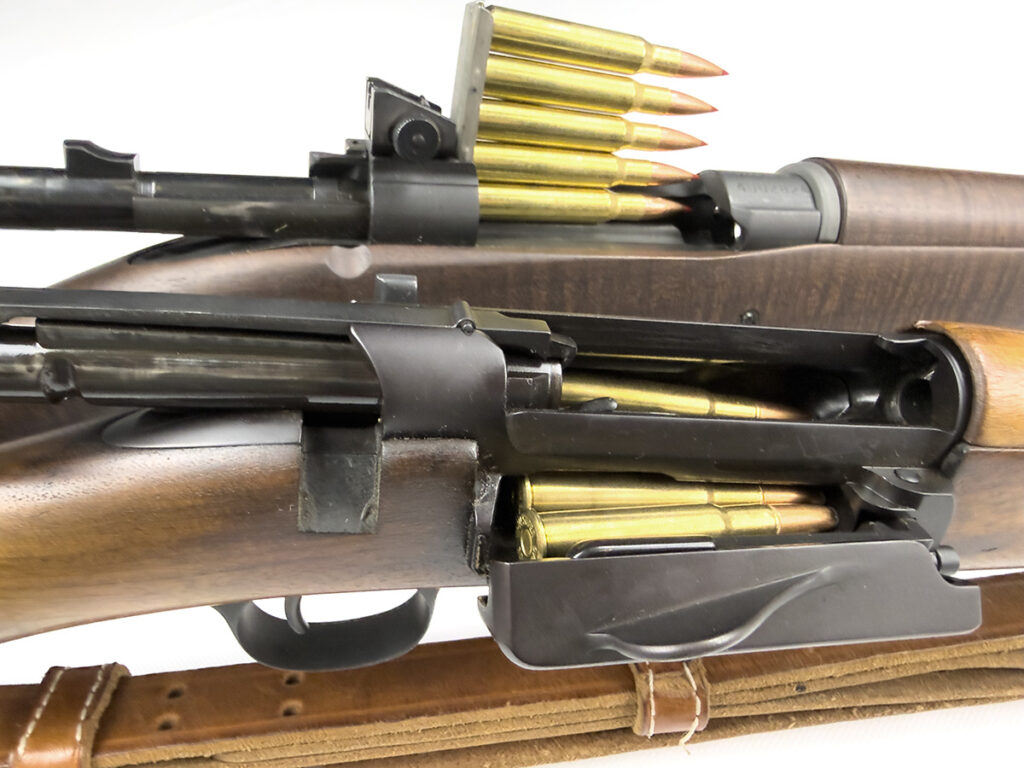
While the rifles themselves could not necessarily be faulted, the Americans went up against the Spanish 7mm Mauser, and this encounter ended with a glaring technology gap. Remarkably, even when the Americans developed their own Mauser rifle, the M1903 Springfield, it was originally made for the .30-03 cartridge (.30-45), another round-nose load that was ballistically inferior to European cartridges.
However, the Krag has gained quite a legacy in the past 130 years. It’s a rifle well-known for reliability and accuracy. My own original example was made in 1901 and still produces 1-inch groups at 100m with Hornady factory 180-grain loads. The rifle is still supported by a number of small companies that make new stocks. Should you need a full replacement, Criterion makes brand-new barrels for both the carbine and full-size service rifle. My CMP-restored Krag has a Criterion barrel and is incredibly accurate, easily sub-MOA at most ranges.
Lastly, there is hardly an action made as smooth. You probably heard it before, but there really is nothing that cycles as smooth as a Krag.
World War I
The M1917 and the .30-06 Government
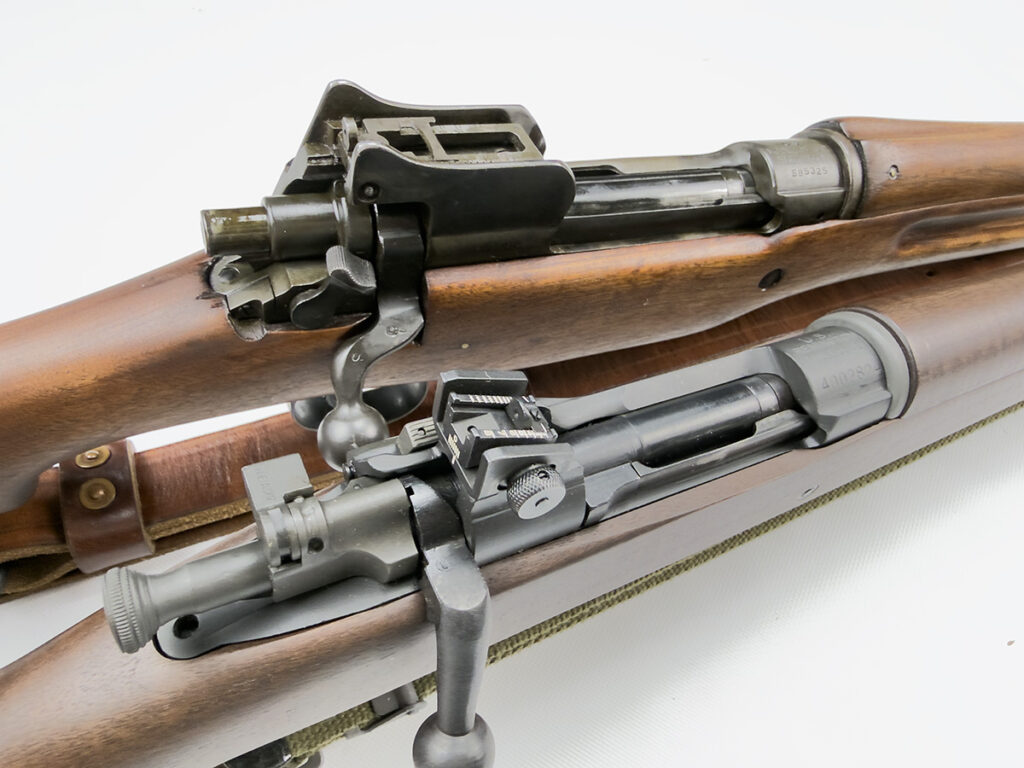
I know what you’re thinking: Don’t worry, we will get to the Springfield in just a moment, but I wanted to address a rifle that did a lot of work for this country and doesn’t get very much recognition. I’m of course talking about the M1917, sometimes called the Eddystone or P17—and they’re all pretty much correct, depending on who you ask. This rifle represents a global pattern of thinking that happens when confronted with the mechanical superiority of the Mauser rifle.
American forces, of course, adopted the M1903, a Mauser, after facing the Spanish, and the British went up against the Mauser during the Boer Wars in Africa. After these experiences, the British designed their own Mauser, called the Pattern 13, in a special .276 cartridge, but this was ultimately scrapped for the standard .303 British in the P14 version, and eventually dumped all together as WWI kicked off, leaving the British with the classic Enfield.
To make a much longer story short, wartime pressure forced the British to have rifles made in America, and when the U.S. was about to enter the war, there were simply not enough M1903 Springfields made to fill demand. So, the P17, chambered for .30-06, was developed and put into mass production.
This rifle was made in large numbers at a variety of factories, with the most notable being Eddystone, a subset of Remington. It’s very common to find these rifles with the name “Eddystone” embossed on the receiver, which has led people to believe that Eddystone is the official model name. American forces in Europe would, in point of fact, be primarily armed with the M1917. Although a rifle that served with distinction, it seems to have become something of a footnote, as its use as a military rifle was overshadowed by virtually every other model out there.
It did earn its stripes on the civilian side, however, where it became one of the most popular hunting rifles of the immediate postwar era thanks to a large number of them being released as surplus.
The rifle would continue to go on to serve in WWII, but again in a capacity that’s largely forgotten. They were part of a lease program with the British and Canadians but phased out of service by the Korean War.
Today, much like the Krag, there are companies that continue to make replica stocks for the rifle, as well as new barrels. Again, Criterion makes a military-spec replacement barrel that has an excellent reputation. The example you see in this article is all original, but I have shot with these new barrels, and they are very good.
The .30 Government, aka .30-06, began coming into its own during this time. It was in its day, and continues to be, a prolific cartridge. It could be argued that it’s the progenitor of most of our small arms theory today. The cartridge is very long serving, and it would play a role in both World Wars, dozens of worldwide conflicts, the Korean War and into the Vietnam era. It’s still considered to be one of the best cartridges ever designed and, in my opinion, is truly one of the great American cartridges.
World War II
The M1 Carbine and M1903A3
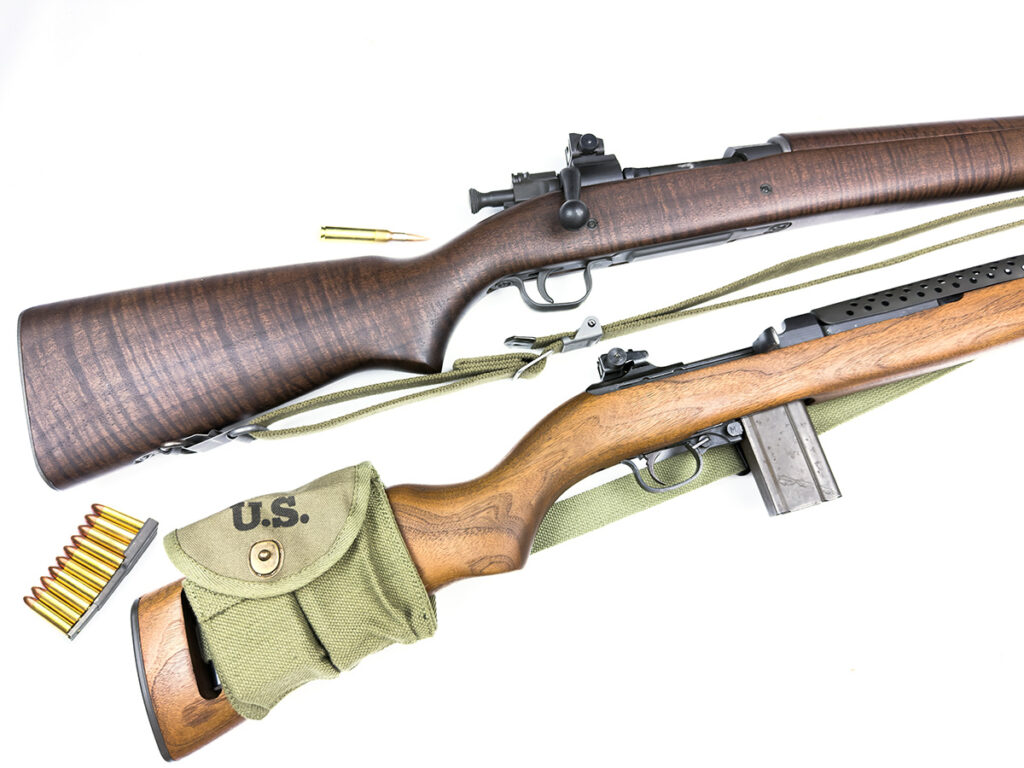
The Second World War would see some interesting development in American rifles. The M1903 A3 was one of those, and it represented something very interesting in terms of small arms manufacturing. A number of the parts on the rifle were simply just stamped, a departure from the loving machining and perfect fit of years past commonly seen on its predecessor. The A3 was not a crude rifle, but rather a distilled and simplified version of an established design that lost nothing as far as accuracy and ruggedness. It demonstrated a type of thinking that embodied the times, a mass-produced rifle that was still capable of target-grade accuracy, a functional minimalism that was results-driven and offered a high degree of performance at minimal cost and time.
One of the most iconic weapons of the WWII era was the M1 carbine, a handy little rifle that fired its own unique cartridge, the .30 Carbine. There were a number of models of this rifle that saw service, but the common characteristic was their light overall weight and a high magazine capacity for the time. This little rifle would become a darling of Americans everywhere, it had a lively life during and after the war, and it continues to be a very popular gun among collectors and shooters. Eventually, it would be found across the globe, in the hands of everyone from communist revolutionaries to local police forces.
These two rifles are still very popular in the shooting sports, in particular CMP matches. Today, the A3 is widely supported, and complete reclaimed rifles are available through the CMP. Barrels can be had again through Criterion, and stocks are available from a number of sources. There is also a wide number of surplus parts available in like-new condition.
Common modifications of the rifle include different calibers, such as .308/7.62 NATO. The M1 Carbine is also widely available in the form of both original rifles and brand-new replicas. Variations of the gun were manufactured consistently since WWII, with many commercial guns being available for a good price as compared to collectible originals. There is a plethora of accessories available as well, and ammunition is relatively common and fairly inexpensive. Fulton Armory produces a number of these guns, and you can have them built on a custom basis to include threaded barrels, scout, configurations and more.
Korean War
The M1 Garand and Evolution of the 7.62 Nato
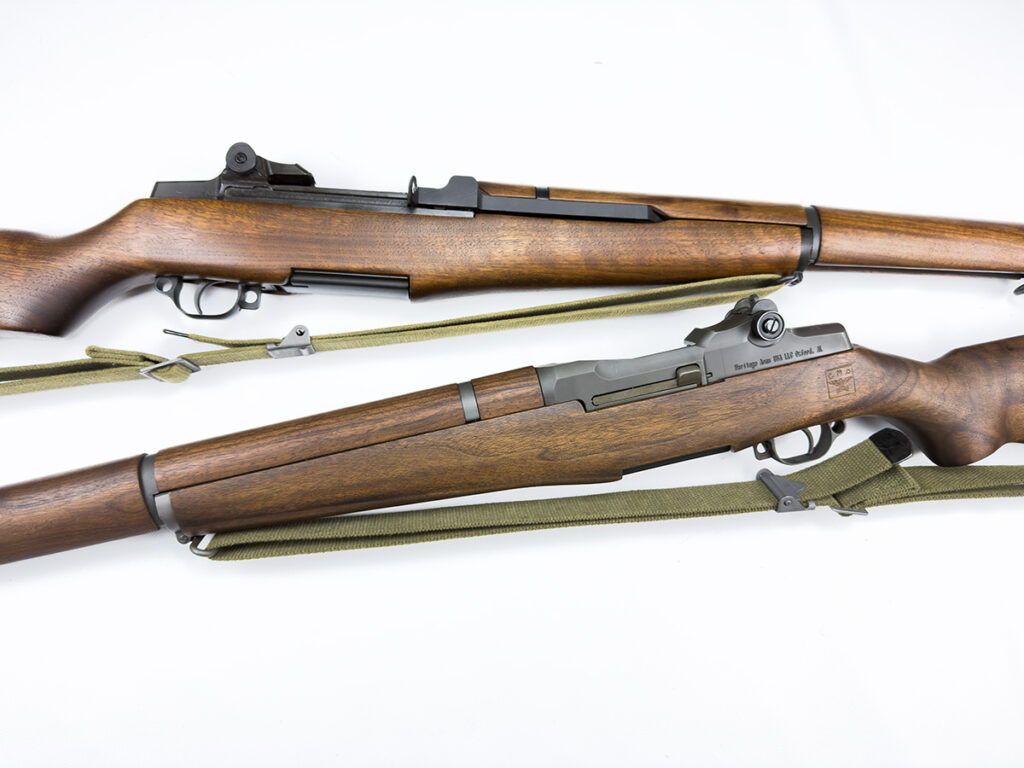
You’re probably wondering why I didn’t include the venerable M1 Garand in the WWII section, but I wanted to use it to spotlight the Korean War and the people who served in it. The Korean War is something of a forgotten war. It happened in close proximity to WWII and was very brutal. It was also fought with most of the standard small arms that were used during WWII, making it a little bit less distinctive in terms of the media used to portray it.
The M1 rifle was the primary service arm used by American forces during this conflict, and the conditions it was used in proved to be just as bad, if not worse, than in Europe. The combat in Korea varied greatly from in Europe, with American forces facing down communist enemies over a long distance, as well as during human wave attacks. The M1, already somewhat obsolete in terms of design, still performed very admirably in this conflict where it was also used as a sniper rifle in the form of the M1D. The lessons learned in Korea really began to push the modernization program that eventually led to the 7.62 NATO and M14 rifle.
The development of the 7.62 was a foundational element of combat, hunting and target shooting in the years that followed. Effectively taking the majority of the power of the .30-06, making it smaller and full-auto capable, the cartridge proved to be quite a great performer, even if the M14 struggled during its early development. This would become something of a trend as small arms development continued into the era of proxy warfare against the Soviet Bloc and communist countries, where the diversity of landscapes and terrain resulted in small arms being used at a disadvantage in one biome while being highly advantageous in others.
Effectively, the intersection of cartridges and rifles was changing, and the M1 and .30-06 held on for quite a long time until the M14 and 7.62 NATO took over. While many were sad to see it go, the M1 never really lost relevance in the American public mind, and it has always remained a highly prized possession.
There remains a wide support for the rifle today. Companies like Fulton Armory offer complete rebuild packages, which allow for a number of custom features to your liking. The CMP has introduced a brand-new M1 rifle, and yours truly was privileged to be the first person to fire a complete, finished rifle at the 2025 National Matches. That rifle can be seen here in this article’s photography. The M1 has a number of accessories available, including a variety of types of barrels from Criterion and Faxon. It can be had in various calibers, barrel lengths and has the option to mount modern optics thanks to the efforts of a variety of small companies. The M1 is now and will forever remain one of the most iconic guns ever.
Vietnam War
The M21 Sniper Rifle, M16A1 and the 5.56 Nato
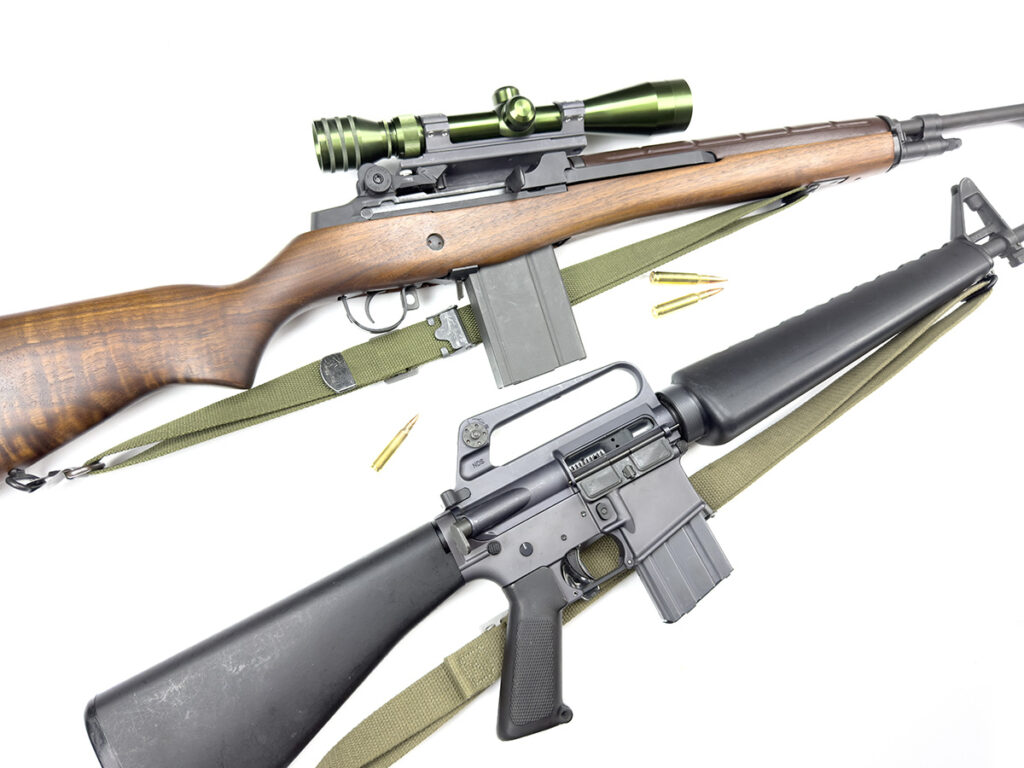
To close out our purview of classic American military rifles, we have the dawn of our modern age, which saw the introduction of the AR into our lexicon. Early on in Vietnam hostilities, American forces were using a mixed bag of weapons, including the M14 in 7.62 NATO. At the time, warfare in the jungle was not something the American military had a great deal of experiencing, especially not on a broad scale. The close-quarter fighting did not favor the large battle rifles that would have been a substantial advantage during the Korean War.
The M14 was arguably an ideal weapon for the frozen, long-distance fighting in Korea, but in Vietnam it was ungainly and too powerful to use effectively. Eventually, a novel design from ArmaLite was selected and put into mass production: the M16. This was a revolutionary rifle that represented a lot of space age thinking, and it fired a small war, high-velocity cartridge, the 5.56 NATO.
Like many American misadventures, the rifle ran into some substantial problems in the wet, humid environment of the jungle, and production problems only made that worse. Not only was the ammunition causing corrosion issues, but the rifles themselves were literally rotting in soldier’s hands due to what could only be said was manufacturing neglect. After some very serious teething problems, the M16 A1 remedied a good number of these problems and eventually became well respected as a combat rifle. Its legacy is likely in your safe right now—the AR platform we all know and love today is the direct descendant of the choices made on the M16 A1.
The story of the M14 in Vietnam was far from over. The rifle saw a good amount of use there, especially in rolls that played to its strength, such as a sniper rifle. The XM 21 program resulted in an accurate, lightweight and lethal sniper rifle that saw service throughout the war. The XM 21 became well respected and was famously used a number of times by well-known snipers throughout the war. While not technically designed from the ground up as a sniper rifle, it was easily on par and better than rifles being issued to communist forces, which at the time would have been WWII-era Mosin bolt-action rifles and the new-at-the-time Soviet SVD.
Today, the retro rifle trend has continued to grow, and a variety of companies make brand-new copies of the M16A1 and other early variants. Brownells, Fulton Armory, H&R and more make versions of the classic. The M14 and its commercial variants are also common, with Fulton, Bula, Springfield Armory and more making new models that you can transform into your chosen variation. This article features a replica Vietnam-era M14 Classic M21 mount from Heritage Optics and a new M40 optic from Hi-Lux. This combination is National Match legal for Vintage Sniper matches. A wide range of other accessories are available. Should you want to assemble a different-era M14, classic stocks are available from McMillan, and chassis systems such as the EBR are available from US Tactical Supply.
A Tribute to Those Who Served
Keeping these rifles in action is something that carries with it a lot of pride. I value these rifles far above any of my modern guns. The thing about them isn’t that they are magic swords or carry a perfect design pedigree; they are imperfect, just like this country is, but are always improving. These designs represent windows into the culture of a given era, the artifacts that exist on them speak to things that were considered important at the time. Magazine cutoffs on the early American bolt actions demonstrate a need to conserve ammunition, the military was often cash strapped.
The M1 Carbine represented a new era of mechanized combat; it was a chosen arm for people who had to get in and out of vehicles constantly as opposed to dismounting horseback. Yet it still maintained the sling setup used by cavalry for centuries. The M16 represented space age thinking, right down to the lines it was designed along, echoing the style of automobiles and rockets in the 1950s and the view toward a future in the stars.
These weapons are indicative of our culture. The materials used in them and the cartridges that they fired all represented something unique in their own era. I am very grateful to the people who have kept this alive as long as they have, and the companies that continue to devote valuable resources to keeping these old warhorses running.
Editor’s Note: This article originally appeared in the July 2026 issue of Gun Digest the Magazine.
More Historical Military Firearms
- The StG 44: Father Of The Modern Combat Rifle
- The Karabiner 98k: The Best Combat Bolt-Action Rifle Ever Made
- SKS: Collecting & Identifying The Simonov
- All About The Mosin Nagant
- The Gewehr 43: The Road To Germany’s Garand
- Fusil Automatique Leger: Everything You Want To Know About The FN FAL
- Lee Enfield: The Right Arm Of The Empire
- The Rise And Fall Of The AR-10
- The M1 Garand: America’s Original Battle Rifle