
It can be tough to hang up a favorite hunting rifle, but when laws requiring straight-wall cartridges go away, you might find yourself doing just that.
I have become increasingly sentimental about things, to the point that I worry it might be a terminal descent into nostalgia instead of a meaningful period of reflection on what I have thus far accomplished in life. It could be the kids growing up or my hometown having changed so much that it no longer feels like the place I knew.
And the changes keep coming.
Even good things, on occasion, have a touch of dread—signaling broader changes and the unknown. Michigan recently announced that the “straight-wall zone” was no more, and regular rifle cartridges could be used for hunting deer. While this isn’t interesting to many people, it struck a chord that an era of hunting, scouting and friendships had come to an end.
Using My Soapbox
A lot of people I speak to know I publish on these esteemed pages. With them, I’m usually referred to as Josh the Writer to separate me from the rather dense crowd of other men blessed with that name who populate my neck of the woods. More accurately, I should be called Josh the Bullsh*tter, because talking others to death in dive bars while taking a break from fishing is my true profession.
For years now, one of the most persistent points of conversation I have with the local fauna is the utter disdain for the straight-wall zone and the hyperbole of logic used by our masters in government to justify their position on the topic. I’ve had this conversation hundreds of times. Everyone hated straight-wall cases with a passion, and I’d been hearing for years that it might change one day. Among the arguments was that a hunter could use a 6.5 Creedmoor for coyote day and night year-round on private land, but it was too dangerous for the same rifle to be used in the same field on deer.
Being a motivated individual, I spoke to all kinds of DNR officers, including the chief of the whole shebang. And in going all the way to the top, I found that there was a surprising amount of dissident on what counted as “safe” and “sportsmanlike,” and where Johnny Law really stood.
Topics like using thermal drones to track came up, and somehow that is verboten. Straight-wall cases were just safer—trust us. There wasn’t much detailed thinking going on, and I even got an answer from a DNR source that coyote hunters were just safer hunters than deer hunters and could allegedly be trusted with bottlenecked cases. There was never any data to back this up.
I did end up going to Lansing, Michigan, and spoke to the panel directly. Even then, I was stonewalled with a lack of understanding, going so far as to say that there were new cartridges I knew about in development for the straight-wall zone that were effectively as powerful as the .458 Lott (I had to say “elephant gun” to make it understandable, and it wasn’t received as fact). My efforts to lobby this change started there, and I’ve been working an underground campaign ever since to encourage this change.
Then, it happened. I was talking to my hunting buddy while driving, and he shot me a text later saying that the straight-wall push was dead.
Many years ago on these pages, I made the claim that if the laws changed, it would kill the .450 Bushmaster entirely. I had spent years trying to change the law knowing it would kill the cartridge, and I felt a bit of remorse for a moment because it had become something of a cultural icon in the Midwest. Over time, I had come to like the cartridge—despite hating everything about it—and it brought into focus just how many of my traditions rotated around the limits of the round and how far I’d managed to push its abilities. In truth, I think it made me a better hunter.
My Years with the 450 Bushmaster
When Michigan followed other Midwestern states in allowing straight-walled cases in the shotgun deer hunting zone, it was big news. I suspect when the laws were written, they hadn’t fully appreciated the looming popularity of the .450, which at the time was a dying round that never really took off.
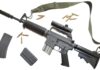
The initial appeal of the .450 was as a self-styled Jeff Cooper “Thumper” cartridge that prioritized mass over velocity and fit into an AR magazine. There is more to it, but the era that spawned the .450 saw a massive proliferation of other equally doomed AR cartridges that tried to take advantage of the system’s modularity. The .450 was always too much for the AR in my opinion, and I stand by that even now. The concept was flawed in general. Even in Cooper’s era, they were throwing things at the wall to see what would stick. This whole Thumper theme never really played out because the logic was just completely flawed to start, an intentionally handicapped cartridge and corresponding rifle isn’t worth the weight to carry it all in practicality.
Nevertheless, the .450 was legal when the .45-70 was not (case length was restricted to 1.8 inches), and it became the most popular hunting cartridge in the Midwest.
I was an immediate adopter of the .450, because I, at that time, had been hunting with borrowed shotguns and some of my muzzleloaders. I hated cleaning those things. So, when it became legal, I started taking deer with the .450 Bushmaster.
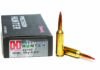
In the early days, there wasn’t much information on load data and even available loaded ammo. I did my early hunting with, and ironically ended up returning to, Hornady’s 250-grain FTX load. At first, I wasn’t satisfied with the performance at close range—“hand grenade” would be putting it lightly in some cases.
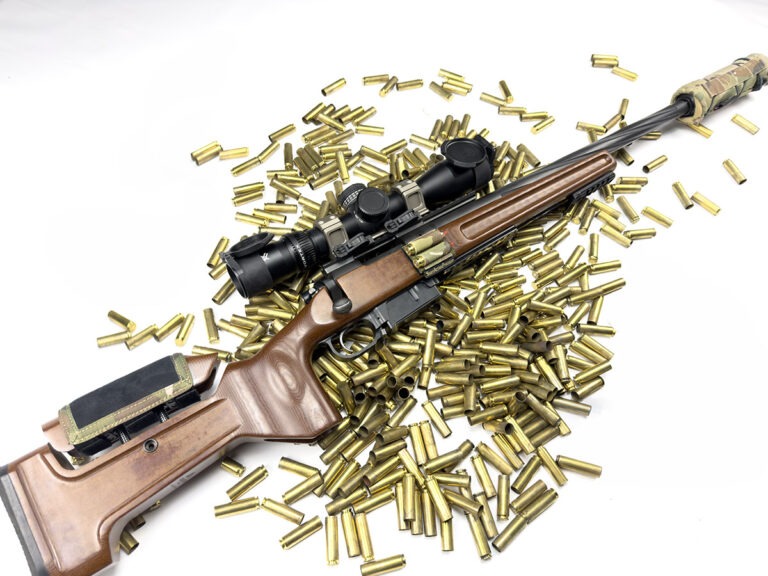
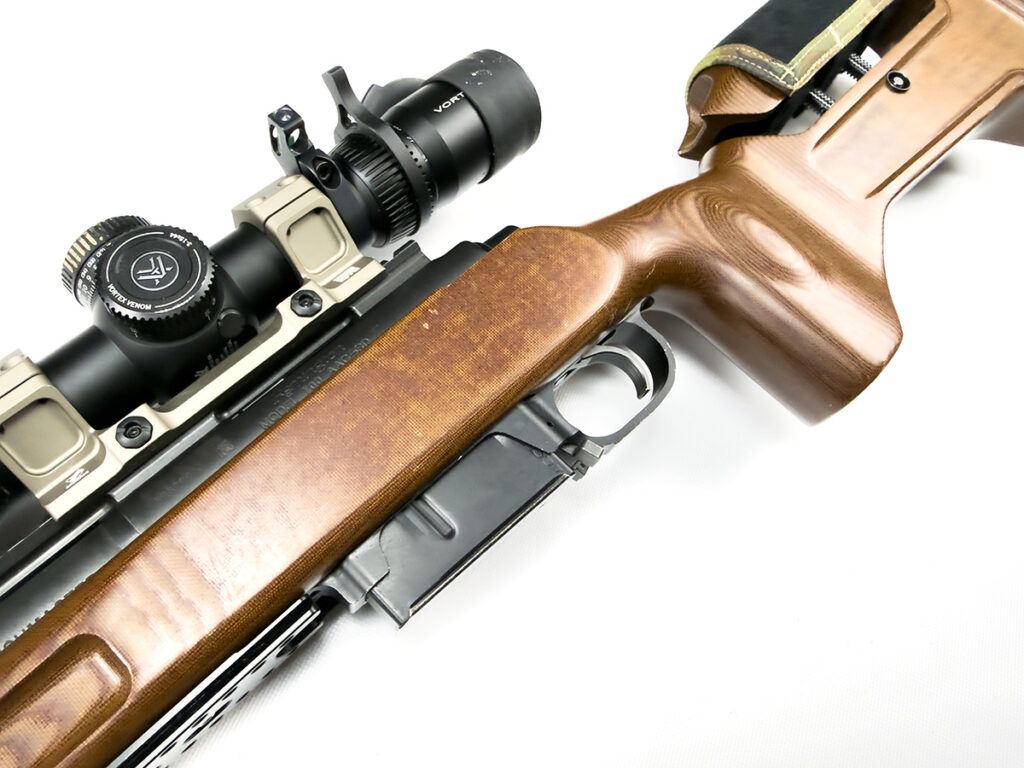
Things changed when I opted to have a dedicated Remington 700 built for the .450. It was able to use AICS mags and the standard .308 bolt face, so it was a matter of getting a new barrel screwed on. I had the action trued and had a pinned-and-welded 14.5-inch barrel installed. I went short for use in the brush, expecting close shots.
As it turned out, the .450 did have better range and accuracy than a slug or patched ball, so I began to introduce some target rifle features I was using for PRS.
My iterations of this rifle began to evolve with my skills. Over the years, I began to play with different optics and loads, eventually settling on a Sig 3-15x scope and a carbon-fiber stock. I began hunting at ranges of 150 yards with this setup, but it was still lacking. Namely, it was hard to use in wide open areas thanks to the inherent drop of the massive bullets … but also its lack of ability to be steadied reliably.
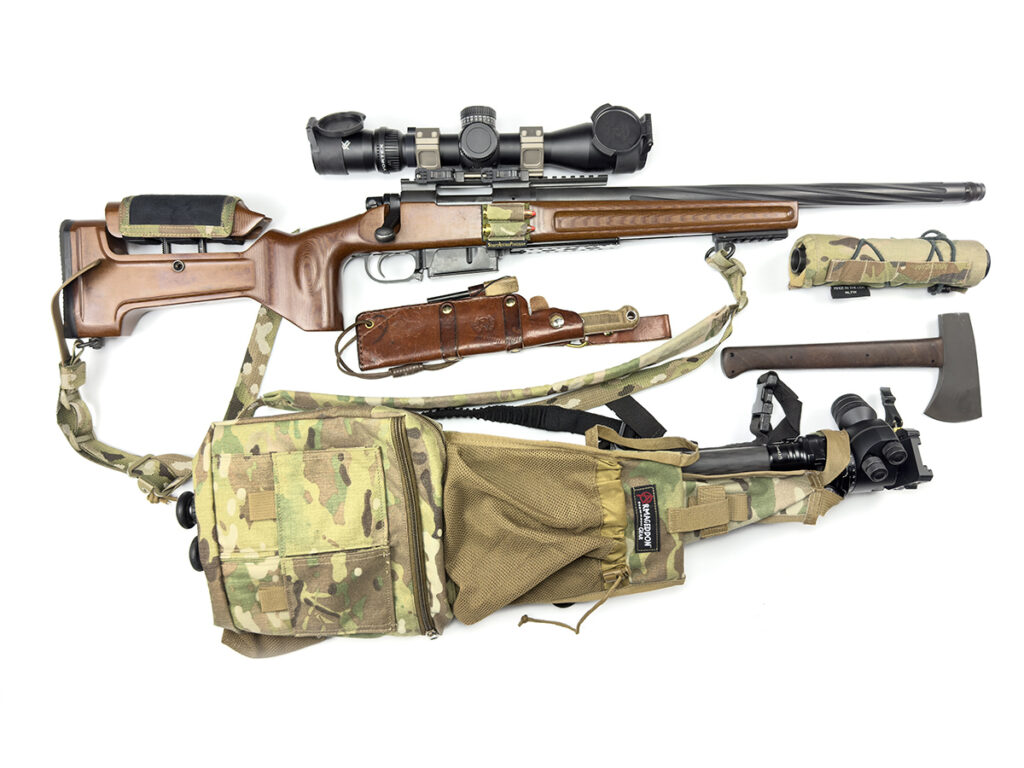
I started using tripods for match shooting and eventually found their field utility to be just what I needed for the open-ground hunting I was doing. The use of tripods really got me thinking strategically about the .450’s shortcomings, and I ended up honing my game to perfect the “corner shot,” where I would set up on the edge of a field corner using the angle to hide my presence while offering me a defined zone I could take advantage of my handicap: the dramatic bullet drop.
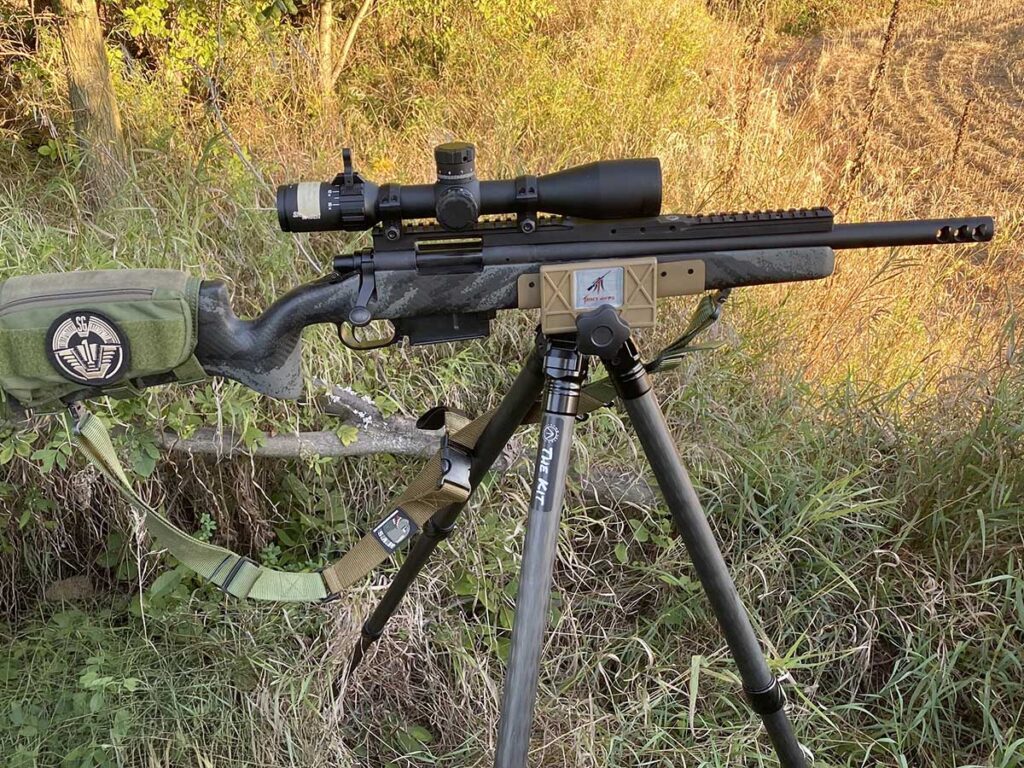
I would set up to use the corresponding tree line as a known distance with a predetermined 200M point being the start of the kill zone. Using this method, I could own everything in my sight. I eventually upgraded stocks and chassis several times, as well as optic setups. When I began using suppressors for hunting, I opted for a longer 20-inch barrel that performed better with supersonic loads but also made Hornady 395-grain SubX loads very, very quiet. The optics I used at the time, like the Leupold MK5, allowed speedy switch-ups between subsonic and supersonic zeroes, but I eventually abandoned using subsonics out of utility.
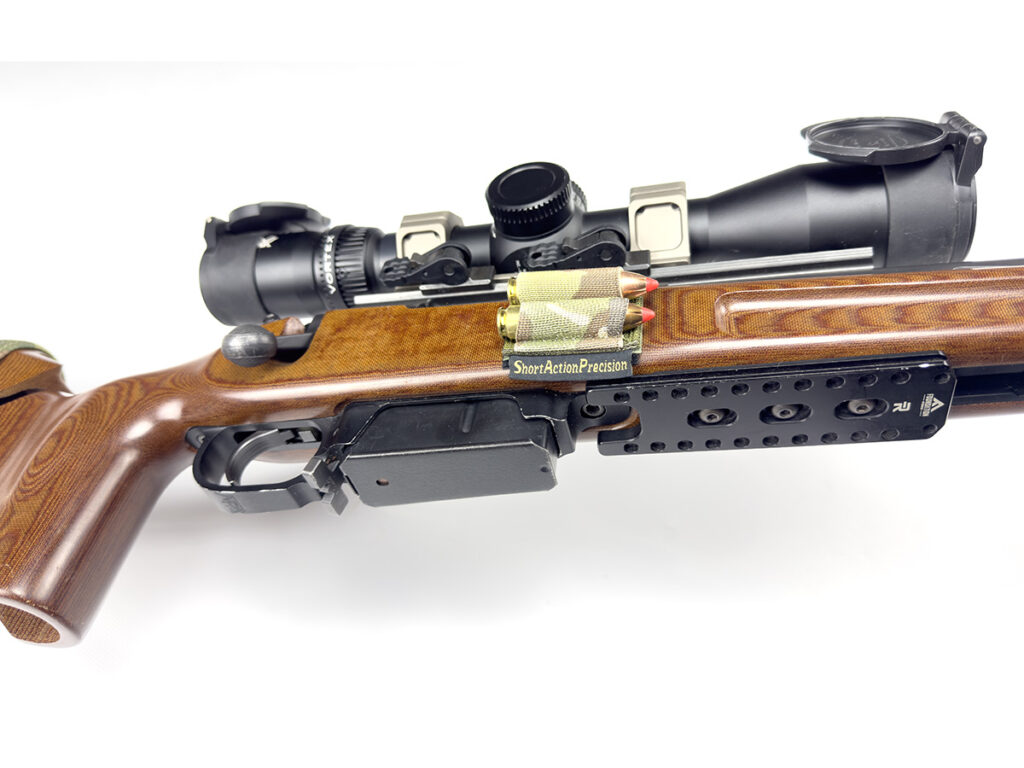
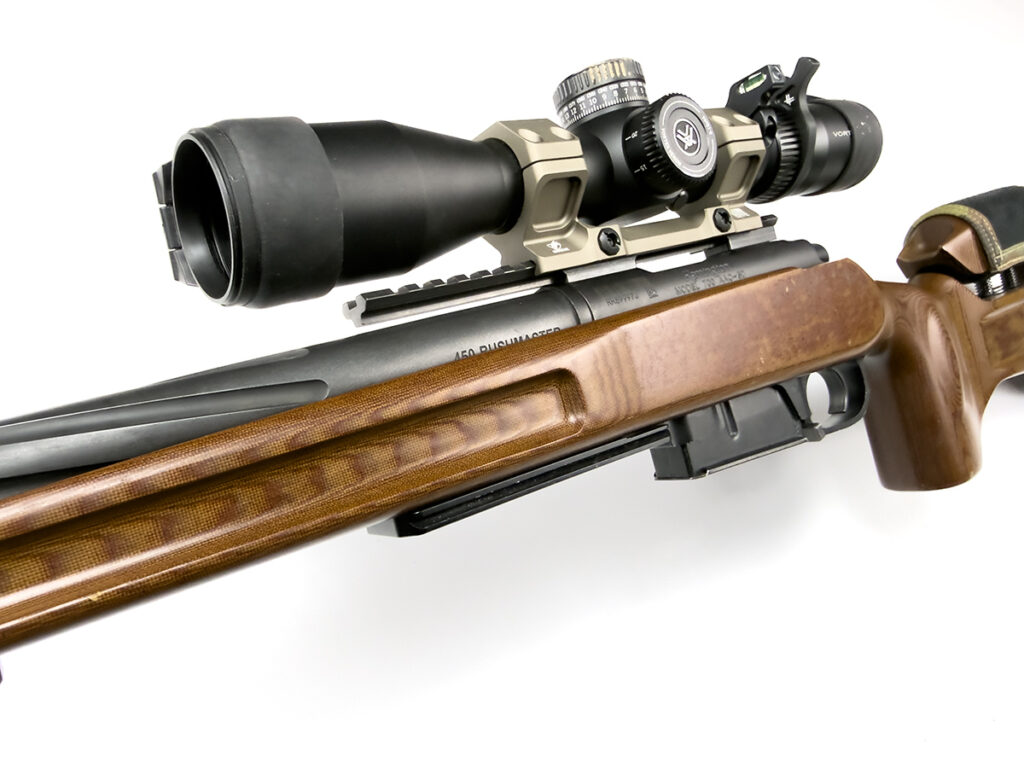
The rifle you see here in the studio photography is the “ultimate” expression of my hundreds of hours in the field taking lots of big game. The action and barrel are as described, the stock is from Foundation and is very comfortable for tripod use. This is a heavy rifle at 14 pounds, effectively a short-range PRS rifle. I have used both JK Armament and SilencerCo suppressors on this rifle, but my preference is for the lighter JK model.
The optics rail is an extended version from PRI, and it gives me more flexibility should I want to swap out the day optic for a thermal or red-dot, depending on where I’m hunting. The optic featured here is a Vortex Venom 3-15x44mm in MOA, which I have come to prefer over Mil reticles for the drop on .450. This rifle represents all my experience in the field and the type of hunting I was forced to do based on straight-wall regulations. In a way, being forced to use a rifle with a known and prominent handicap truly made me a better and more thoughtful hunter.
My Experiences with .450 Ammunition
The biggest problem with the .450 wasn’t just its poor trajectory and heavy recoil, but also the fact that its general existence was plagued by the AR-15 platform. If it was designed as a bolt-action cartridge, it would have likely been gifted with better bullets and flatter trajectory, but in this life we get what we get and the AR-length loads are what pretty much everyone understands about this ill-fated cartridge. The short overall length confounded the round by limiting it to stout bullet shapes that delivered disappointing trajectory and velocity stats.
The .450 isn’t particularly accurate—my average group at 200 meters being about 7 inches despite the 100M accuracy being within 2 inches. The bullets seem to disperse erratically as distance increases, making longer shooting much more difficult. Straight-wall cases, combined with big, heavy bullets moving at a modest pace, can’t generate the same kind of groups you expect from bottleneck cases. It’s not that the guns aren’t mechanically accurate, it is the combination of bullet, powder type and pressure as well as environmental factors like wind, which heavily impacts big, slow bullets.
As mentioned, I have killed piles of deer with this cartridge, I can tell you with absolute certainty that .450 bullets do wild things. I have had, in exact conditions and exact distance +/- 2 yards, three one-shot kills with the same point of aim using the Remington 260-grain load and had three different results. One was an exit wound the size of a grapefruit. Another was an ice pick hole clean exit. The last was a perfect expansion that stopped under the skin.
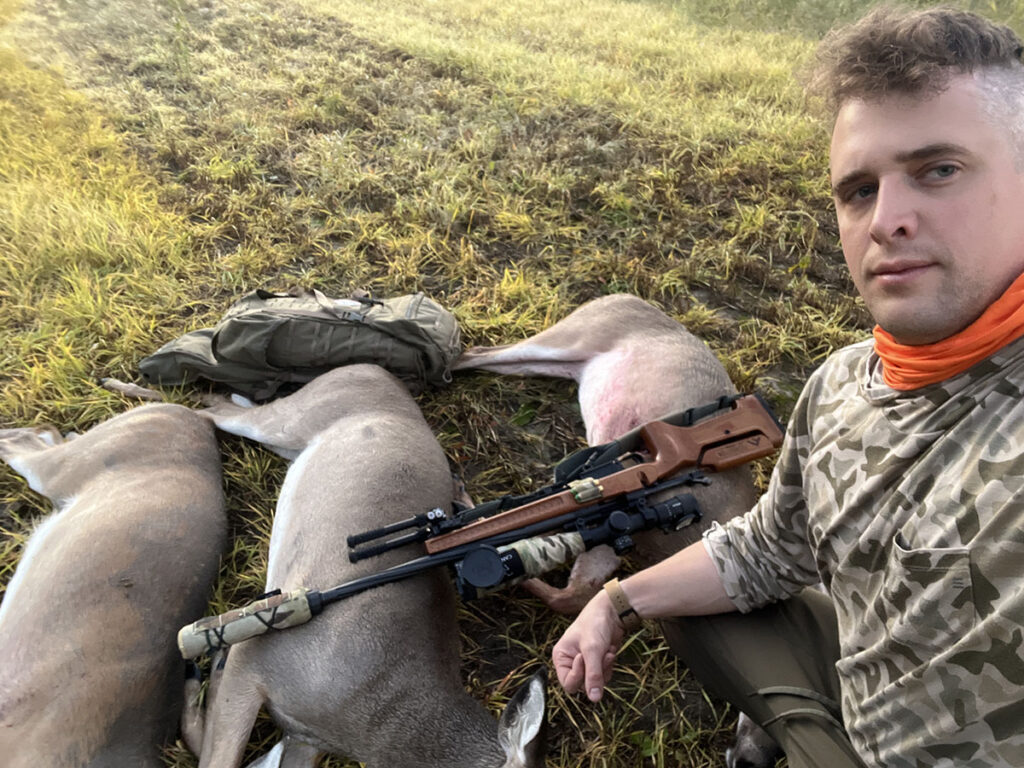
The solid 275-grain Barnes bullets I used for a few years delivered total penetration; I never recovered one. The Hornady bullets using the FTX tip have been sporadic at best on game, with some shattering on shoulder bones and others delivering perfect mushrooms. These bullets tend to shed their jackets more easily than others, but unlike some of the other monolithic or thick-jacketed bullets, they are the most accurate at distance across the board.
The Closing Chapter
As Michigan goes, so goes the Midwest, and the .450 Bushmaster is unlikely to survive as a commercial cartridge with the change of the winds here. I give it a few years before there are only a few rifles available. The .450 was never the round we wanted. I wrote years ago that I’d drop it the second that law changed, and it seems that I’m far from the only one. Everyone I talk to is planning to bust out Grandpa’s .30-30, the old Springfield 1903, or even the Savage 99. Laws made it that we couldn’t use guns that made sense, so we had to make sense of what we could use.
Closing the door on old friendships has a funny way of showing you your own effort to keep things going, and sometimes it’s best to leave well enough alone as opposed to beating a dead horse. I don’t think my efforts to create the perfect rifle for Michigan hunting worked, and now I’ll never know what that could have been if I kept trying.
So long, old friend.
Editor’s Note: This article originally appeared in the September 2026 issue of Gun Digest the Magazine.
More On Rifle Ammo
- A Closer Look At Hornady’s .22 ARC
- .45-70 Ammo Buyer’s Guide: The Good Kind Of Big Gov’t
- Holland’s Super 30: .300 H&H Magnum
- .22LR Ammo Top Hunting Loads Tested
- .22 Nosler Overview: Ballistics & Beyond
- Is .220 Swift Still The Reigning Speed King?
- Four Great .223 Remington Loads

Next Step: Get your FREE Printable Target Pack
Enhance your shooting precision with our 62 MOA Targets, perfect for rifles and handguns. Crafted in collaboration with Storm Tactical for accuracy and versatility.
Subscribe to the Gun Digest email newsletter and get your downloadable target pack sent straight to your inbox. Stay updated with the latest firearms info in the industry.


I’ll have to stick with my custom Savage 99 in .41 Great Lakes caliber for my Michigan deer hunting. Yes it is a straight wall cartridge but it also groups under an inch at 100 yards and has the power to take deer in excess of 400 yards cleanly. The recoil is considerably less than the 450 also.