
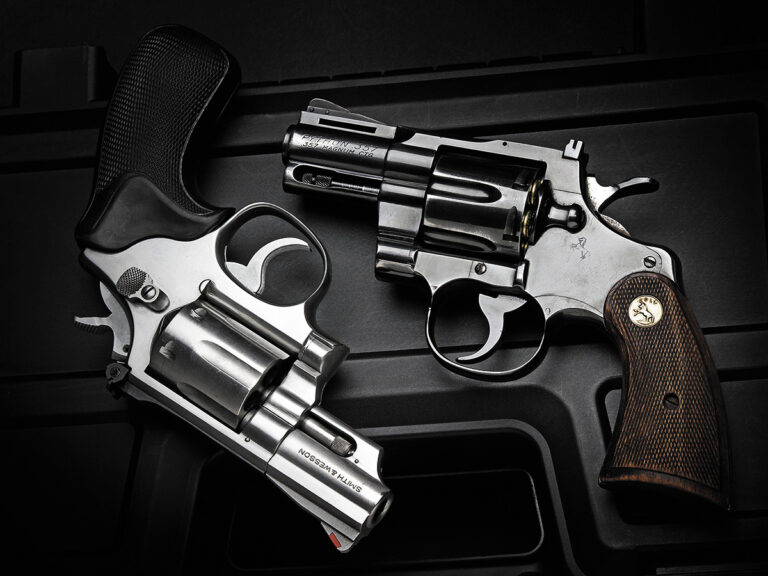
We address some of the downsides, and upsides, of carrying a revolver for self-defense.
The Western lawman. Cop movies set in the 1970s and ’80s. Detective pulp novels with dames and private investigators. Wyatt Earp. Roger Murtaugh getting too old for this sh*t. All these share two common traits: unironic mustaches and deadly wheel guns. But there’s more to the revolver than history, pop culture, and a throwback to ancient days.
There are people in the gun world who wonder why this far into the 21st century anyone would choose a revolver over a modern semi-auto pistol. Well, we’re glad you asked. We’re reminded of the late Pat Rogers and his old axiom: “The mission drives the gear train.” In short, for some people, and some situations, the revolver can be the dreaded “just as good as,” or an even better.
While it is true that the modern military-grade semi-auto service pistol has replaced the revolver for hard use in defensive carry, police and military service, this in no way means the revolver isn’t a capable handgun for defensive and sport use.
To start, let’s address what’s often perceived as an issue when revolvers are considered for defensive carry use: the deadly duo of low ammunition capacity and slow reload speed.
Ammunition Capacity
This is actually a non-issue for the concealed carry paradigm. We can learn quite a bit by examining what has happened in real-world incidents. To borrow a line from Tom Givens, when speaking of experiences from his students who’ve actually been in defensive shootings: “three shots in 3 seconds at 3 feet” is still what a typical defensive shooting looks like.
It’s here that it’s worthy to note Givens is also famous for saying, “The primary cause of needing to reload is missing.”
To pursue this idea further, we draw on the research of friend and mentor Keith Jones. Jones is a Vietnam combat vet, nearly 40-year police officer, multiple gunfight winner, very competent researcher and gun guy. Back in the days when coppers only carried revolvers, Jones looked at the experiences of the officers in his area. He found that in 199 incidents, from 1970 through 1988, there was only one (!) instance where the officer had to reload to prevail in the fight.
Everything else was settled with the five or six rounds available in the wheel gun.
The patrol officer shootout is often a very different fight than we see in the concealed carry/defensive pistol realm; suspects fight more aggressively to avoid arrest, multiple suspects are more likely to be involved, and there’s a duty to pursue. Yet in these 199 incidents, the revolver clearly had enough capacity to get the job done.
Claude Werner, a gifted instructor, noted researcher and generally the smartest guy in the room tells us the average number of shots fired in the defensive gunfight is 1.43.
Reliability
An underappreciated advantage of the revolver is the rate of malfunctions that occur in real-world fights. Although the military-grade semi-auto service pistol is clearly more tolerant of abuse and hard service than the revolver, all semi-auto pistols are subject to malfunction when the shooter uses a weak grip, is floating the gun one-handed, if the ammunition is underpowered and if the pistol is poorly lubed and/or full of dust bunnies.
While the “six for sure” mantra of revolver proponents is a myth, it’s a fact the revolver is vastly more tolerant of a poor grip and garbage ammunition.
Even though yours truly started in the defensive handgun world in the days when cops carried by-God-steel-framed-revolvers and leather gear, uses for the wheel gun nowadays include backup gun/lightweight carry gun, hunting/“kit gun,” general fun shooting and training gun.
Being an old cop, using the snubby as a backup gun was a natural thing. Over the years we have tried several semi-auto backup guns but have repeatedly come back to the snub due to some very concrete advantages that this platform gives versus the semi-auto pistol.
An airweight snub, such as an S&W 642 or a Ruger LCR, generally carries on an ankle or in a pocket better than any semi-auto pistol. It also draws more cleanly and consistently when pushing speed. The snub can be reliably fired with hard muzzle contact, clothing interference or even through a pocket. The shape of a snubby often makes it conceal better than a similarly sized semi-auto, and this shape also makes it easier to get a shooting grip on the gun when carried in deep concealment.
In extensive testing, shooting and training with various pocket pistols over the years, not one can equal the reliability of an S&W or Ruger snub. The perceived advantages of higher capacity and faster reload speed are siren songs, but the .38 snub still wins the reliability game—along with the aforementioned cleaner draw and speed to a first-shot hit.
Accuracy
It’s boringly common to find service-grade revolvers in .38 Special and .357 Magnum capable of 1- to 1½-inch groups off of a rest at the 25-yard line. The same cannot be said of service pistols. Groups as small as 6 inches at 100 yards with a 4- or 6-inch .357 Magnum revolver, fired in single action, from a rollover prone isn’t terribly difficult.
This level of accuracy starts to shade into carbine territory. For this reason, the midsized .357 Magnum revolver, such as an old Ruger Security Six or S&W model 66 or 681, can easily be a “go to the woods” gun.
Ease Of Training
An advantage of the double-action revolver over many of the modern striker-fired pistols so popular now is the revolver is easier to use for dry-fire practice and for “ball and dummy” training at the range.
The DA revolver can be dry-fired repeatedly without the need to reset the trigger, and when used in specific drills, the ball and dummy exercise can be done without the need to buy or load dummy rounds into the gun. Dry practice is typically underappreciated as a skill builder, but it’s critical to the development of trigger control. Trigger control is the toughest pistol skill to learn, and the most easily perishable when neglected.
The revolver has a simpler manual of arms and it’s impossible to “forget” that one has a round in the chamber after the magazine is removed, which can be a real advantage to the novice shooter.
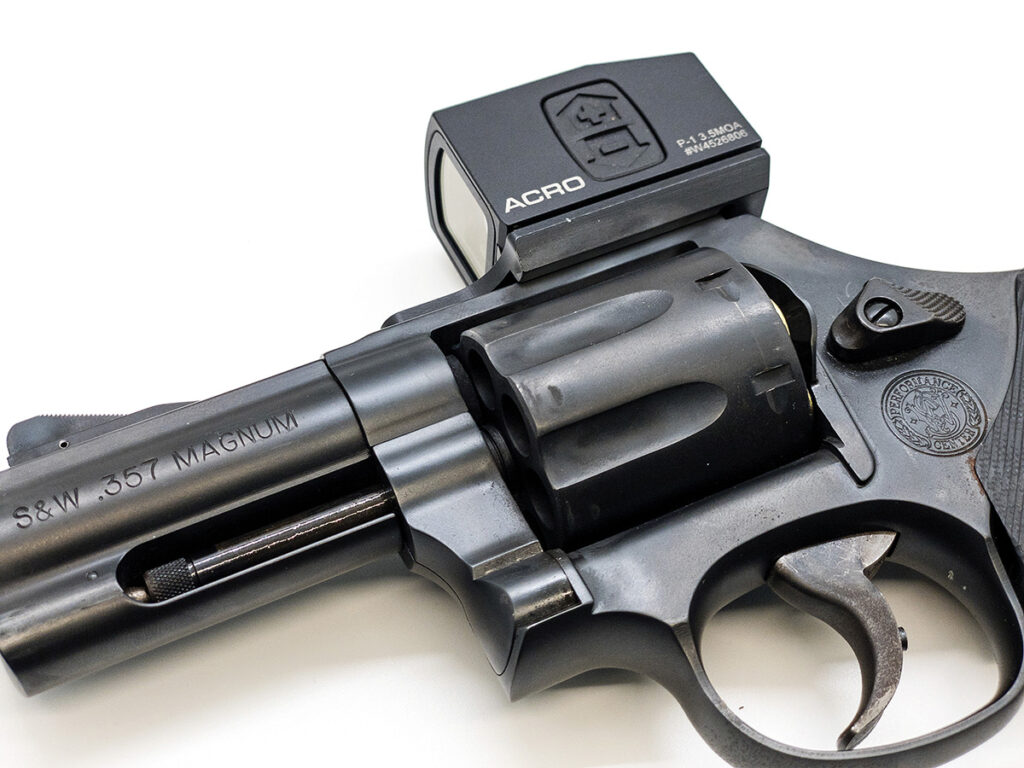
While the snubby as a defensive firearm is often thought of as an “expert’s gun,” that idiom hasn’t panned with either officers or students.
Here’s a recent personal example: A gentleman decided he wanted to buy a defensive firearm but had no idea where to start. At the range he was able to handle and fire several semi-auto pistols and revolvers. He preferred the simplicity of the revolver and eventually bought a Ruger LCR in .38 Special. In follow-up sessions at the range, he went from having never fired a gun in his life to being able to keep 100 percent of his shots in the “down 0” zone of an IDPA target out to 10 yards.
He achieved this level of marksmanship in less than 100 rounds fired in conjunction with approximately four hours of practice.
Versatility
Revolvers still maintain a significant edge over semi-auto pistols for large game hunting or large animal defense. While big-assed semi-auto pistols such as the Desert Eagle exist, they’re far from being handy, easy to carry or quick into action. They look cool in movies though. Service-sized pistols such as the Glock 20 in 10mm simply pale in available power level when compared to even middle-of-the-road loadings for the .44 Magnum. Said .44 Mag is itself easily outclassed by things like a heavy-loaded .45 Colt, .454 Casull, and more. While you can hot rod a semi-auto, it can also bring its own issues such as stoppages due to excessive slide velocity.
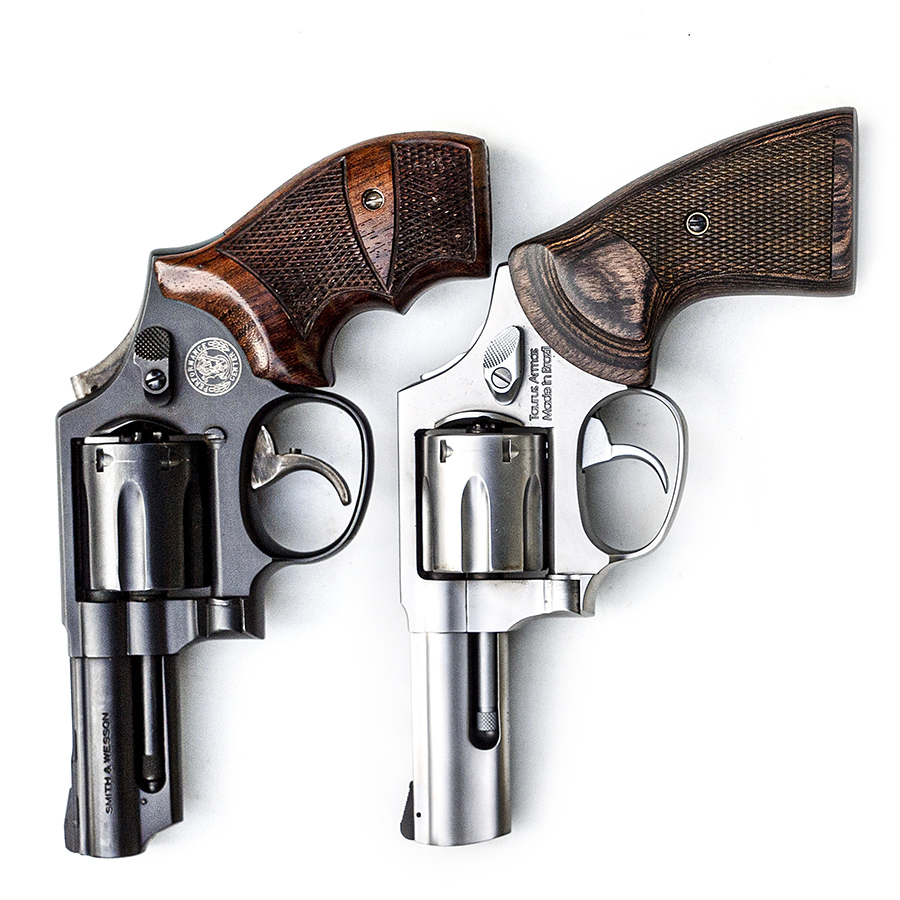
A 4-inch .357 Mag has the ability to safely fire any .38 Special or .357 Magnum ammunition that will chamber in the gun. This includes defensive carry with JHPs, snake and rodent whacking with shot loads, plinking and small game with wadcutters, predator control with lightweight hollow points, deer hunting with heavier versions of the same and bear protection with high-penetration ammo.
For just plain fun that translates well to serious purposes, it’s hard to beat live fire with a good .22 revolver. For this reason, some favorite handguns are .22 wheel guns. Though we’d be hard pressed to pick a favorite, the Ruger LCR in .22 LR and the S&W 317 and 43c are currently seeing the most use for training and plinking. Each of these guns displays a high level of accuracy, with near zero recoil. Each is capable of reliably firing .22 CB, short, long, and long rifle ammunition, in either standard or high velocity loadings—not possible with a semi-auto pistol.
But What About Reload Speed?
To address the persistent issue of the worry about the need to reload in a defensive shooting scenario, note that revolver science has been well developed over the past 100-plus years.
For the snubs, ensure the chamber edges are chamfered or otherwise smoothed to avoid catching the bullets during the reload. This simple step in prepping the defensive revolver for carry is similar to making sure your semi-auto pistol has a flared magwell or mag funnel for speed reloading. In the revolver, it pays off in dividends.
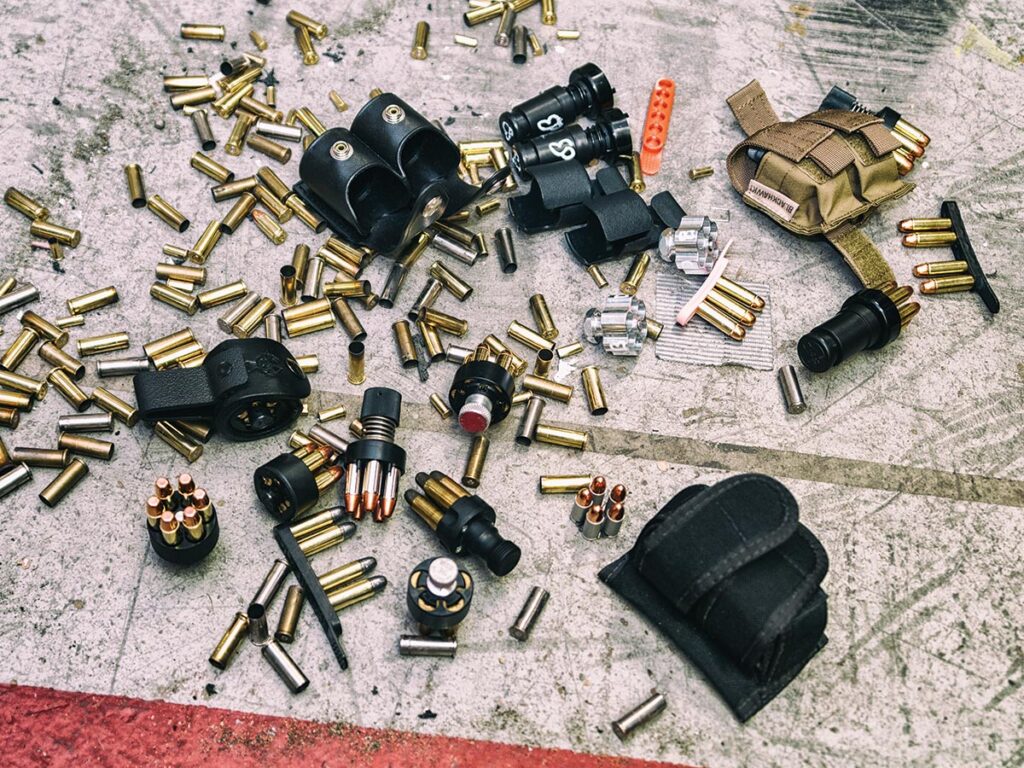
For concealed carry, a Bianchi Speed Strip makes for a small package. Instead of completely filling these up, having four rounds instead of five or six significantly reduces your time to target. Getting that last round or two in the cylinder takes more time than the previous four. It may sound strange but do it on the shot clock for yourself.
If you can get away with a larger footprint, Jetloaders or Safariland Comp speedloaders can give you a reload of under 5 seconds with practice. USPSA reload speed this isn’t, but it’s certainly better than fumbling with loose rounds.
There’s also an old-school copper skill of reloading two with eyes down range, in case you need to close the cylinder and engage an aggressive bad guy (a hard won lesson from the Newhall fight …).
Carry The Damn Thing
It’s no small comfort that research has yet to find a case where a police officer was able to access a backup gun and didn’t survive the fight. The lesson here for cops is this: Carry a backup gun and quit worrying about things like magazine or ammo interchangeability with your primary pistol.
This same lesson translates to the concealed-carry world. “What gun?” and “How many rounds on board?” are vastly secondary to the ability of the carrier to have the gun with them at all times. And the ability to draw quickly from concealment. And place one to three effective hits on target at a car length or less.
If you can’t find an instructor who can teach you these skills, seek out a crusty old cop; he’ll know what to do.
Editor’s Note: This article originally appeared in the March 2026 issue of Gun Digest the Magazine.
More On Defensive Revolvers
- .357 Magnum Revolver: Controllable Concealed Carry Options
- Best Concealed Carry Revolvers For Personal Defense
- Fighting Revolver Project: Smith & Wesson Model 586
- Rolling With A .45 ACP Revolver
Next Step: Get your FREE Printable Target Pack
Enhance your shooting precision with our 62 MOA Targets, perfect for rifles and handguns. Crafted in collaboration with Storm Tactical for accuracy and versatility.
Subscribe to the Gun Digest email newsletter and get your downloadable target pack sent straight to your inbox. Stay updated with the latest firearms info in the industry.
This ‘discussion’ is nearly in the same realm as the ongoing caliber wars. Since NONE of us is psychic, there is NO way we will be able to know (and hopefully be able to avoid) a DGU ahead of time nor how many bandits we might be faced with. That is particularly true since far too many of them are now running in crews.
Bottom line is each of us has to evaluate our personal preferences in our choice of sidearm based on those preferences. IF we knew ahead of time we would all have extra help on hand and perhaps even artillery and/or air support on standby. YMMV.
You missed a big misunderstanding of statistics in your article. Mr. Werner’s research results showing an average of 1.43 shots fired in a DGU does not provide adequate information for capacity needed. What is the median number? What is the frequency that more than 3 rounds were needed? More than 6? What is the frequency and median number of times that a semi-auto malfunctioned…or a revolver? It is well established that the vast majority, numbers I have seen are over 90%, of the DGU encounters result in zero rounds fired. By your logic, no rounds are needed – just point the gun. You only have one life – is it worth risking when reliable semi-autos with 10 or more rounds capacity are readily available, and carrying extra ammo is as convenient as it is? Yes, there are some advantages that revolvers have over semi-autos, but they are only in very specific carry techniques (pocket or purse carry). In general defensive carry, semi-autos seem to be the better option.
Excellent writing Chuck ! While I don’t fully agree on the “6 for sure … is a myth”, you described rather well the reality when relying on a revolver as a defense piece, at least it is the same reality I have been through and still living in. The only times I encountered “firing trouble” with my revolvers were when loaded with black powder ( for the fun of it) and when sand and/or mud entered the “clockwork”. Somehow in either cases pulling rearward the hammer with the non-firing hand forced rather easily cylinder rotation and the gun fired as usual.