At GunDigest, we independently review products. However, we may earn a commission when you purchase through links on our site. Learn More
Ruger RXD 910Ti Review: One Versatile 10mm Suppressor
I hit the range to test out Ruger’s RXD 910Ti, a very unique and versatile 10mm suppressor.
Without question, we have solidly entered the age of the suppressor. The sound damping device commonly referred to as a “silencer” has now become the most popular firearms accessory.
Three things led us to this moment.
The first was the introduction of the .300 AAC Blackout cartridge, which elevated general interest in suppressors. The second was the establishment of mail-order suppressors by Silencer Central. And the third was the passage of the Big Beautiful Bill last year that eliminated the $200 tax on suppressors.
Probably, to no one’s surprise, Ruger has now entered the suppressor market and with some help from Dead Air, they’ve introduced a new 9mm/10mm suppressor called the RXD 910Ti.

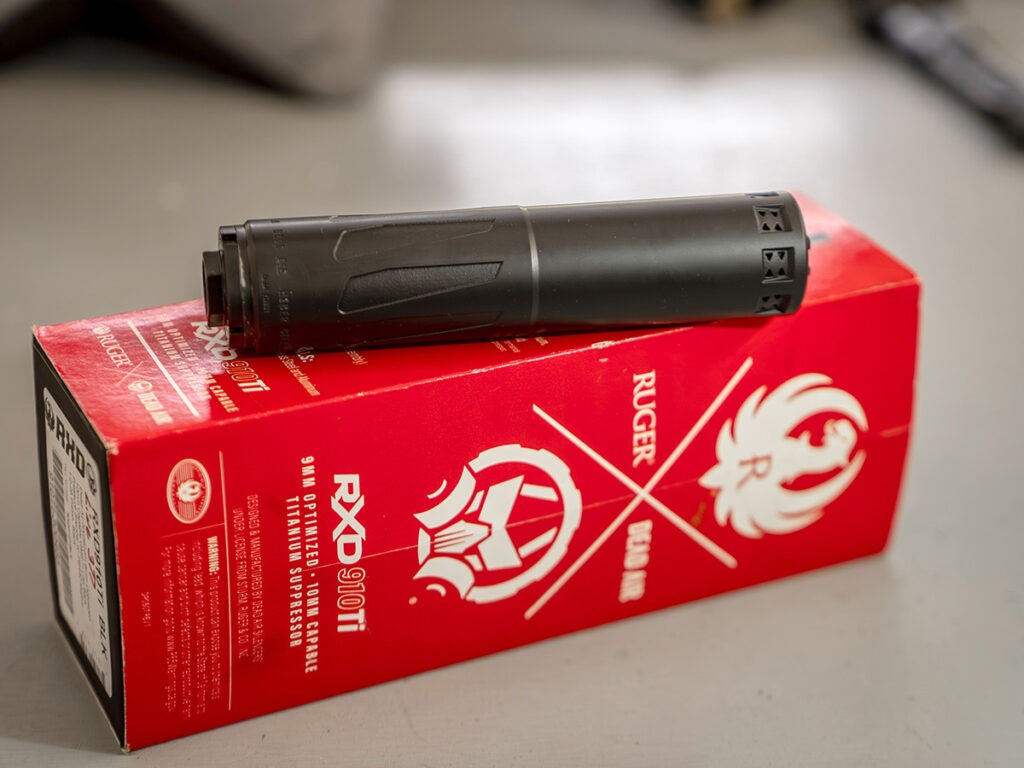
Ruger RXD 910Ti Stats
Manufacturer: Ruger/Dead Air
Caliber: .40
Length: 7.7 Inches
Diameter: 1.48 inches
Weight: 11.4 Ounces
Materials: 6AL4V Titanium (body), 17-4 PH Stainless Steel (piston), 7075 Aluminum (endcap)
Color: Black or Flat Dark Earth (FDE)
Cartridge Compatibility: 5.7x28mm, 9mm Luger, .38 Special, .357 Magnum, 10mm Automatic, .300 AAC Blackout, .400 Legend
Muzzle Energy Rating: 1,900 foot-pounds
Full-Auto Rating: 5.7x28mm, 9mm Luger, 10mm Automatic, 300 AAC Blackout* (subsonic)
Minimum Barrel Length: None
MSRP: $1,000
Pros
- Compatible with wide range of calibers
- Optimized to suppress 9mm & 10mm
- Low backpressure
- Features recoil-reducing ports
Cons
- A bit big and heavy for use on pistols
Dynamic Duo
Ruger is an iconic and gigantic brand in the firearms industry, and Dead Air is a very respected suppressor manufacturer. They’ve teamed up to offer Ruger’s new RXD line of suppressors to complement a wide variety of Ruger firearms.
The RXD 22Ti is designed for the .22 Long Rifle, .22 Magnum, .17 HMR and 5.7x28mm, and it retails for $499. The RXD 30Ti will work with centerfire rifle cartridges up to 0.30-caliber, such as the 6.5 Creedmoor, .308 Winchester and even the .300 PRC. It retails for $1,099. The RXD910Ti, which retails for $999, might be the most versatile of the trio because it’ll work with the 5.7x28mm, 9mm Luger, .38 Special, .357 Magnum, 10mm Auto, .300 Blackout and .400 Legend.
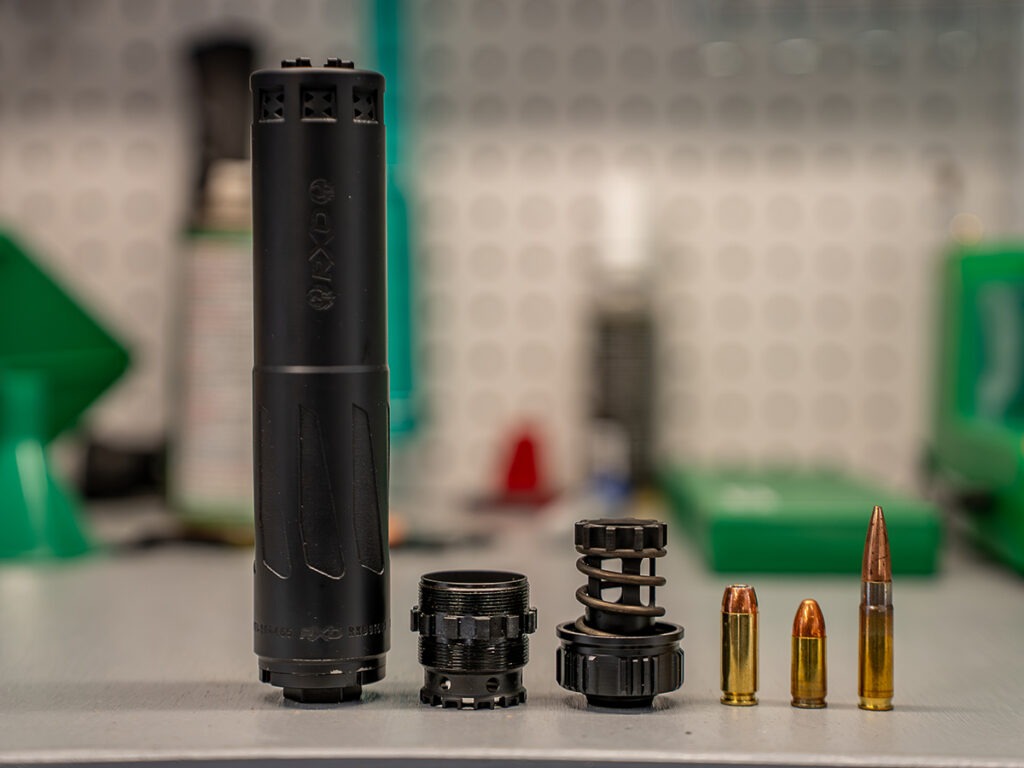
The RXD 910Ti suppressor is manufactured from 6AL4V titanium and comes with a 1/2×28 stainless-steel piston, and the front cap is made from 7075 aluminum. The suppressor body features a black or flat dark earth high-temperature Cerakote finish, the piston has a Nitride coating, and the front cap has level III anodizing.
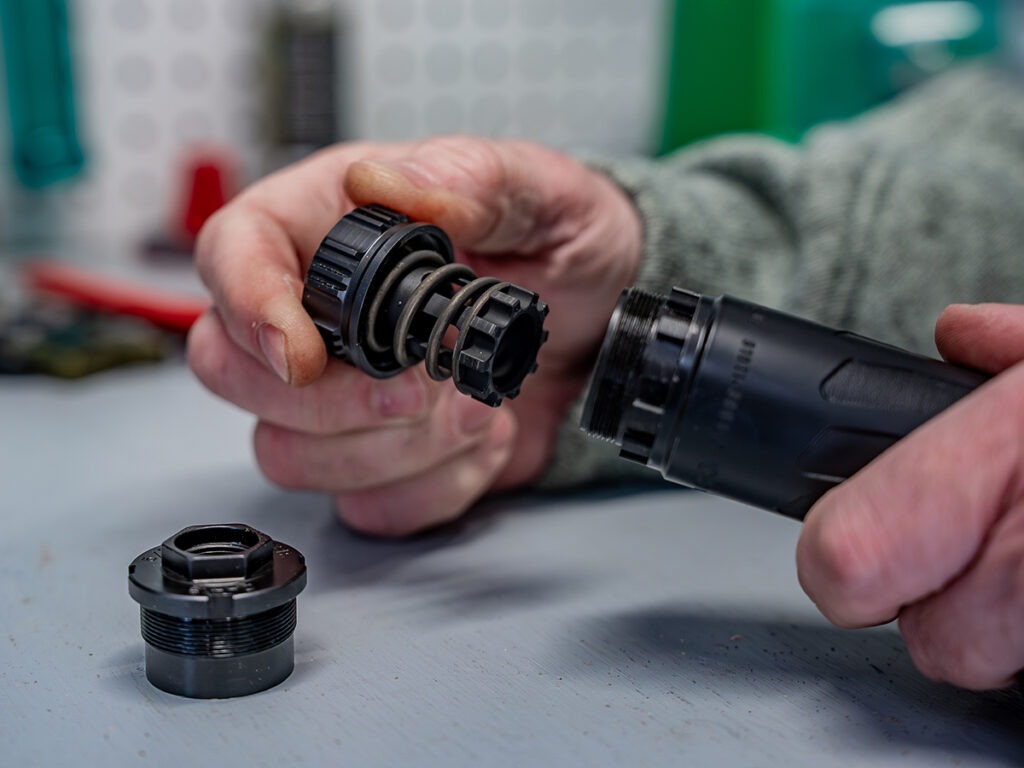
The silencer is 7.7 inches long, 1.48 inches in diameter, and it weighs 11 ounces. It’s also full-auto rated in 9mm Luger, 10mm Auto, 5.7x28mm and subsonic .300 Blackout ammunition. The necessary spanner/installation wrenches for rifle/handgun adaptation are included.
Baffle Evolution
The RXD 910Ti utilizes a new patent-pending Triskelion baffle system designed to provide best-in-class noise reduction. Specially optimized for the 9mm Luger and 10mm Auto, the Triskelion gas management system ensures the noise-to-ear relationship does not degrade when changing cartridges or platforms. It’s manufactured by 3D-printing titanium into a solid continuous piece of metal that keeps weight down but also provides superior strength. It also allows for minimal backpressure, leaving you with less gas in the face, less receiver fouling, and a much cleaner shooting experience. Additionally, the RXD 910Ti incorporates recoil-reducing ports on the front of the suppressor to redirect gas and soften felt recoil for faster follow-up shots.
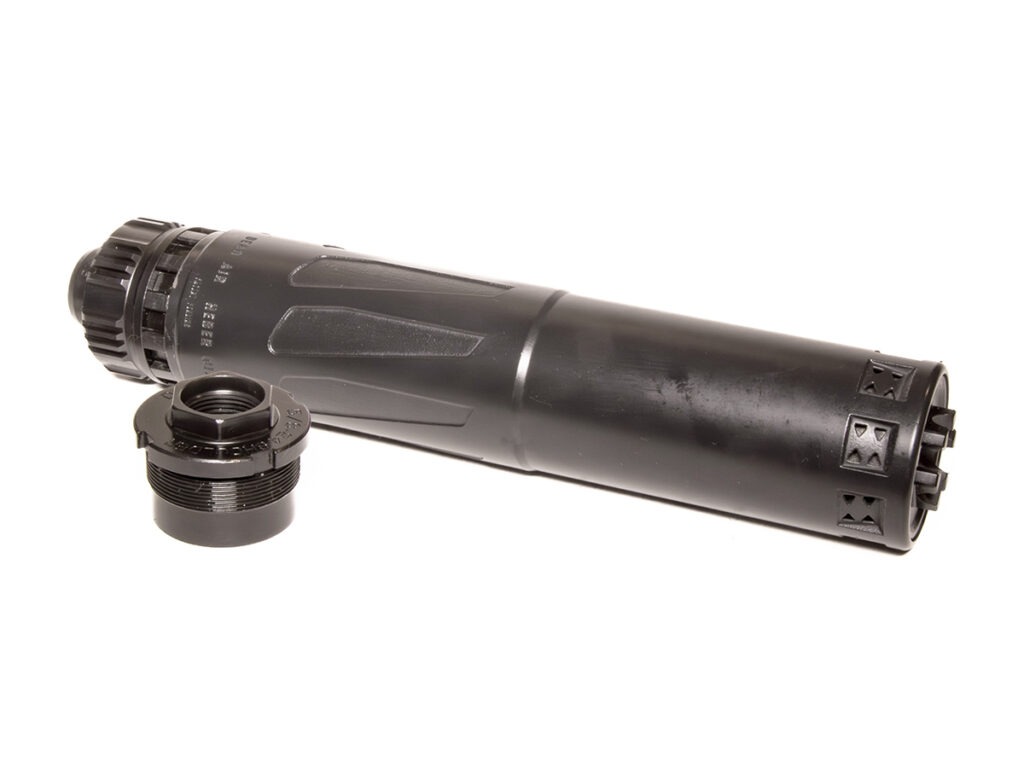
I’ve been working with Marlin’s new 1894 Trapper chambered for the 10mm Auto cartridge, and I was excited to test this suppressor on that handy little carbine. However, the 1894’s muzzle is threaded at 5/8×24, and it does not require a piston. This meant I needed an adapter for the RXD 910Ti. I removed the Dead Air PB501 Mojave Booster Assembly that includes the PB440 1/2×28 Mojave piston from the muzzle attachment end of the RXD 910Ti suppressor with the included spanner wrench.
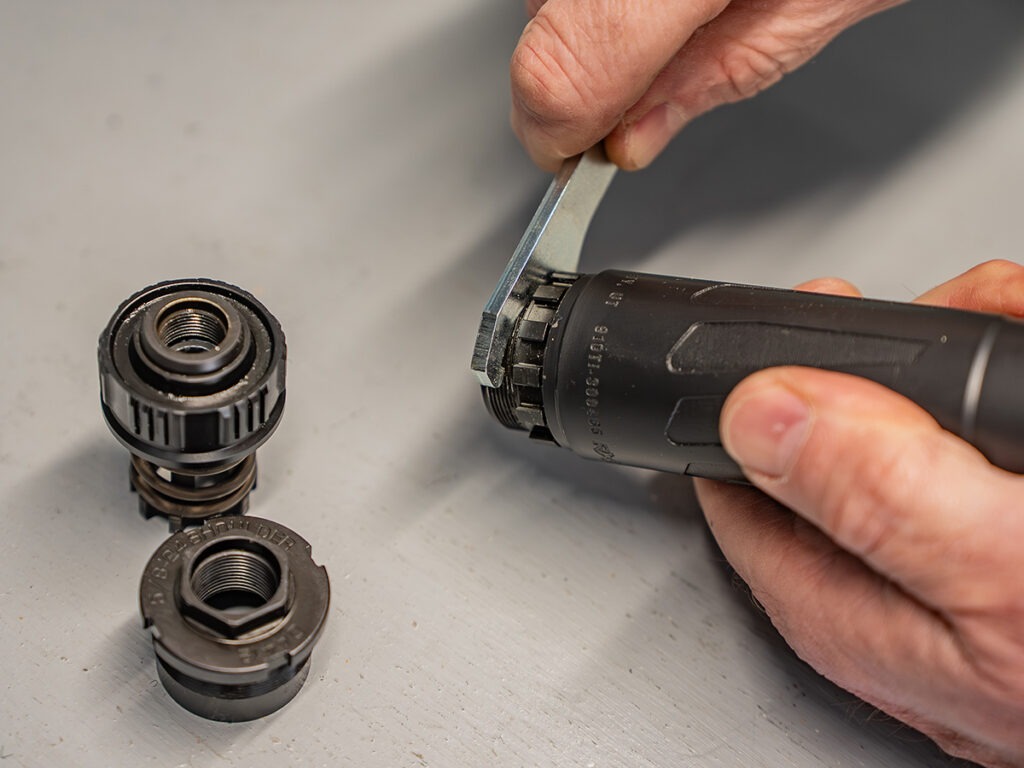
I then needed a 5/8×24 hub, direct-mount adapter. Dead Air manufacturers a variety of P-Series mounts and adapters, and the #DA412 P-Series Fixed Mount ($89) solved my problem. Because this 16-inch-barreled 1894 is a bit butt heavy, it’s incredibly handy; however, this handiness sacrifices the carbine’s steadiness on target.
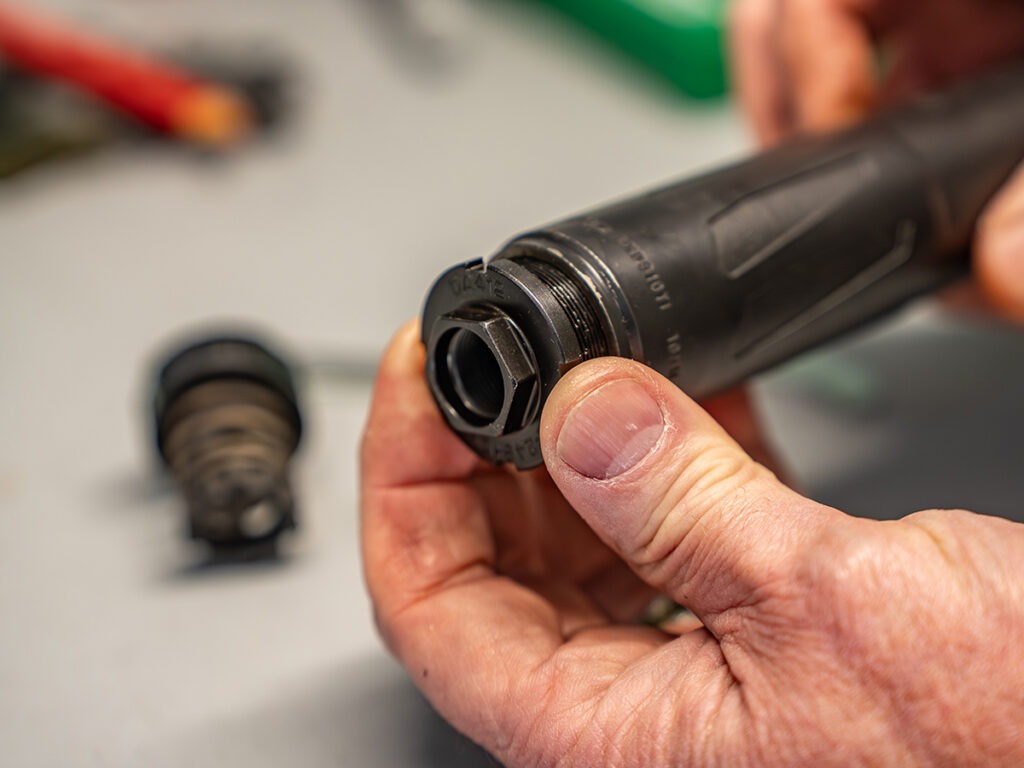
The addition of the 11-ounce RXD 910Ti to the Marlin gave it the muzzle-heavy feel that’s needed to help it sort of hang on target when shooting off hand. Of course, this is at the expense of its short overall length, which the suppressor extends to right at 40 inches.
Running the RDX 910Ti
I tested 10 loads in the Trapper—from the bench and while shooting offhand—and the RXD 910Ti kept the report comfortable to my ears with every load tested. It also provided noticeable recoil reduction, but the recoil of the 6.5-pound Trapper carbine was far from offensive anyway.
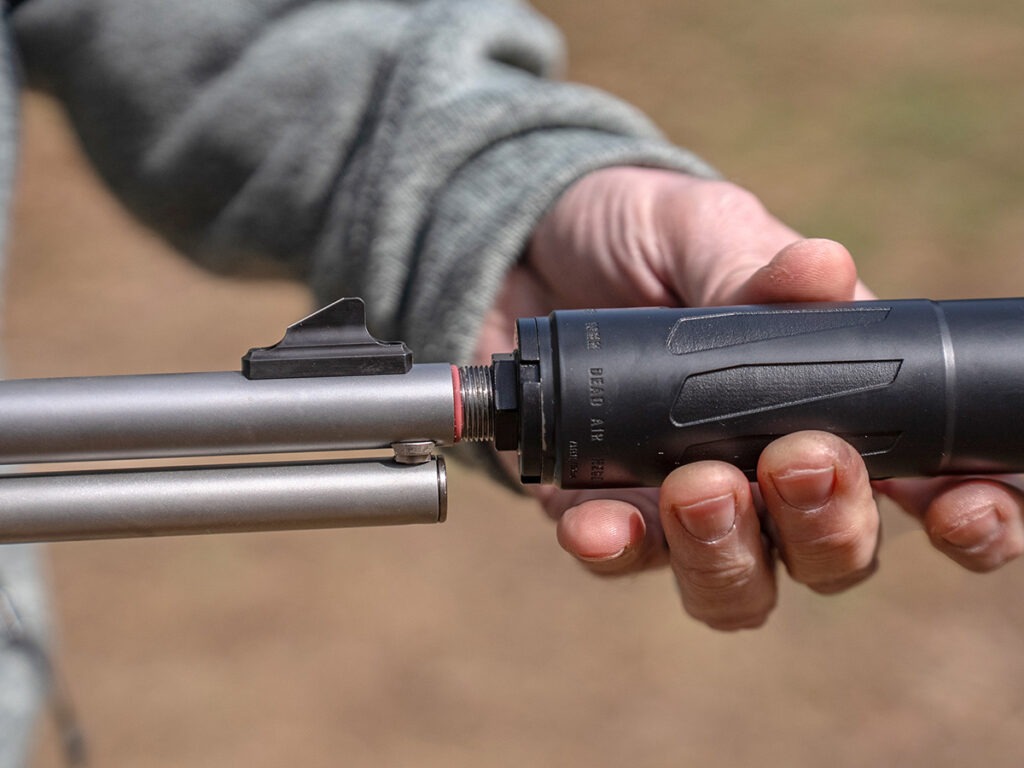
I did notice a slight point-of-impact shift with the suppressor, but with all the loads tested, it was minimal and sorted with just a few clicks to the riflescope. There were some variations in muzzle velocity and precision, but in every case the variances were within the standard deviation of the carbine’s performance without the suppressor installed.
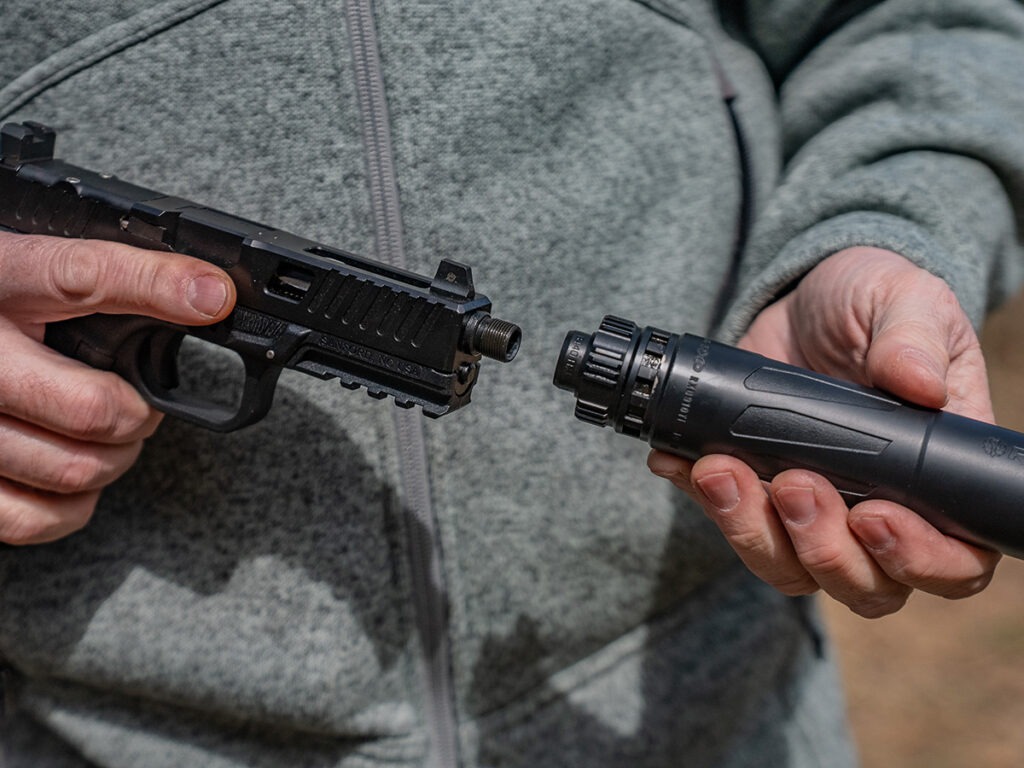
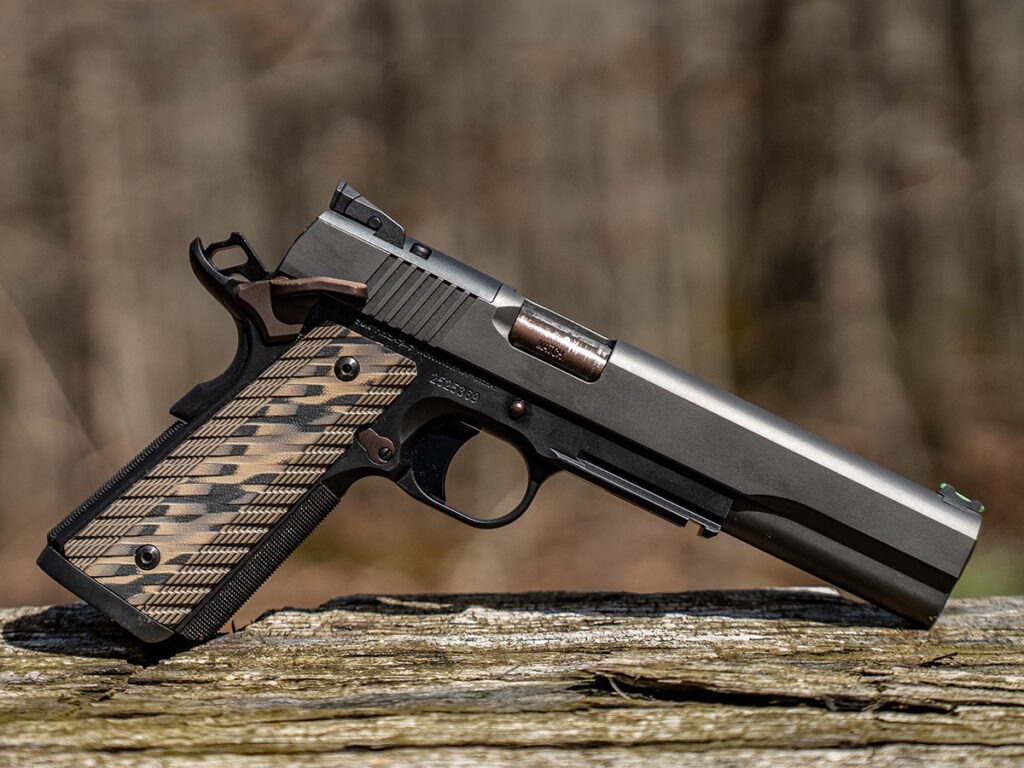
The only 10mm pistol I had on hand for testing was a 6-inch barreled Dan Wesson 1911 without a threaded muzzle, but I did test the RXD 910Ti on a Bear Creek Arsenal Grizzly 9mm pistol. Of course, this required removing the 5/8×24 hub mount and reinstalling the booster assembly the RXD 910Ti comes with.
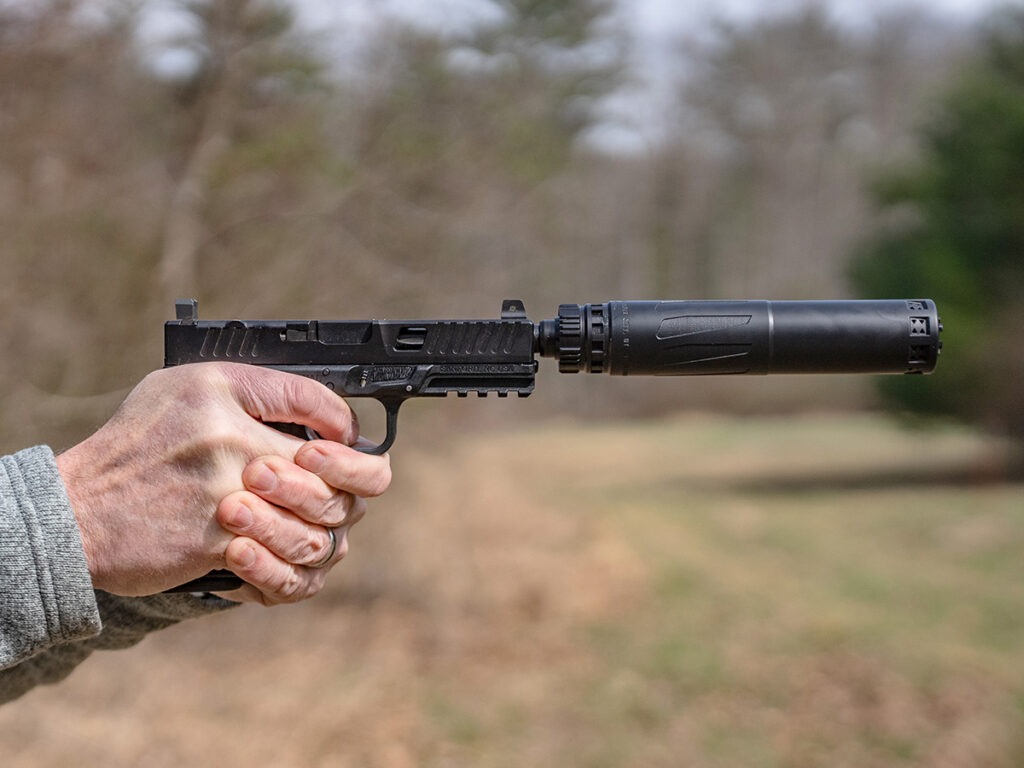
Admittedly, this suppressor is on the large side for a 9mm pistol—the Banish 9K is only 4 inches long and weighs less than 3 ounces—however, it worked to perfection, reduced the report to an ear-comfortable level, and substantially lessened the felt recoil. Depending on the 10mm pistol you might use the RXD 910Ti on, this felt recoil reduction could be greatly appreciated.
While running a suppressor on a traditional lever action rifle like the 1894 Trapper—even one modernized to fire the 10mm Auto cartridge—might seem a bit odd, and while it might seem the RXD 910Ti was purpose built for this handy little carbine, it should work just as well on other and more modern-styled carbines like the Ruger PC and LC.
Just as importantly, the versatility of this suppressor cannot be ignored. Those looking for a compact can that they can effectively run on pistol caliber and subsonic .300 Blackout carbines, would be hard pressed to find a better option. I’m not a frequent user of suppressors on pistols, but after working with the RXD 910Ti, I can hardly imagine owning a Marlin Trapper in .357 Magnum or 10mm Auto without one.
Ammo Notes: 10mm Pistol Vs. Rifle
The 10mm Automatic cartridge has had an up and down history. It enjoyed some popularity after it was introduced in 1983, and later it rose to fame after it was selected by the FBI for service in the aftermath of FBI’s disastrous shootout in Miami. But by the mid-1990s, the .40 Smith & Wesson—also known as the “10mm Short” or “40 Short & Weak”—dominated law enforcement and the 10mm Auto sort of fell from grace.
However, in 2015, the FBI returned to the 9mm Luger as the primary cartridge for duty handguns and the .40 S&W began to fade into obscurity. Oddly, with the abandonment of the .40 S&Ws, there’s been a tremendous resurgence of interest in the 10mm Auto.
This revival of the 10mm is evidenced by the new and first of its kind 10mm lever-action rifle from Marlin, and the introduction of a 9mm suppressor from Ruger and Dead Air that’s been optimized for 10mm. The 10mm Auto has not regained favor with law enforcement or found a home with most who carry a pistol concealed.
But, it has become rather well established as a cartridge suitable for self-defense in the wild and is often thought of as a viable option for the .44 Magnum for predator defense. Ballistically, the 10mm falls way short of the .44 Magnum, but it is available in a pistol as opposed to a revolver and now also in a compact, fast-handling lever gun.
Generally, when handgun cartridges are chambered in rifles, which has been common with revolver cartridges like the .357 and .44 Magnums, shooters will see a substantial velocity increase. For example, with the .44 Magnum, an increase in velocity of around 200 to 300 fps is common, and you’ll see the same or more with the .357 Magnum. With some .327 Federal Magnum loads, I’ve seen the velocity jump by as much as 400 fps from a handgun to a 16-inch barreled rifle.
This is not the case with the 10mm.
I tested 10, 10mm Auto loads in the new Marlin 1894 with its 16-inch barrel, and out of a Dan Wesson 1911 with a 6-inch barrel. The increase in velocity ranged from -14 fps (slower in the rifle) to 205 fps, with an average velocity increase for all 10 loads of only 92 fps. The included chart details the results as well as the average precision of five-shot groups fired at 10 yards with the pistol and at 50 yards with the rifle. This is not a knock on the 10mm cartridge, it’s just a matter of ballistic fact, determined by the cartridge’s bore diameter to powder charge relationship, and the pressure curve produced by the powders 10mm ammunition is loaded with.
| Load | Pistol Velocity | Rifle Velocity | Pistol Precision | Rifle Precision |
| Doubletap 180-gr. FP FMJ Match | 1,240 | 1,333 | 1.75 | 2.90 |
| Winchester 170-gr. USA Defense | 1,294 | 1,432 | 0.77 | 1.90 |
| Buffalo Bore 180-gr. TLF JHP | 1,280 | 1,412 | 1.74 | 1.10 |
| Buffalo Bore 155-gr. TLF | 1,384 | 1,528 | 1.16 | 1.65 |
| Doubletap 155-gr. SC HP | 1,378 | 1,476 | 1.13 | 1.80 |
| Buffalo Bore 190-gr. Dangerous Game | 1,168 | 1,156 | 1.48 | 2.01 |
| Hornady 150-gr. FTX Leverevolution | 1,239 | 1,336 | 2.21 | 2.12 |
| Federal 200-gr. HST | 1,145 | 1,182 | 1.51 | 2.02 |
| Federal 200-gr. Solid Core | 1,153 | 1,358 | 0.92 | 2.82 |
| Federal 200-gr. Power Shock | 1,095 | 1,081 | 1.42 | 2.11 |
Editor’s Note: This article originally appeared in the June 2026 issue of Gun Digest the Magazine.
More On Suppressors
Next Step: Get your FREE Printable Target Pack

Enhance your shooting precision with our 62 MOA Targets, perfect for rifles and handguns. Crafted in collaboration with Storm Tactical for accuracy and versatility.
Subscribe to the Gun Digest email newsletter and get your downloadable target pack sent straight to your inbox. Stay updated with the latest firearms info in the industry.
