At GunDigest, we independently review products. However, we may earn a commission when you purchase through links on our site. Learn More
Ammo Brief: 9mm Luger
A look at the prolific 9mm Luger cartridge, a worldwide favorite that’s been with us since 1902.
The 9mm Luger, or 9mm Parabellum, was introduced in 1902 with the Luger automatic pistol. It was adopted first by the German Navy in 1904 and then by the German Army in 1908. Since that time, it has been adopted by the military of practically every non-communist power.

The 9mm Luger has become the world’s most popular and widely used military handgun and submachine gun cartridge. In 1985, the 9mm Luger was adopted as the official military cartridge by U.S. Armed Forces, along with the Beretta Model 92-F (M-9) 15-shot semi-auto pistol.
General Comments
Although the 9mm Luger delivers good performance for police, military or sporting use, it was not popular in the United States until years after its inception. The principal reason was that no American-made arms were chambered for it initially. In 1954, Smith & Wesson brought out its Model 39 semi-automatic in this chambering, and Colt chambered its lightweight Commander for the 9mm Luger in 1951. This plus the influx of military pistols chambered for the 9mm greatly increased both popularity and acceptance in this country. Currently, the 9mm Luger is the most widely used cartridge in the United States, though a principal complaint has always been that the 9mm Luger lacks stopping power as a defensive cartridge.
However, the only automatic pistol cartridge with proven stopping power is the .45 Automatic. For hunting use, the 9mm Luger is adequate for most small game, if hollow-point bullets are used. Modern, premium, jacketed hollow-point loads can dramatically improve performance. A variety of 9mm loadings are offered by every major U.S. ammunition maker.
The term “stopping power,” as referred to in the above text, is really nothing more than words used to describe something that gun writers have never been able to quantify like they do with velocity and group size. Since the 1980s, when the 9mm became a very popular cartridge for use by law enforcement officers, those who have conducted research into the ability of a handgun cartridge to actually “stop” a bad guy have learned a great deal.
Additionally, modern bullet engineering, combined with the moderately high velocities obtainable with a 9mm Luger, 9mm Luger +P and 9mm Luger +P+ loads has changed not only the outlook on but the performance of the 9mm Luger. Extensive tests in 10 percent ordnance gelatin have shown that many defensive loads for the 9mm expand to a wider diameter and penetrate as deeply as many .45 Auto loads—and they do this with a higher impact velocity, which translates to more tissue destruction.
9mm Luger Loading Data and Factory Ballistics
| Bullet (grains/type) | Powder | Grains | Velocity | Energy | Source |
| 100 | Unique | 5.1 | 1,150 | 294 | Hornady |
| 115 | Herco | 6.0 | 1,200 | 368 | Speer |
| 115 | Bullseye | 4.8 | 1,250 | 399 | Speer, Hornady, Sierra |
| 115 | 231 | 5.2 | 1,150 | 338 | Speer, Hornady, Sierra |
| 124/125 | Unique | 5.5 | 1,150 | 364 | Speer, Sierra |
| 124/125 | 700X | 4.3 | 1,150 | 364 | Speer, Sierra |
| 80 TAC-XP JHP | FL | FL | 1,560 | 433 | DoubleTap Factory Load |
| 115 FMJ | FL | FL | 1,160 | 345 | Factory load |
| 124 JHP | FL | FL | 1,300 | 465 | Buffalo Bore Factory Load |
| 124 FMJ | ML | ML | 1,299 | 465 | Military load, U.S. |
| 124 FMJ | FL | FL | 1,120 | 345 | Factory load |
| 147 JHP | FL | FL | 975 | 310 | Factory load |
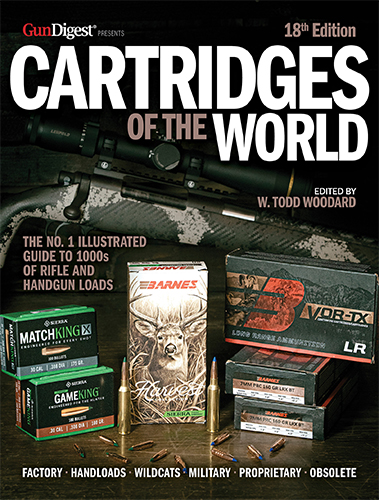
Editor’s Note: This article is an excerpt of Gun Digest’s Cartridge’s Of The World.
Raise Your Ammo IQ
- A Closer Look At Hornady’s .22 ARC
- .45-70 Ammo Buyer’s Guide: The Good Kind Of Big Gov’t
- Holland’s Super 30: .300 H&H Magnum
- .22LR Ammo Top Hunting Loads Tested
- .22 Nosler Overview: Ballistics & Beyond
- Is .220 Swift Still The Reigning Speed King?
- Four Great .223 Remington Loads
Next Step: Get your FREE Printable Target Pack

Enhance your shooting precision with our 62 MOA Targets, perfect for rifles and handguns. Crafted in collaboration with Storm Tactical for accuracy and versatility.
Subscribe to the Gun Digest email newsletter and get your downloadable target pack sent straight to your inbox. Stay updated with the latest firearms info in the industry.
