
Editor’s Note: This article on .223 vs 5.56 comparisons is an excerpt from Gun Digest 2013, the world’s greatest gun book.
.223 vs 5.56: Things Get Ugly
But the problem isn’t just pressure. That CIP pressure of 62,000 PSI? It is measured in a 5.56 chamber. If we take the same round, which shows 60,000 PSI/SAAMI (still 5,000 PSI over the .223 max) and put it into a .223 chamber, things get ugly. Really ugly, and really quickly. The pressure spike piles onto an already over-pressure round. I’ve talked to professional ballisticians, guys who use million-dollar labs to measure ammo for their ammo manufacturing bosses. (You know, those guys with the computers and transducers than can measure pressure by the thousandth of a second or finer.) They have reported some instances of 5.56 ammo in .223-chambered pressure barrels demonstrating peak pressures at or above 75,000 PSI. That is the pressure of the proof load each rifle gets tested with at the rifle maker’s, before shipping.
Proof loads, for those who aren’t remembering, are the deliberate, plus-30 percent loads that each rifle maker fires, once per gun, in their rifles before they ship them. They do so in the full expectation that the rifle will do just fine. Once. More is abusive, stupid and asking for trouble.
At this point, many an advocate of “there is no difference” will say “I’ve shot thousands of rounds through my AR and it hasn’t given me any problems.” I’ve worked in gun shops for too many years to accept round-counts mentioned across the counter at face value. Nothing personal guys, but the true number of rounds fired is typically a quarter to a tenth of the asserted number. I teach law enforcement patrol rifle classes in the summer, and I see how much work (and have done it myself) it takes to run 1,000 rounds through a rifle. If your buddy says “Yea, we went to the range this weekend and put a thousand rounds through each rifle,” he’s exaggerating. And if he isn’t, you do not want to borrow any of his rifles, as a thousand rounds in two days is enough to smoke the barrel.
Also, most shooters haven‘t fired enough real 5.56 ammunition to actually test their rifle. Almost all the “generic” ammo you shoot is not 5.56. Oh, it says “.223 Remington/5.56” on it, but it isn’t really 5.56. The high-volume, low-cost bulk ammunition that most of us use is not loaded right to the red line. I’ve chrono’d enough of it to know that much of it falls 100 to 200 fps short of full-book 5.56 spec. That right there is enough to make it no big deal chamber pressure-wise, because the peak pressure of the .223 load is sufficiently less than that of the 5.56 that the artificially-induced spike still falls below the pressure ceiling.
The extra pressure produces faster wear on your rifle. Since most shooters don’t shoot enough to wear out their rifles in any reasonable time frame, the extra wear is hardly noticed. But you can have a serious problem if the variables stack up against you in a range session. Rifles get hot when you shoot them. They also get hot in the summer, in the heat and the sun.
So there you are on a hot summer day, shooting your supply of real-deal 5.56-spec ammo through your .223-chambered rifle. The summer sun beats down and pressures rise. Black rifles left in the sun can easily reach 140 degrees even before they’re fired. Add to that the temperature increases from shooting, and you have some real heat problems coming on. Let’s make it worse: the particular lot of your 5.56 ammo is at the top of the allowed pressure and at the bottom of the allowed brass hardness. The ammo maker tested it in a 5.56-chambered test barrel and, while it was in the top end of the allowed specs, it is within the safety margin.
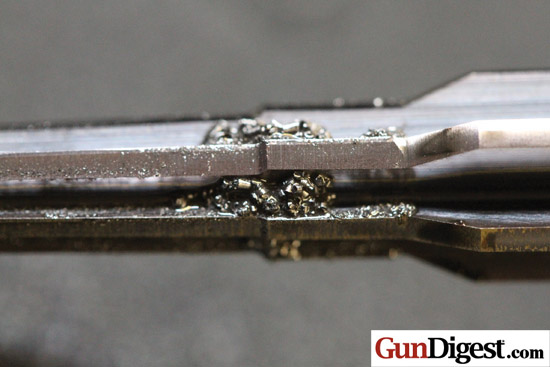
You’re having a blast, when all of a sudden your rifle stops working. What happened? Well, the heat increased the already maximum-made-excessive pressure and, on extracting a fired case, the pressure had expanded the case enough for a primer to fall out of the primer pocket and into your rifle. Actually, it probably has been losing primers for the last couple of magazines—pick up and inspect all your brass. You’ll see you’ve been losing ne or two primers per magazine. But it wasn’t until one fell into your action and tied things up that you noticed.
How bad can this get? In a patrol rifle class last year, a police officer was pushing his safety back to Safe (and the selector was resisting), when the rifle suddenly spat out a three-shot burst, then stopped working entirely. He’d blown a primer, and the anvil of the primer had wedged under the trigger in just such a way as to create the burst. Typically, the primer wedges under the trigger in such a way as to keep the rifle from shooting at all. Either way, not good.